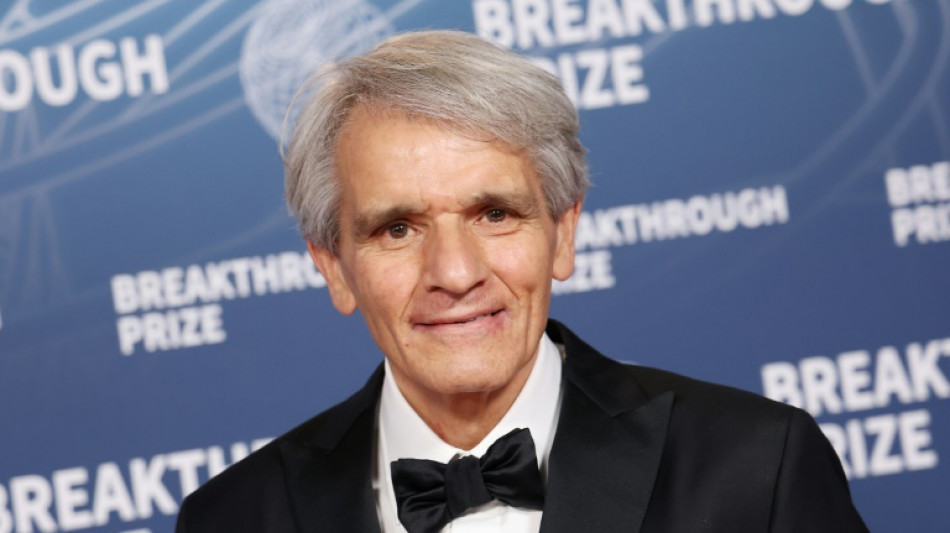
Research on multiple sclerosis wins 'Oscars of science' / Photo: Michael Tran - AFP
An American neurologist and an Italian epidemiologist whose work revolutionized the treatment of multiple sclerosis on Saturday won a prestigious Breakthrough Prize, the award nicknamed the "Oscars of science."
Stephen Hauser and Alberto Ascherio were recognized for their decades researching the debilitating neurodegenerative disease, which affects nearly three million people worldwide and was long considered an impenetrable enigma.
Hauser's work on multiple sclerosis (MS) started more than 45 years ago, when he met a young patient named Andrea, "an extraordinarily talented young woman who was already an attorney" and working at the White House under then-president Jimmy Carter, he told AFP.
"Then MS appeared in an explosive fashion and destroyed her life," he said.
"I remember seeing her, unable to speak, paralyzed on the right side, unable to swallow, and soon, unable to breathe on her own, and I remember thinking that this was the most unfair thing I had ever seen in medicine."
Then 27 years old, he decided to make it his life's work.
- Rough road -
"At the time, we had no treatments for MS. In fact, there was also a pessimism that treatments could ever be developed," said Hauser, now 74 and director of the neuroscience institute at the University of California San Francisco.
Scientists knew the disease, which damages the central nervous system and leads to paralyzing cognitive and motor problems, was caused by the immune system turning on the body.
But they thought the white blood cells known as T cells were the lone culprit.
Hauser questioned that.
Studying the role played in the disease by B cells, another type of white blood cell, he and his colleagues managed to recreate the damage MS causes to the human nervous system in small monkeys known as marmosets.
The US federal body overseeing medical research dismissed the link as "biologically implausible," and turned down their application for funding for a clinical trial.
But Hauser and his team pressed on.
They persuaded pharmaceutical company Genentech to back testing. In 2006, they got resounding results: treatments targeting B cells were associated with "a dramatic, more than 90-percent reduction in brain inflammation," Hauser said.
It was "something of a scope that had never been seen before."
That threw open a door to bring new treatments to market that slow the advance of the disease in many patients.
But it also raised other questions. For example, what would cause our white blood cells to turn against us?
- The virus connection -
That was a question that puzzled Ascherio, today a professor at Harvard.
He decided to investigate why MS mostly affected people in the northern hemisphere.
"The geographical distribution of MS was quite striking," he told AFP.
"MS is very uncommon in tropical countries and near the equator."
That made him wonder whether a virus could be involved.
He and his team carried out a long-term study following millions of young US military recruits.
After nearly 20 years of research, they came up with an answer. In 2022, they confirmed a link between MS and the Epstein-Barr virus (EBV), a common infection responsible for another well-known disease, infectious mononucleosis, or mono.
"Most people infected with EBV will never develop MS," said Ascherio, 72.
But everyone who develops MS has had EBV first.
The discovery still did not explain why MS occurs. But it fuelled hope of finding new treatments and preventive measures for a disease that remains uncurable, and whose current treatments do not work on all patients.
Ascherio's breakthrough could also help treat other conditions.
"We are now trying also to extend our investigation, to investigate the role of viral infection in other neurodegenerative diseases, like Alzheimer's or amyotrophic lateral sclerosis," also known as ALS or Lou Gehrig's disease, he said.
The link remains theoretical for now. But "there is some evidence," he said.
"It's like where we were on MS 20 or 30 years ago."
C.Masood--DT