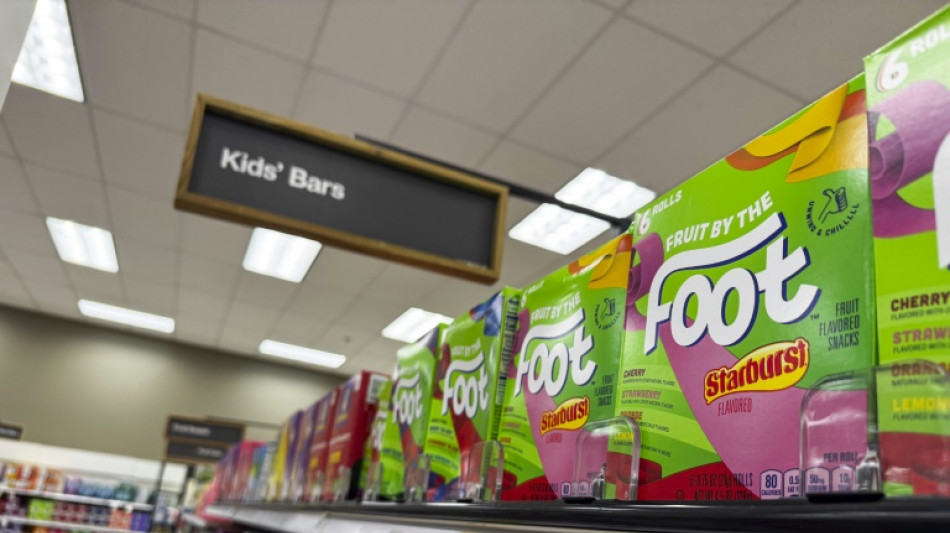
US bans controversial red food dye, decades after scientists raised alarm / Photo: ROBERTO SCHMIDT - AFP
Outgoing US President Joe Biden's administration on Wednesday announced a ban on Red Dye No 3, a controversial food and drug coloring long known to cause cancer in animals.
Decades after scientific evidence first raised alarm, Red 3, as it is also called, is currently used in nearly 3,000 food products in the United States, according to the nonprofit Environmental Working Group.
"FDA is revoking the authorized uses in food and ingested drugs of FD&C Red No 3 in the color additive regulations," said a document from the Department of Health and Human Services, published in the Federal Register on Wednesday.
The decision stems from a petition filed in November 2022 by the Center for Science in the Public Interest (CSPI) and other advocacy groups, which cited the "Delaney Clause" -- a provision mandating the prohibition of any color additive shown to cause cancer in humans or animals.
Notably, the FDA determined as early as 1990 that Red 3 should be banned in cosmetics because of its link to thyroid cancer in male rats.
However, the additive continued to be used in foods, largely due to resistance from the food industry. Manufacturers of maraschino cherries, for example, relied on Red 3 to maintain the iconic red hue of their products.
It's also present in thousands of candies, snacks and fruit products -- and thousands of medicines, according to a search of a government-run database, DailyMed.
"Manufacturers who use FD&C Red No 3 in food and ingested drugs will have until January 15, 2027, or January 18, 2028, respectively, to reformulate their product," the FDA said.
Although the agency acknowledged a cancer link in rats, it maintained that the available evidence does not support such a link in humans, citing differences in hormonal mechanisms between the species and significantly lower exposure levels in people.
- US lags behind -
While the FDA determination focused on carcinogenicity, other research has also found potential neurobehavioral effects of synthetic food dyes on children, notably Attention-Deficit/Hyperactivity Disorder (ADHD).
"The body of evidence from human studies indicates that synthetic food dyes are associated with adverse neurobehavioral outcomes in children, and that children vary in their sensitivity to synthetic food dyes," a California government report found in 2021.
Animal studies indicated that synthetic food dyes caused changes in neurotransmitter systems in the brain and produced microscopic changes in brain structure, affecting activity, memory and learning.
The United States has been slow to act on Red 3 compared to other major economies. The European Union banned its use in 1994, with similar prohibitions enacted in Japan, China, the UK, Australia, and New Zealand.
CSPI hailed the FDA's decision as long overdue and expressed hope that it would pave the way for broader action on other harmful chemicals in food.
"They don't add any nutritional value, they don't preserve the food -- they're just there to make food look pretty," Thomas Galligan, a scientist with CSPI, told AFP.
"There's growing discussion across the political spectrum about food additives and chemicals, which reflects ongoing failures by the FDA."
The nonprofit called on the incoming administration of President-elect Donald Trump to take further steps to protect consumers, including setting stricter limits on heavy metals like lead, arsenic and cadmium, in foods consumed by children.
A.El-Ahbaby--DT