Dubai Telegraph - 'Exceptional' wildfires across Americas in 2024: EU monitor

EUR -
AED 4.277424
AFN 76.282379
ALL 96.389901
AMD 444.278751
ANG 2.0846
AOA 1067.888653
ARS 1666.882107
AUD 1.752778
AWG 2.096182
AZN 1.984351
BAM 1.954928
BBD 2.344654
BDT 142.403852
BGN 1.956425
BHD 0.438198
BIF 3455.206503
BMD 1.164546
BND 1.508021
BOB 8.044377
BRL 6.334667
BSD 1.164081
BTN 104.66486
BWP 15.466034
BYN 3.346807
BYR 22825.091832
BZD 2.341246
CAD 1.610276
CDF 2599.265981
CHF 0.936525
CLF 0.027366
CLP 1073.571668
CNY 8.233458
CNH 8.232219
COP 4463.819362
CRC 568.64633
CUC 1.164546
CUP 30.860456
CVE 110.752812
CZK 24.203336
DJF 206.963485
DKK 7.470448
DOP 74.822506
DZD 151.068444
EGP 55.295038
ERN 17.468183
ETB 180.679691
FJD 2.632397
FKP 0.872083
GBP 0.872973
GEL 3.138497
GGP 0.872083
GHS 13.3345
GIP 0.872083
GMD 85.012236
GNF 10116.993527
GTQ 8.917022
GYD 243.550308
HKD 9.065929
HNL 30.604708
HRK 7.534265
HTG 152.392019
HUF 381.994667
IDR 19435.740377
ILS 3.768132
IMP 0.872083
INR 104.760771
IQD 1525.554607
IRR 49041.926882
ISK 149.038983
JEP 0.872083
JMD 186.32688
JOD 0.825709
JPY 180.935883
KES 150.58016
KGS 101.839952
KHR 4664.005142
KMF 491.43861
KPW 1048.083022
KRW 1716.311573
KWD 0.357481
KYD 0.970163
KZT 588.714849
LAK 25258.992337
LBP 104285.050079
LKR 359.069821
LRD 206.012492
LSL 19.73949
LTL 3.438601
LVL 0.704422
LYD 6.347216
MAD 10.756329
MDL 19.807079
MGA 5225.31607
MKD 61.612515
MMK 2445.475195
MNT 4130.063083
MOP 9.335036
MRU 46.419225
MUR 53.689904
MVR 17.938355
MWK 2022.815938
MXN 21.164687
MYR 4.787492
MZN 74.426542
NAD 19.739485
NGN 1688.68458
NIO 42.826206
NOK 11.767853
NPR 167.464295
NZD 2.015483
OMR 0.446978
PAB 1.164176
PEN 4.096293
PGK 4.876539
PHP 68.66747
PKR 326.50949
PLN 4.229804
PYG 8006.428369
QAR 4.240169
RON 5.092096
RSD 117.610988
RUB 88.93302
RWF 1689.755523
SAR 4.37074
SBD 9.584899
SCR 15.748939
SDG 700.4784
SEK 10.946786
SGD 1.508557
SHP 0.873711
SLE 27.603998
SLL 24419.93473
SOS 665.542019
SRD 44.985272
STD 24103.740676
STN 24.921274
SVC 10.184839
SYP 12877.828498
SZL 19.739476
THB 37.119932
TJS 10.680789
TMT 4.087555
TND 3.436865
TOP 2.803946
TRY 49.523506
TTD 7.89148
TWD 36.437508
TZS 2835.668687
UAH 48.86364
UGX 4118.162907
USD 1.164546
UYU 45.529689
UZS 13980.369136
VES 296.437311
VND 30697.419423
VUV 142.156196
WST 3.249257
XAF 655.661697
XAG 0.019993
XAU 0.000278
XCD 3.147243
XCG 2.098055
XDR 0.815205
XOF 655.061029
XPF 119.331742
YER 277.802752
ZAR 19.711451
ZMK 10482.311144
ZMW 26.913878
ZWL 374.983176
  • JRI

    0.0400

    13.79

    +0.29%

  • NGG

    -0.5000

    75.41

    -0.66%

  • SCS

    -0.0900

    16.14

    -0.56%

  • BCC

    -1.2100

    73.05

    -1.66%

  • BP

    -1.4000

    35.83

    -3.91%

  • GSK

    -0.1600

    48.41

    -0.33%

  • CMSC

    -0.0500

    23.43

    -0.21%

  • RIO

    -0.6700

    73.06

    -0.92%

  • BTI

    -1.0300

    57.01

    -1.81%

  • AZN

    0.1500

    90.18

    +0.17%

  • RYCEF

    -0.1600

    14.49

    -1.1%

  • BCE

    0.3300

    23.55

    +1.4%

  • VOD

    -0.1630

    12.47

    -1.31%

  • RBGPF

    0.0000

    78.35

    0%

  • RELX

    -0.2200

    40.32

    -0.55%

  • CMSD

    -0.0700

    23.25

    -0.3%

'Exceptional' wildfires across Americas in 2024: EU monitor
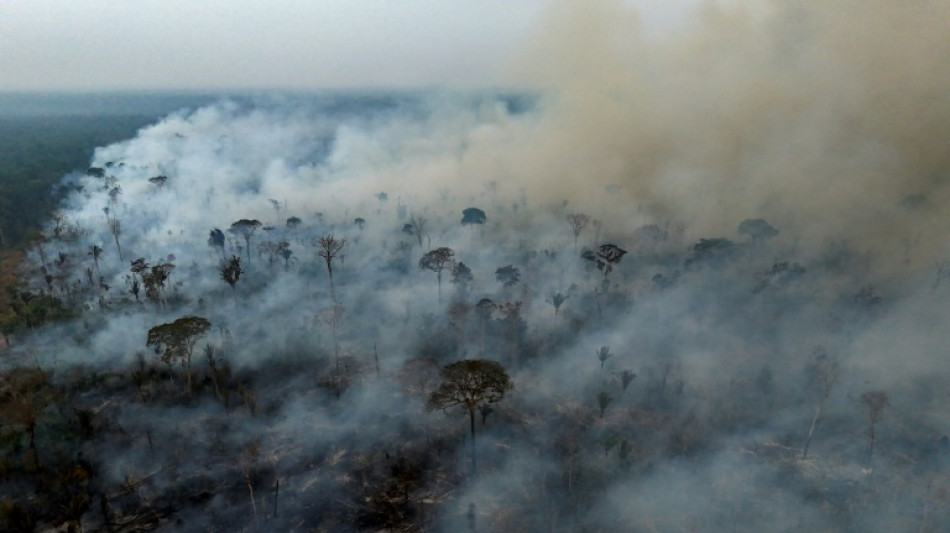
'Exceptional' wildfires across Americas in 2024: EU monitor / Photo: MICHAEL DANTAS - AFP/File

'Exceptional' wildfires across Americas in 2024: EU monitor

Severe drought stoked rampant wildfires across North and South America this year and churned up record carbon pollution in Bolivia, Nicaragua and the Pantanal wetlands, according to new data from Europe's climate monitor.

Text size:

Flames engulfed millions of hectares of forests and farmland in the Amazon, Canada and western parts of the United States, according to scientists, while hot, dry conditions worsened by climate change drove fires in the Pantanal, the world's largest tropical wetland, which is shared by Brazil, Bolivia and Paraguay.

"Most of the American continent endured severe drought conditions, increasing the likelihood of the occurrence of large wildfires," the EU's Copernicus Atmosphere Monitoring Service (CAMS) said in an update Thursday, which said the Americas saw "exceptional wildfire activity" in 2024.

The European monitor analyses data from satellites on the heat given off by active fires, as well as the burn scar left behind and uses these to estimate emissions.

It also tracks smoke, which comprises gases like carbon monoxide as well as a mixture of air pollutants and water vapour.

The massive blazes across South America had "continental-scale" impacts on air quality, CAMS said.

Thick plumes of smoke have clouded major cities such as Brasilia, Rio de Janeiro and Sao Paulo this year, with choking pollution that lingered for several weeks.

"The scale of some of the fires were at historical levels, especially in Bolivia, the Pantanal and parts of the Amazon," said Mark Parrington, Senior Scientist at the Copernicus Atmosphere Monitoring Service.

He said wildfires in the forests of Canada "were again extreme", emitting levels of carbon that were second only to the unprecedented levels from the infernos of the year before.

Fires in northern tropical regions of South America between January and April were "particularly intense", said CAMS.

- 'Fire pandemic' -

Drought has parched the Amazon region since mid-2023, driven by human-caused climate change and the El Nino warming phenomenon.

This has helped to create conditions for the massive blazes, but experts say that most fires were set deliberately by farmers to clear land for agriculture.

CAMS found that across the Brazilian Amazon, fires emitted 176.6 megatonnes of carbon, the highest level since 2010.

Scientists warn that continued deforestation will put the Amazon on track to reach a point where it will emit more carbon than it absorbs, accelerating climate change.

Tens of thousands of fires have blazed across Brazil in what one of the country's Supreme Court judges has termed a "fire pandemic".

Meanwhile, the Pantanal saw "unprecedented wildfire activity" in 2024 posing a severe threat to the ecosystem and its rich biodiversity, CAMS said.

Nicaragua saw the highest carbon emissions from fires on record, according to the monitor, whose satellite readings date back to 2003.

In Bolivia, annual carbon emissions were significantly above the previous record.

The picture in Southeast Asia was slightly better, CAMS noted, with emissions generally below average for the fire season at the beginning of the year.

Y.El-Kaaby--DT