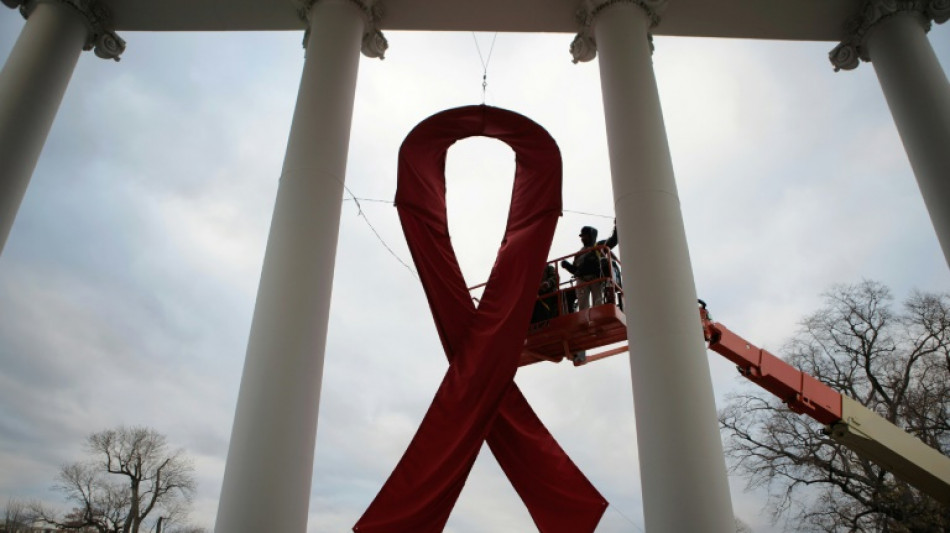
Fewest new HIV cases since late 1980s: UNAIDS report / Photo: CHIP SOMODEVILLA - GETTY IMAGES NORTH AMERICA/AFP/File
Fewer people contracted HIV last year than at any point since the rise of the disease in the late 1980s, the United Nations said Tuesday, warning that this decline was still far too slow.
Around 1.3 million people contracted the disease in 2023, according to the new report from the UNAIDS agency.
That is still more than three times higher than needed to reach the UN's goal of ending AIDS as a public health threat by 2030.
Around 630,000 people died from AIDS-related illnesses last year, the lowest level since a peak of 2.1 million in 2004, the report said ahead of World AIDS Day on Sunday.
Much of the progress was attributed to antiretroviral treatments that can reduce the amount of the virus in the blood of patients.
Out of the nearly 40 million people living with HIV around the world, some 9.3 million are not receiving treatment, the report warned.
And despite the global progress, 28 countries recorded an increase in HIV infections last year.
Efforts to make preventative treatment called Pre-Exposure Prophylaxis (PrEP) available in these countries has seen "very slow progress", the report pointed out.
"Only 15 percent of people who need PrEP were receiving it in 2023," the report said.
UNAIDS deputy director Christine Stegling said that "progress has been driven by biomedical advances, advances in the protection of human rights and by community activism".
"But big gaps in the protection of human rights remain, and these gaps are keeping the world from getting on the path that ends AIDS," she told an online press conference.
She warned that if current trends continue, "we will end up with a much, much higher number of people living with HIV, long after 2030".
UNAIDS emphasised how laws and practices that "discriminate against or stigmatise" people with HIV were hindering the fight against the disease.
It pointed to how Uganda's Anti-Homosexuality Act, one of the harshest anti-gay laws in the world, led to sharp drop in PrEP access since coming into force last year.
Axel Bautista, a gay rights activist from Mexico City, pointed out that same-sex relations are banned in 63 countries.
"Criminalisation exacerbates fear, persecution, hate, violence and discrimination and has a negative impact on public health," he told the press conference.
- 'Game-changer' new drug -
A new drug called lenacapavir, which early trials have found is 100 percent effective in preventing HIV infection, has been hailed as a potential game-changer in the battle against the disease.
But concerns have been raised over its high price -- US pharmaceutical giant Gilead has been charging around $40,000 per person per a year for the drug in some countries.
Last month Gilead announced deals with generic drugmakers to make and sell the drug at lower costs in some lower-income countries. However activists have warned that millions of people with HIV will not be covered by the deals.
Stegling said that such "game-changers will really only get us to the right reduction in new infections when we make sure that everybody will have access to them".
UNAIDS executive director Winnie Byanyima did not attend the press conference.
Byanyima revealed last week that her husband, veteran Ugandan opposition politician Kizza Besigye, was "kidnapped" in neighbouring Kenya earlier this month.
UN rights chief Volker Turk has been among those calling for the Ugandan government to release Besigye, who appeared in a military court in the capital Kampala last week.
Y.Al-Shehhi--DT