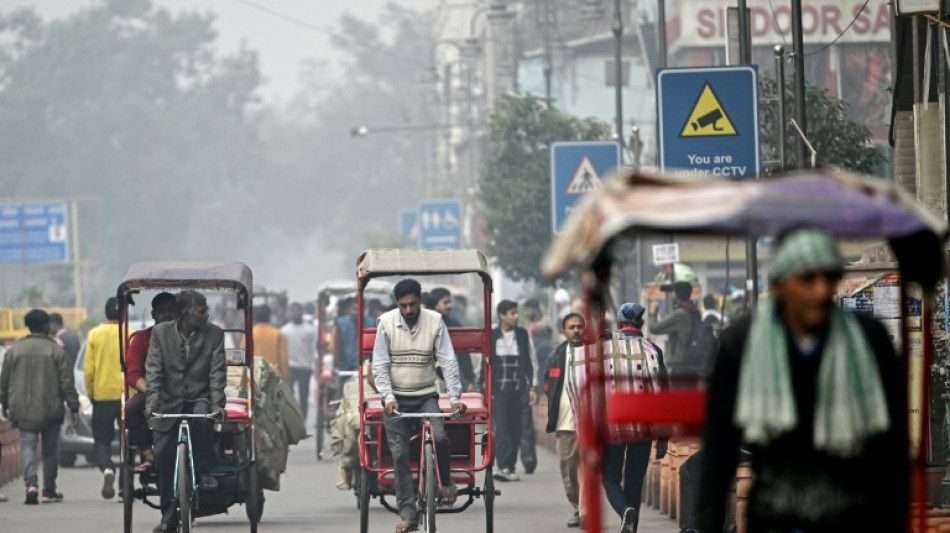
South Asia air pollution fell in 2022, but remains major killer: report / Photo: Arun SANKAR - AFP/File
A surprise improvement in air quality in South Asia in 2022 drove a decline in global pollution, with favourable weather a likely factor, a new report said Wednesday.
But the region continues to breathe the world's most-polluted air, with its residents losing more than 3.5 years of life expectancy on average, the annual Air Quality Life Index (AQLI) warned.
And globally, most countries have either no pollution standards or are failing to meet what they have set, subjecting their citizens to air quality that causes a broad range of health problems.
For two decades, air pollution has increased annually in South Asia, but satellite data for 2022 -- the most recent year available -- showed a surprise 18 percent fall.
The declines were recorded in every country in the region apart from Sri Lanka, according to the report, produced by the University of Chicago's Energy Policy Institute (EPIC).
"While it is difficult to conclusively determine what reduced PM2.5 levels across South Asia, it is safe to posit that favourable meteorological conditions may have played a part," the report said, referring to tiny particulates that can travel deep into the body.
The widespread nature of the decline, along with the above-average rainfall across the region in 2022, lend support to that theory.
"Only time will tell whether policy changes are having an impact," the report added, warning that people in South Asia are still breathing air eight times more polluted than the World Health Organization deems safe.
"Continued observations, efforts towards policy enforcement and monitoring impacts of policy interventions will be critical for understanding and sustaining these reductions," the report said.
The decline in South Asia led to a nine percent global drop in air pollution, even as poor air quality spiked elsewhere, including in the Middle East and North Africa, with concentrations up 13 percent from a year earlier.
The report warned an ongoing lack of air quality data on the ground is hampering policy-making and implementation.
"Highly polluted countries that have little or no air quality data often fall into a bad feedback cycle where having little data leads to little attention or policy investment in the issue, which reinforces little demand for data," said Christa Hasenkopf, director of EPIC's Clean Air Program.
Earlier this year, the centre launched a $1.5 million fund to finance the installation of air quality monitors that offer open data worldwide.
Air pollution as a whole receives relatively little funding despite its outsized impact on human health.
For example, in some of Africa's most-polluted nations, air pollution "is a more serious threat to life expectancy than HIV/AIDS, tropical diseases, malaria or water, sanitation and handwashing", the report said.
There are bright spots, however, including China's remarkably successful efforts to combat dirty air.
It took measures including restricting the number of cars in big cities, reducing heavy industry capacity and banning new coal plants from certain regions.
It has reduced air pollution by 41 percent since 2013, meeting its national standards and adding an average of two years of life expectancy for its citizens, AQLI said.
Still, even in China, pollution remains more than five times higher than WHO guidelines, and the benefits of Beijing's measures are unevenly spread.
Air quality remains poor across several major provinces, and in some prefectures has actually increased since 2013.
H.Hajar--DT