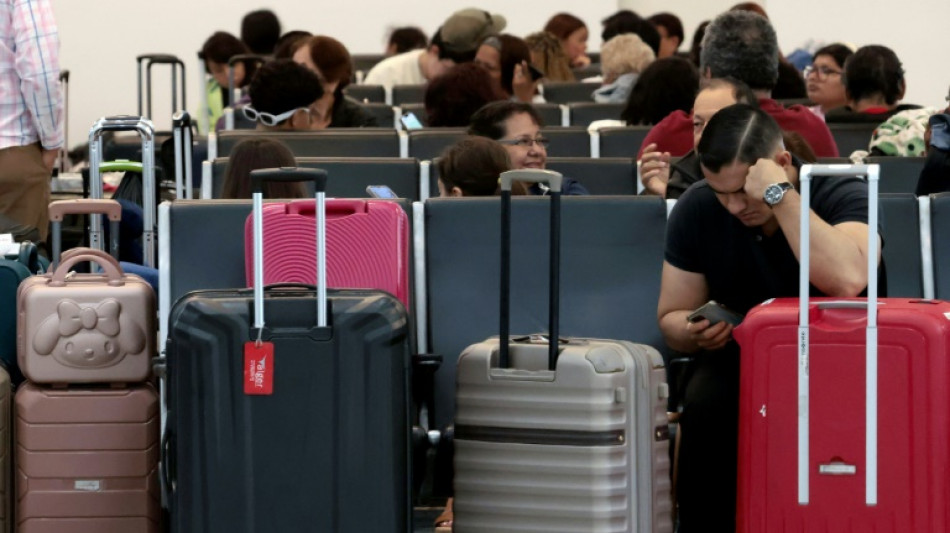
Airlines resume services after global IT crash wreaks havoc / Photo: ULISES RUIZ - AFP
Airlines were gradually coming back online Saturday after global carriers, banks and financial institutions were thrown into turmoil by one of the biggest IT crashes in recent years, caused by an update to an antivirus program.
Passenger crowds had swelled at airports on Friday to wait for news as dozens of flights were cancelled and operators struggled to keep services on track, after an update to a program operating on Microsoft Windows crashed systems worldwide.
Multiple US airlines and airports across Asia said they were now resuming operations, with check-in services restored in Hong Kong, South Korea and Thailand, and mostly back to normal in India, Indonesia and at Singapore's Changi Airport as of Saturday afternoon.
"The check-in systems have come back to normal (at Thailand's five major airports). There are no long queues at the airports as we experienced yesterday," Airports of Thailand president Keerati Kitmanawat told reporters at Don Mueang airport in Bangkok.
Microsoft said the issue began at 1900 GMT on Thursday, affecting Windows users running the CrowdStrike Falcon cybersecurity software.
CrowdStrike said it had rolled out a fix for the problem and the company's boss, George Kurtz, told US news channel CNBC he wanted to "personally apologise to every organisation, every group and every person who has been impacted".
It also said it could take a few days to return to normal.
US President Joe Biden's team was talking to CrowdStrike and those affected by the glitch "and is standing by to provide assistance as needed", the White House said in a statement.
"Our understanding is that flight operations have resumed across the country, although some congestion remains," a senior US administration official said.
Reports from the Netherlands and Britain suggested health services might have been affected by the disruption, meaning the full impact might not yet be known.
Media companies were also hit, with Britain's Sky News saying the glitch had ended its Friday morning news broadcasts, and Australia's ABC similarly reporting major difficulties.
By Saturday, services in Australia had mostly returned to normal, but Sydney Airport was still reporting flight delays.
Australian authorities warned of an increase in scam and phishing attempts following the outage, including people offering to help reboot computers and asking for personal information or credit card details.
Banks in Kenya and Ukraine reported issues with their digital services, while some mobile phone carriers were disrupted and customer services in a number of companies went down.
"The scale of this outage is unprecedented, and will no doubt go down in history," said Junade Ali of Britain's Institution of Engineering and Technology, adding that the last incident approaching the same scale was in 2017.
- Flight chaos -
While some airports halted all flights, in others airline staff resorted to manual check-ins for passengers, leading to long lines and frustrated travellers.
The US Federal Aviation Administration (FAA) initially ordered all flights grounded "regardless of destination", though airlines later said they were re-establishing their services and working through the backlog.
India's largest airline Indigo said operations had been "resolved", in a statement posted on X.
"While the outage has been resolved and our systems are back online, we are diligently working to resume normal operations, and we expect this process to extend into the weekend," the carrier said Saturday.
A passenger told AFP that the situation was returning to normal at Delhi Airport by midnight on Saturday with only slight delays in international flights.
Low-cost carrier AirAsia said it was still trying to get back online, and had been "working around the clock towards recovering its departure control systems (DCS)" after the global outage. It recommended passengers arrive early at airports and be ready for "manual check-in" at airline counters.
Chinese state media said Beijing's airports had not been affected.
In Europe, major airports including Berlin, which had suspended all flights earlier on Friday, said departures and arrivals were resuming.
- 'Common cause' -
Companies were left patching up their systems and trying to assess the damage, even as officials tried to tamp down panic by ruling out foul play.
CrowdStrike's Kurtz said in a statement his teams were "fully mobilised" to help affected customers and "a fix has been deployed".
But Oli Buckley, a professor at Britain's Loughborough University, was one of many experts who questioned the ease of rolling out a proper fix.
Other experts said the incident should prompt a widespread reconsideration of how reliant societies are on a handful of tech companies for such an array of services.
"We need to be aware that such software can be a common cause of failure for multiple systems at the same time," said John McDermid, a professor at York University in Britain.
He said infrastructure should be designed "to be resilient against such common cause problems".
burs-sco/js
Y.Sharma--DT