Poisoned by arsenic, and with no way out, Peruvians live in fear / Photo: ERNESTO BENAVIDES - AFP
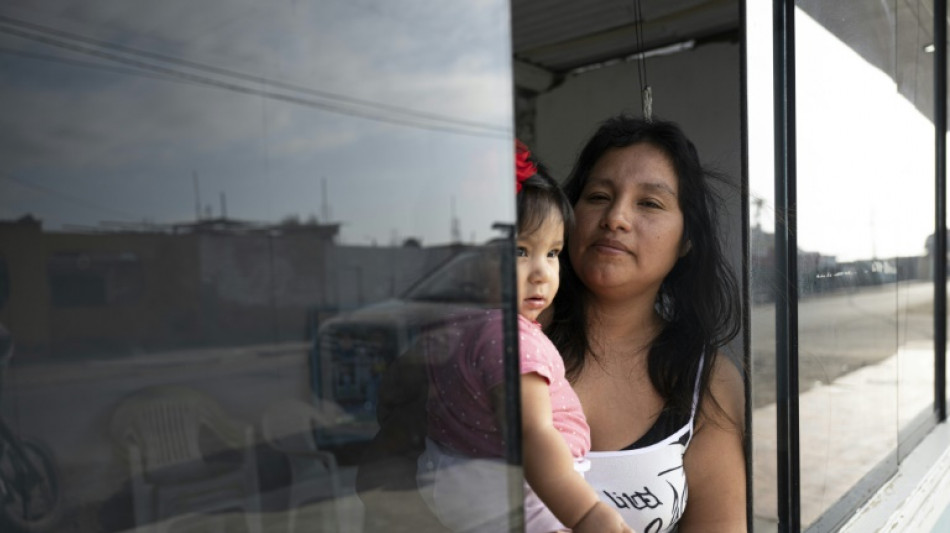
Sayuri Moreno found out while pregnant that her body was contaminated with arsenic, but could not afford doctors' advice to avoid breastfeeding and leave her home in a mining area in northern Peru.
The 37-year-old is one of 120 residents of the Huarmey slums in the Ancash department who were found to have high levels of arsenic in their blood when 140 people were tested last year, according to the Ministry of Health.
Some 3,000 live in this community of wooden houses facing the sea, most of them living off fishing. Behind the settlement rise the hills through which underground pipelines descend, transporting copper and zinc concentrate to Port Huarmey.
Arsenic -- a highly toxic chemical -- can be found naturally alongside copper ore and is released as a byproduct of its processing. Arsenic can also naturally contaminate groundwater.
Peru is the world's second-largest copper producer, however health authorities say they have yet to determine whether the widespread contamination in Huarmey is linked to mining operations.
Most of those affected are women and children. The poisonous chemical can cause skin lesions and cancer, mainly of the lungs, skin and bladder.
"I was scared because I heard that it caused cancer," said Moreno, who was diagnosed during a pre-natal checkup.
- 'Abandoned' -
Her children, Keity, 11, and Iker, 7, also tested positive for high levels of arsenic. Her 11-month-old, Valeria, "was born normal."
The doctor recommended "that we get out of here and that I don't breastfeed my baby," Moreno told AFP.
But like many residents in the region, she and her fisherman husband, Alan Guerrero, were not in a financial position to follow this advice to the letter.
They left Port Huarmey for three months to "detox," but had to return after finding no other work. When they have the money they buy bottled water and formula for the baby.
"We are abandoned in the port, we have no help from anyone, we have a mining industry that is so powerful that we can't do anything," said Guerrero.
Inorganic arsenic is the biggest "chemical contaminant" of drinking water, according to the World Health Organization (WHO), which classifies it as a carcinogen and one of the 10 most dangerous substances for public health.
Jose Saldivar, director of the Huarmey Hospital, said the number of those affected in the community and the levels of arsenic in their bodies was "worrying."
"Every time we do more screening, it is likely that 80 percent" of the cases will come out positive for high levels of arsenic, he said.
Peru's health ministry says the maximum amount of arsenic in the body should be 20 micrograms per liter of urine.
Moreno had 60 micrograms, her eldest daughter, 81 micrograms and her son 70 micrograms.
- 'There is no cure' -
The WHO estimates 140 million people across the globe are exposed to drinking water containing high levels of arsenic.
"There is no cure," said Percy Herrera, a heavy metals expert at the health ministry.
"The best intervention is to identify what the source is and control this source," he added.
When Mireya Minaya was pregnant she was found to have 142 micrograms of arsenic per liter of urine. Her baby, Danna, was born contaminated.
But her three-year-old son, Fabricio, who suffers from anemia, has an even higher concentration: 540 micrograms.
Given the number of cases in Huarmey, the government last year paid for those affected to be treated in Lima, 290 kilometers (180 miles) away.
Minaya was hospitalized for 10 days. Doctors discovered tumors in her ovaries that they told her were probably malignant.
"I didn't want to know anything out of fear and I asked for my voluntary discharge and I came back" to the port, said Minaya, who is a restaurant cook.
"We lived normally... and from one moment to the next we had this nightmare. We don't know if it will ever end."
G.Mukherjee--DT