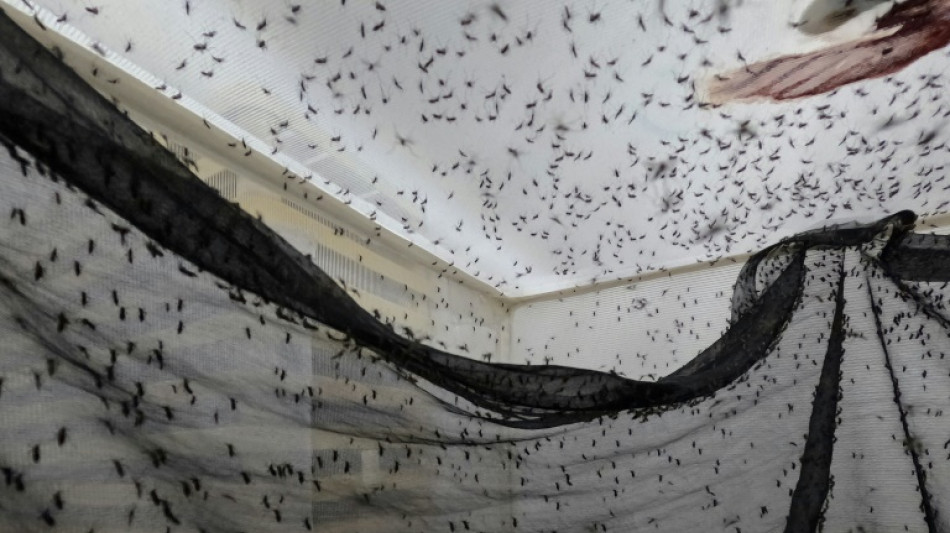
Colombian mosquito factory fights dengue and disinformation / Photo: JAIME SALDARRIAGA - AFP
The jars of larvae in stagnant water and thick clouds of mosquitoes at a Colombian lab may seem like the stuff of nightmares. They are in fact crucial to a project to fight the spread of dengue fever.
For nearly ten years, the World Mosquito Program (WMP) has been replacing local populations of Aedes aegypti mosquitoes with biologically modified insects to prevent the spread of a virus that has killed over 4,500 in Latin America and the Caribbean so far this year.
Rather than deploying harmful insecticides, "this technology is designed so that a living bacterium, within a mosquito -- an organism that is also alive -- can be released to continue preserving life," said biologist Nelson Grisales.
The project, supported by American multi-billionaire Bill Gates, has achieved promising results: dengue cases have fallen 95 percent in the northwestern Antioquia department, health authorities say.
Gates is a popular target of conspiracy theories and the mosquito project is no different, with viral rumors "that the mosquitoes we release are equipped with Bill Gates' mind control chips, that they can make people homosexual or that they transmit stronger diseases," said Grisales.
Rather, scientists are producing mosquitoes infected with Wolbachia, a bacteria common in other insect and mosquito species, hoping the Aedes aegypti will spread it in the wild.
Wolbachia works in two ways: it boosts a mosquito's immune system, making it less likely to contract dengue.
But if the mosquito does get infected, Wolbachia makes it harder for the virus to grow inside the insect and be transmitted to humans.
"This is not a genetic modification," said another biologist at the WMP, Beatriz Giraldo.
"The bacteria enters the mosquito cell and makes a biological modification."
- As planet warms, dengue spreads -
People will still suffer an annoying mosquito bite, but will be spared dengue fever, which causes joint and bone pain, earning it the nickname "breakbone fever."
The virus can provoke hemorrhagic fever in severe cases, and even death.
Dengue cases have soared in recent decades, and Latin America experienced its worst outbreak on record in the first months of 2024, attributed to a muggy summer intensified by the El Nino weather phenomenon.
The European Union's health agency has warned of rising cases in Europe as climate change creates warmer conditions perfect for mosquito breeding.
In Colombia, the modified mosquitoes are brought in jars to areas hard-hit by the virus and released into the wild to breed with, and slowly replace, local populations.
Wolbachia's dengue-fighting abilities were discovered by scientists in Australia, where the first trials were held in 2011.
In Colombia, the first infected mosquitoes were introduced in the city of Medellin in 2015, and the project was later taken to the city of Cali.
The same experiment has been conducted in Indonesia and Brazil and will soon be implemented in El Salvador.
The program "has accelerated at the same time as the dengue problem has grown," said Grisales.
For now, the project operates as a private initiative authorized by local authorities, but Grisales hopes it will soon become "public policy."
In Cali, where Wolbachia mosquitoes have been flying since 2019, "many people did not like the initial impact of the mosquito releases," said resident Albency Orozco.
"But as the monitoring and proper explanations were carried out, people accepted it."
A.El-Ahbaby--DT