Dubai Telegraph - Videoconferencing hinders creativity, study finds

EUR -
AED 4.306153
AFN 75.0429
ALL 95.503739
AMD 434.75432
ANG 2.098709
AOA 1076.390828
ARS 1633.24778
AUD 1.628526
AWG 2.110569
AZN 1.997971
BAM 1.957785
BBD 2.362126
BDT 143.899979
BGN 1.955914
BHD 0.44281
BIF 3489.474751
BMD 1.172539
BND 1.496038
BOB 8.103802
BRL 5.808644
BSD 1.172804
BTN 111.252582
BWP 15.938311
BYN 3.309523
BYR 22981.755751
BZD 2.358712
CAD 1.59436
CDF 2720.28988
CHF 0.91605
CLF 0.026783
CLP 1054.112588
CNY 8.006387
CNH 8.009617
COP 4288.442525
CRC 533.195048
CUC 1.172539
CUP 31.072272
CVE 110.746729
CZK 24.373212
DJF 208.384014
DKK 7.475055
DOP 69.770598
DZD 155.365983
EGP 62.894658
ERN 17.588078
ETB 184.088973
FJD 2.570327
FKP 0.863714
GBP 0.862002
GEL 3.142861
GGP 0.863714
GHS 13.136953
GIP 0.863714
GMD 85.595732
GNF 10289.026269
GTQ 8.959961
GYD 245.356495
HKD 9.186899
HNL 31.213432
HRK 7.537125
HTG 153.631453
HUF 363.42071
IDR 20325.193765
ILS 3.451755
IMP 0.863714
INR 111.286226
IQD 1536.025512
IRR 1540715.666567
ISK 143.847483
JEP 0.863714
JMD 183.766277
JOD 0.831376
JPY 184.174195
KES 151.433806
KGS 102.503912
KHR 4704.815418
KMF 492.466605
KPW 1055.284674
KRW 1725.179882
KWD 0.36031
KYD 0.977362
KZT 543.223189
LAK 25772.39793
LBP 105000.828342
LKR 374.82671
LRD 215.600573
LSL 19.53494
LTL 3.462202
LVL 0.709257
LYD 7.446066
MAD 10.847448
MDL 20.206948
MGA 4866.035425
MKD 61.633886
MMK 2461.733132
MNT 4195.16771
MOP 9.463379
MRU 46.86681
MUR 55.144932
MVR 18.121629
MWK 2041.980281
MXN 20.469245
MYR 4.655421
MZN 74.929587
NAD 19.534934
NGN 1613.390048
NIO 43.044332
NOK 10.900392
NPR 177.995572
NZD 1.986849
OMR 0.451129
PAB 1.172774
PEN 4.112684
PGK 5.087352
PHP 71.847345
PKR 326.874482
PLN 4.245704
PYG 7213.019006
QAR 4.272149
RON 5.203848
RSD 117.378833
RUB 87.908248
RWF 1713.665104
SAR 4.396996
SBD 9.429684
SCR 16.118093
SDG 704.113715
SEK 10.803423
SGD 1.492177
SHP 0.875418
SLE 28.848748
SLL 24587.542811
SOS 669.519913
SRD 43.920994
STD 24269.180819
STN 24.869543
SVC 10.262409
SYP 129.594802
SZL 19.534925
THB 38.122791
TJS 11.000548
TMT 4.109748
TND 3.378963
TOP 2.823192
TRY 52.931326
TTD 7.960816
TWD 37.086813
TZS 3054.463338
UAH 51.532291
UGX 4409.902668
USD 1.172539
UYU 46.771998
UZS 14011.836168
VES 573.304233
VND 30903.426254
VUV 137.95079
WST 3.183664
XAF 656.670246
XAG 0.01556
XAU 0.000254
XCD 3.168845
XCG 2.113677
XDR 0.815653
XOF 656.621982
XPF 119.331742
YER 279.771908
ZAR 19.540971
ZMK 10554.258277
ZMW 21.901789
ZWL 377.556938
  • CMSD

    0.1500

    23.28

    +0.64%

  • RBGPF

    0.5000

    63.1

    +0.79%

  • BCC

    -1.1400

    78.13

    -1.46%

  • GSK

    -0.7000

    51.61

    -1.36%

  • BCE

    0.1800

    23.96

    +0.75%

  • RIO

    0.1000

    100.58

    +0.1%

  • CMSC

    0.0600

    22.88

    +0.26%

  • BP

    -0.9700

    46.41

    -2.09%

  • BTI

    -0.0900

    58.71

    -0.15%

  • NGG

    -1.0600

    88.48

    -1.2%

  • JRI

    -0.0100

    12.98

    -0.08%

  • RELX

    -0.2400

    36.35

    -0.66%

  • VOD

    0.3500

    16.15

    +2.17%

  • AZN

    -2.6300

    184.74

    -1.42%

  • RYCEF

    0.5500

    16.35

    +3.36%

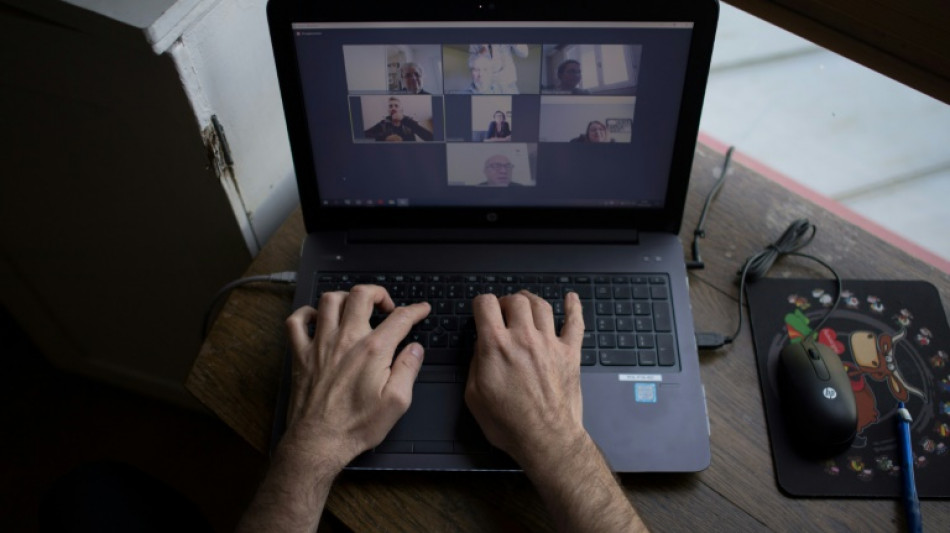
Videoconferencing hinders creativity, study finds
Videoconferencing hinders creativity, study finds / Photo: Loic VENANCE - AFP/File

Videoconferencing hinders creativity, study finds

People are worse at coming up with creative ideas during a video call compared to meeting in person, a study said Wednesday, suggesting that workplaces should prioritise brainstorming sessions for the office.

Text size:

The pandemic has changed the nature of office work, propelling a massive rise in videoconferencing that looks unlikely to abate as homeworking becomes more entrenched across the world.

Seeking to find out how this huge change affects creativity, US researchers studied nearly 1,500 employees of a telecommunications company in Finland, Hungary, India, Israel and Portugal.

In pairs, either in person or on a Zoom call, the employees came up with as many creative ideas as they could for the company's products, then picked the best one.

The pairs who spoke in person came up with around 15 percent more, according to the study published in the Nature journal.

The researchers found similar results in an experiment involving more than 600 university students, who were also paired off and told to come up with creative ideas for either a frisbee or bubble wrap.

The in-person pairs came up with 14 percent more ideas.

However, it was not all bad news for Zoom, Skype and the other videoconferencing apps.

Both sets of results found that video calls were just as effective for selecting the best idea, a decision which requires "cognitive focus and analytical reasoning", the study said.

- 'We're most creative when unfocused' -

To understand the difference, the researchers tracked the gaze of the participants.

"In the virtual condition people are looking significantly more at their partner -- almost double -- at the expense of their broader environment," the study's co-author Melanie Brucks, an assistant marketing professor at Columbia University, said in a Nature video.

The study said that "videoconferencing hampers idea generation because it focuses communicators on a screen, which prompts a narrower cognitive focus".

That kind of focus might help select the best idea -- but hinder coming up with one in the first place.

"We're most creative when we're unfocused and free," Brucks said.

"I always suggest turning off the camera during idea generation, so you can walk around, you can look around."

These results could inform how companies plan remote working, said the study -- particularly in hybrid home-office set-ups where "it might make sense to prioritise creative idea generation during in-person meetings".

The researchers added that they had had to exclude results from a telecommunications company's engineers in Poland who, unlike the other groups, met in a hotel conference room.

"Perhaps for this reason, participants exhibited rampant non-compliance, including a notable preoccupation with the hotel catering's coffee and cookie station," the study said.

Y.Sharma--DT