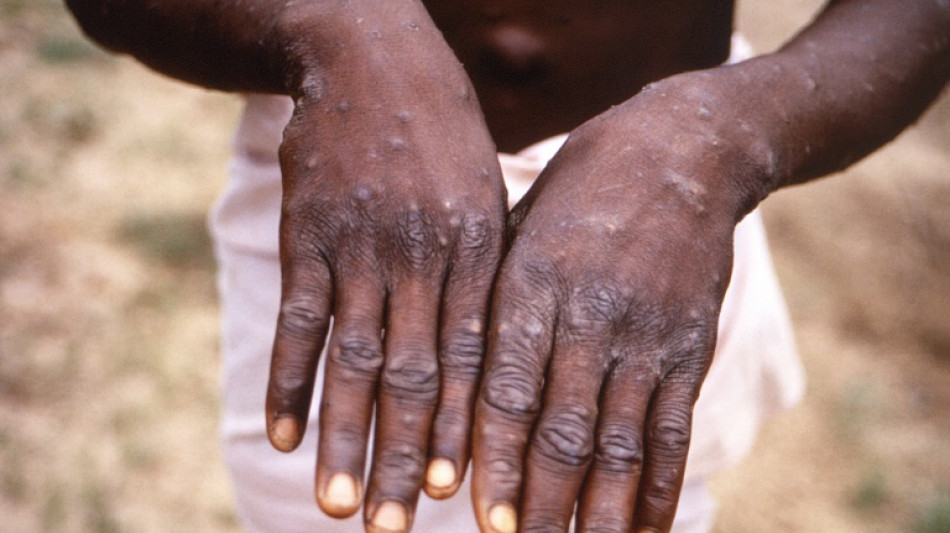
Fears new 'most dangerous' mpox strain could cross borders / Photo: Brian W.J. Mahy - Centers for Disease Control and Prevention/AFP/File
A new deadlier strain of mpox that transmits more easily between people is killing children and causing miscarriages in the Democratic Republic of Congo and may have already spread to neighbouring countries, researchers have warned.
All countries should be preparing for "this new strain before it spreads to other places, before it is too late," John Claude Udahemuka, a researcher at the University of Rwanda studying the outbreak, told AFP.
A global outbreak of a new strain of Mpox, previously known as monkeypox, in 2022 spread to more than 110 countries, mostly affecting gay and bisexual men. That was the clade II strain.
But there have been regular outbreaks of the clade I strain -- which is 10 times deadlier -- in Africa since it was first detected in DR Congo in 1970.
While the global outbreak was largely sexually transmitted, people in Africa normally caught clade I from infected animals, such as when eating bushmeat.
But "it was obvious something was different" about an mpox outbreak detected among sex workers in the remote mining Congolese town of Kamituga in September last year, Udahemuka told an online press conference.
Unlike previous outbreaks in the central African country, the virus was being transmitted via sex between heterosexuals.
Testing revealed it was a mutated variant of the original strain called clade Ib.
It is "undoubtedly the most dangerous strain so far," Udahemuka said.
More than 1,000 cases of clade Ib have been reported in South Kivu province since, said Leandre Murhula Masirika, who has led local research into the outbreak.
There are more than 20 new cases every week in Kamituga alone -- and the number is rising, he warned.
- 'Incredibly worrying' -
Five percent of adults and 10 percent of children who get the strain die, researchers said.
It gives sufferers "horrendous whole body rashes," unlike clade II, which caused lesions normally more limited to the genital area, said Trudie Lang, a global health researcher at Oxford University.
The clade Ib strain has also been spreading through non-sexual contact between people -- including among families or children playing together at school -- marking a major change from previous outbreaks, the researchers said.
There has been a "high amount" of transmission between mothers or carers and children, Lang said.
The strain has also caused numerous miscarriages, and researchers are studying its long-term effect on fertility.
These significant differences from previous mpox strains are "incredibly worrying," Lang said.
And the extreme cases turning up at hospital are likely "the tip of the iceberg," because many patients likely have less severe symptoms, she added.
There remain many "important unknowns" about the new strain, Lang cautioned, comparing this stage of investigation to the early days of Covid-19.
Out of 384 people who died from all mpox strains in DR Congo this year, more than 60 percent were children, according to the World Health Organization.
- Fears of wider outbreak -
So far, clade Ib has spread to the Congolese cities of Bukavu, Uvira and Kamanyola -- and this week was declared in North Kivu province's capital, Goma, the researchers said.
These cities are near DR Congo's borders with Rwanda, Burundi and Uganda.
While the new strain has not been officially reported outside of DR Congo, it may have already spread to neighbouring nations, Murhula Masirika said. Some infected sex workers came from these countries, he added.
And Goma, notably, has an international airport.
"There is definitely the opportunity for this to get on an airplane," Lang said, calling on the world to act quickly to contain the outbreak.
One way researchers want to stem the outbreak is to vaccinate local sex workers.
It remains to be determined whether existing vaccines will work for the new strain.
But smallpox vaccines -- which are cheap, widely available in many countries, and can work for mpox -- have not been made available in Kamituga, Udahemuka said.
Researchers in Africa have been calling for DR Congo to get access to the vaccines and treatments used against mpox in much of the world during the global outbreak.
Because if this strain spreads further it will cause "really great damage," Murhula Masirika warned.
"We are very afraid."
R.Mehmood--DT