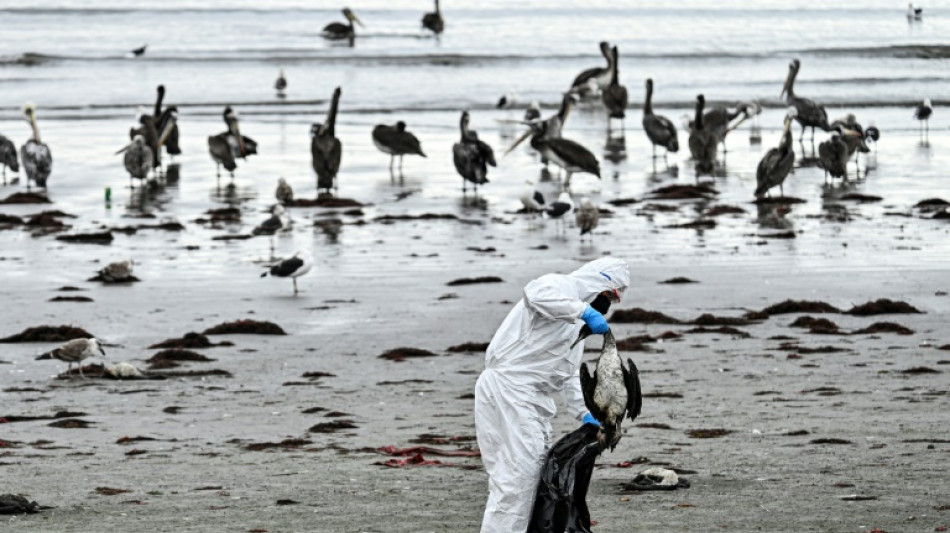
Experts warn bird flu virus changing rapidly in largest ever outbreak / Photo: MARTIN BERNETTI - AFP
The virus causing record cases of avian influenza in birds across the world is changing rapidly, experts have warned, as calls increase for countries to vaccinate their poultry.
While emphasising that the risk to humans remains low, the experts who spoke to AFP said that the surging number of bird flu cases in mammals was a cause for concern.
Since first emerging in 1996, the H5N1 avian influenza virus had previously been confined to mostly seasonal outbreaks.
But "something happened" in mid-2021 that made the group of viruses much more infectious, according to Richard Webby, the head of a World Health Organization collaborating centre studying influenza in animals.
Since then, outbreaks have lasted all year round, spreading to new areas and leading to mass deaths among wild birds and tens of millions of poultry being culled.
Webby, who is a researcher at St Jude Children's Research Hospital in the US city of Memphis, told AFP it was "absolutely" the largest outbreak of avian influenza the world had seen.
He led research, published this week in the journal Nature Communications, showing how the virus rapidly evolved as it spread from Europe into North America.
The study said the virus increased in virulence, which means it causes more dangerous disease, when in arrived in North America.
The researchers also infected a ferret with one of the new strains of bird flu.
The found an unexpectedly "huge" amount of the virus in its brain, Webby said, indicating it had caused more serious disease than previous strains.
Emphasising that the risk in humans was still low, he said that "this virus is not being static, it's changing".
"That does increase the potential that even just by chance" the virus could "pick up genetic traits that allow it to be more of a human virus," he said.
In rare cases, humans have contracted the sometimes deadly virus, usually after coming in close contact with infected birds.
- 'Scares us' -
The virus has also been detected in a soaring number of mammals, which Webby described as a "really, really troubling sign".
Last week Chile said that nearly 9,000 sea lions, penguins, otters, porpoises and dolphins have died from bird flu along its north coast since the start of the year.
Most mammals are believed to have contracted the virus by eating an infected bird.
But Webby said that what "scares us the most" are indications from a Spanish mink farm, or among sea lions off South America, that the virus could be transmitting between mammals.
Ian Brown, virology head at the UK's Animal and Plant Health Agency, said there has not yet been "clear evidence that this virus is easily sustaining in mammals."
While the virus is changing to become "more efficient and more effective in birds," it remains "unadapted to humans," Brown told AFP.
Avian viruses bind to different receptors on the host cell than human viruses, Webby said.
It would take "two or three minor changes in one protein of the viruses" to become more adapted to humans, he said.
"That is what we're really looking out for."
- Vaccinating poultry -
One way to bring down the number of total bird flu cases, and therefore reduce the risk to humans, would be for countries to vaccinate their poultry, Webby said.
A few nations including China, Egypt and Vietnam have already held vaccination campaigns for poultry.
But many other countries have been reluctant due to import restrictions in some areas, and fears vaccinated birds that nonetheless get infected could slip through the net.
In April, the United States started testing several vaccine candidates for potential use on birds.
France recently said it hopes to start vaccinating poultry as early as autumn this year.
Christine Middlemiss, the UK's chief veterinary officer, said that vaccinating poultry was not "a silver bullet because the virus changes constantly".
But traditionally reluctant countries should consider vaccinating poultry more often, Middlemiss told AFP at an event at the UK's embassy in Paris last week.
World Organisation for Animal Health director general Monique Eloit said that the issue of vaccinating poultry should be "on the table".
After all, "everyone now knows that a pandemic is not just a fantasy -- it could be a reality," she added.
A.Ansari--DT