Dubai Telegraph - Breast cancer drug shown to reduce recurrence risk

EUR -
AED 4.294321
AFN 74.253619
ALL 95.872296
AMD 433.704387
ANG 2.092944
AOA 1073.434204
ARS 1639.383876
AUD 1.630848
AWG 2.107696
AZN 1.96015
BAM 1.954468
BBD 2.355421
BDT 143.521562
BGN 1.950542
BHD 0.441304
BIF 3478.721029
BMD 1.169318
BND 1.491883
BOB 8.111471
BRL 5.829991
BSD 1.169468
BTN 111.167228
BWP 15.875179
BYN 3.307945
BYR 22918.632663
BZD 2.352497
CAD 1.592787
CDF 2708.140315
CHF 0.916739
CLF 0.027102
CLP 1066.675183
CNY 7.986734
CNH 7.98829
COP 4361.123466
CRC 531.735296
CUC 1.169318
CUP 30.986927
CVE 110.675798
CZK 24.396662
DJF 207.811219
DKK 7.472054
DOP 69.685287
DZD 154.832962
EGP 62.591601
ERN 17.53977
ETB 183.67067
FJD 2.57057
FKP 0.860877
GBP 0.864065
GEL 3.139597
GGP 0.860877
GHS 13.090504
GIP 0.860877
GMD 85.913622
GNF 10263.693503
GTQ 8.938111
GYD 244.683224
HKD 9.159616
HNL 31.138853
HRK 7.534738
HTG 153.054918
HUF 365.043672
IDR 20334.381433
ILS 3.442466
IMP 0.860877
INR 111.388823
IQD 1531.806571
IRR 1537653.160541
ISK 143.404954
JEP 0.860877
JMD 184.244419
JOD 0.829086
JPY 183.83781
KES 151.051793
KGS 102.222361
KHR 4691.303387
KMF 491.721159
KPW 1052.386191
KRW 1728.533127
KWD 0.360173
KYD 0.974736
KZT 542.540205
LAK 25681.144292
LBP 104538.465789
LKR 373.722075
LRD 214.716016
LSL 19.680048
LTL 3.452693
LVL 0.707309
LYD 7.407627
MAD 10.812674
MDL 20.136275
MGA 4858.516457
MKD 61.637266
MMK 2455.275164
MNT 4182.27105
MOP 9.437268
MRU 46.71434
MUR 54.676984
MVR 18.071781
MWK 2036.313487
MXN 20.481189
MYR 4.632873
MZN 74.731036
NAD 19.679919
NGN 1603.05293
NIO 42.937367
NOK 10.845132
NPR 177.865485
NZD 1.991121
OMR 0.449603
PAB 1.169703
PEN 4.099639
PGK 5.066072
PHP 72.252128
PKR 325.947045
PLN 4.258832
PYG 7271.044057
QAR 4.259828
RON 5.192473
RSD 117.386687
RUB 87.698649
RWF 1707.788929
SAR 4.387509
SBD 9.384792
SCR 16.054895
SDG 702.171763
SEK 10.866352
SGD 1.492989
SHP 0.873014
SLE 28.824094
SLL 24520.009172
SOS 668.263928
SRD 43.797951
STD 24202.521612
STN 24.731076
SVC 10.23498
SYP 129.238853
SZL 19.67902
THB 38.271563
TJS 10.948537
TMT 4.09846
TND 3.374069
TOP 2.815437
TRY 52.872586
TTD 7.944585
TWD 37.040504
TZS 3034.379932
UAH 51.538272
UGX 4389.126281
USD 1.169318
UYU 47.107891
UZS 14029.47757
VES 571.729555
VND 30799.251277
VUV 138.890167
WST 3.174919
XAF 655.510204
XAG 0.016054
XAU 0.000258
XCD 3.16014
XCG 2.108163
XDR 0.813413
XOF 653.066113
XPF 119.331742
YER 279.028522
ZAR 19.63192
ZMK 10525.262602
ZMW 21.903071
ZWL 376.519917
  • RBGPF

    0.5000

    63.1

    +0.79%

  • RELX

    0.0100

    36.36

    +0.03%

  • BTI

    -0.3600

    58.35

    -0.62%

  • CMSC

    -0.0100

    22.87

    -0.04%

  • GSK

    -0.7100

    50.9

    -1.39%

  • RIO

    -1.9500

    98.63

    -1.98%

  • BCE

    -0.0300

    23.93

    -0.13%

  • AZN

    -1.2800

    183.46

    -0.7%

  • CMSD

    -0.0300

    23.25

    -0.13%

  • NGG

    -0.9800

    87.5

    -1.12%

  • BP

    0.5300

    46.94

    +1.13%

  • JRI

    -0.0500

    12.93

    -0.39%

  • BCC

    -3.8000

    74.33

    -5.11%

  • RYCEF

    -0.3000

    16

    -1.88%

  • VOD

    -0.1000

    16.05

    -0.62%

Breast cancer drug shown to reduce recurrence risk
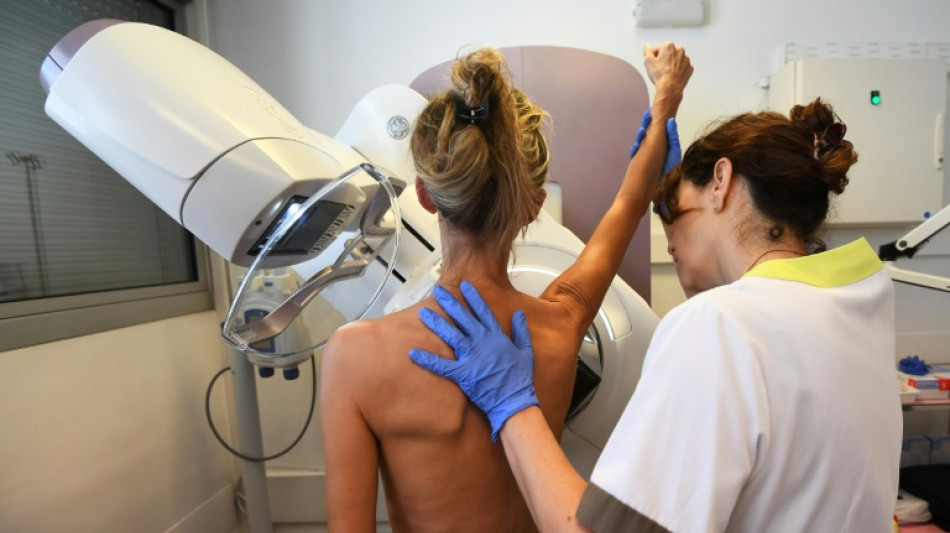
Breast cancer drug shown to reduce recurrence risk / Photo: ANNE-CHRISTINE POUJOULAT - AFP/File

Breast cancer drug shown to reduce recurrence risk

Even when the disease is caught early, breast cancer recurrence is relatively commonplace -- and for survivors, the prospect can be daunting.

Text size:

A drug developed by Swiss pharmaceutical maker Novartis reduced this risk by a quarter in a large group of early-stage survivors of the most common type of breast cancer, according to clinical trial results presented Friday at the American Society of Clinical Oncology's (ASCO) annual meeting, offering patients new hope.

The study of ribociclib, which belongs to a newer class of drugs known as molecularly targeted therapies, was described as a "very important and practice-changing clinical trial," by ASCO expert Rita Nanda, who was not involved in the research.

The majority of the two million new breast cancers diagnosed globally are in the early phases of disease, defined as stages I through III.

"The current standard of therapy for these patients is surgery followed by chemotherapy... or radiation, then followed by between five and 10 years of hormonal blockade by various endocrine therapies," lead author Dennis Slamon of the UCLA Jonsson Comprehensive Cancer Center told reporters.

But recurrence is as high as more than one in three people for stage I, and more than one in two in stage III, with the cancer sometimes returning decades later.

The clinical trial involved more than 5,100 people with stage II and stage III forms of HR-positive, HER2-negative breast cancer, which is the most common subtype, making up nearly 70 percent of all breast cancer cases in the United States.

Half the patients received ribociclib -- marketed under the brand name Kisqali -- as well as hormonal therapy, while the other half received only hormonal therapy. They continued for a treatment period of three years.

But the trial was halted early because a significant difference in outcomes between the two groups became apparent, and it would not have been ethical to allow the hormone therapy-only group to miss out on the more effective treatment.

Overall, 7.4 percent of patients in the ribociclib group experienced a recurrence against 9.2 percent of patients in the hormone therapy-only group, which means an approximate risk reduction of 25 percent.

"Ribociclib also showed more favorable outcomes in overall survival, recurrence-free survival, and distant disease-free survival," a press statement said.

While ribociclib, which is already widely approved around the world, has previously shown benefit for people with metastatic breast cancer, the new study was able to demonstrate it also improves outcomes for people with earlier stages, including those with cancer that hasn't yet spread to the lymph nodes.

The most common side effects were abnormally low counts of a type of white blood cell called neutrophils, as well as joint pain. Less common effects included gastrointestinal issues and fatigue.

Ribociclib works by disrupting proteins in breast cancer cells responsible for cell division.

Novartis plans to continue to study longer-term outcomes.

R.El-Zarouni--DT