Dubai Telegraph - Discovery of tsetse fly mating behavior may help curb sleeping sickness

EUR -
AED 4.294567
AFN 74.242338
ALL 95.860889
AMD 433.652521
ANG 2.092694
AOA 1073.305184
ARS 1638.767571
AUD 1.631336
AWG 2.107444
AZN 1.986399
BAM 1.954234
BBD 2.355139
BDT 143.504399
BGN 1.950308
BHD 0.441243
BIF 3478.305015
BMD 1.169178
BND 1.491705
BOB 8.110501
BRL 5.827244
BSD 1.169328
BTN 111.153934
BWP 15.873281
BYN 3.30755
BYR 22915.891865
BZD 2.352215
CAD 1.593064
CDF 2707.816505
CHF 0.916367
CLF 0.027099
CLP 1066.547693
CNY 7.98578
CNH 7.986603
COP 4361.2099
CRC 531.671706
CUC 1.169178
CUP 30.983221
CVE 110.662554
CZK 24.398879
DJF 207.78623
DKK 7.473272
DOP 69.707804
DZD 154.806756
EGP 62.57652
ERN 17.537672
ETB 183.648675
FJD 2.570789
FKP 0.860774
GBP 0.863946
GEL 3.139237
GGP 0.860774
GHS 13.088963
GIP 0.860774
GMD 85.937627
GNF 10262.466446
GTQ 8.937043
GYD 244.653963
HKD 9.158698
HNL 31.13474
HRK 7.534534
HTG 153.036614
HUF 365.157386
IDR 20331.949681
ILS 3.442055
IMP 0.860774
INR 111.375502
IQD 1531.623385
IRR 1537469.275437
ISK 143.353461
JEP 0.860774
JMD 184.222386
JOD 0.828981
JPY 183.784251
KES 151.034235
KGS 102.210142
KHR 4690.742595
KMF 491.637764
KPW 1052.260338
KRW 1727.402304
KWD 0.360142
KYD 0.974619
KZT 542.475323
LAK 25678.079953
LBP 104525.964223
LKR 373.677382
LRD 214.690352
LSL 19.677233
LTL 3.452279
LVL 0.707224
LYD 7.406735
MAD 10.81141
MDL 20.133867
MGA 4857.935526
MKD 61.637522
MMK 2454.981542
MNT 4181.7709
MOP 9.436139
MRU 46.708364
MUR 54.671139
MVR 18.069677
MWK 2036.126585
MXN 20.462017
MYR 4.621806
MZN 74.721833
NAD 19.677188
NGN 1603.949136
NIO 42.931959
NOK 10.847749
NPR 177.844215
NZD 1.99043
OMR 0.449529
PAB 1.169563
PEN 4.099145
PGK 5.065466
PHP 72.231513
PKR 325.908073
PLN 4.257971
PYG 7270.174526
QAR 4.259337
RON 5.195239
RSD 117.403067
RUB 87.677711
RWF 1707.584697
SAR 4.386985
SBD 9.38367
SCR 16.052975
SDG 702.088912
SEK 10.858506
SGD 1.492807
SHP 0.87291
SLE 28.819962
SLL 24517.076868
SOS 668.182785
SRD 43.79273
STD 24199.627276
STN 24.728118
SVC 10.233756
SYP 129.223397
SZL 19.677487
THB 38.233949
TJS 10.947228
TMT 4.097969
TND 3.373663
TOP 2.815101
TRY 52.829897
TTD 7.943635
TWD 37.036091
TZS 3034.017205
UAH 51.532108
UGX 4388.601394
USD 1.169178
UYU 47.102258
UZS 14027.799564
VES 571.661183
VND 30795.56805
VUV 138.873557
WST 3.174539
XAF 655.431813
XAG 0.016083
XAU 0.000259
XCD 3.159762
XCG 2.107911
XDR 0.813315
XOF 652.988275
XPF 119.331742
YER 278.995087
ZAR 19.661833
ZMK 10524.00789
ZMW 21.900452
ZWL 376.474889
  • RBGPF

    0.5000

    63.1

    +0.79%

  • RYCEF

    -0.3000

    16

    -1.88%

  • CMSC

    -0.0100

    22.87

    -0.04%

  • NGG

    -0.9800

    87.5

    -1.12%

  • RIO

    -1.9500

    98.63

    -1.98%

  • AZN

    -1.2800

    183.46

    -0.7%

  • BTI

    -0.3600

    58.35

    -0.62%

  • GSK

    -0.7100

    50.9

    -1.39%

  • BP

    0.5300

    46.94

    +1.13%

  • RELX

    0.0100

    36.36

    +0.03%

  • BCE

    -0.0300

    23.93

    -0.13%

  • VOD

    -0.1000

    16.05

    -0.62%

  • CMSD

    -0.0300

    23.25

    -0.13%

  • BCC

    -3.8000

    74.33

    -5.11%

  • JRI

    -0.0500

    12.93

    -0.39%

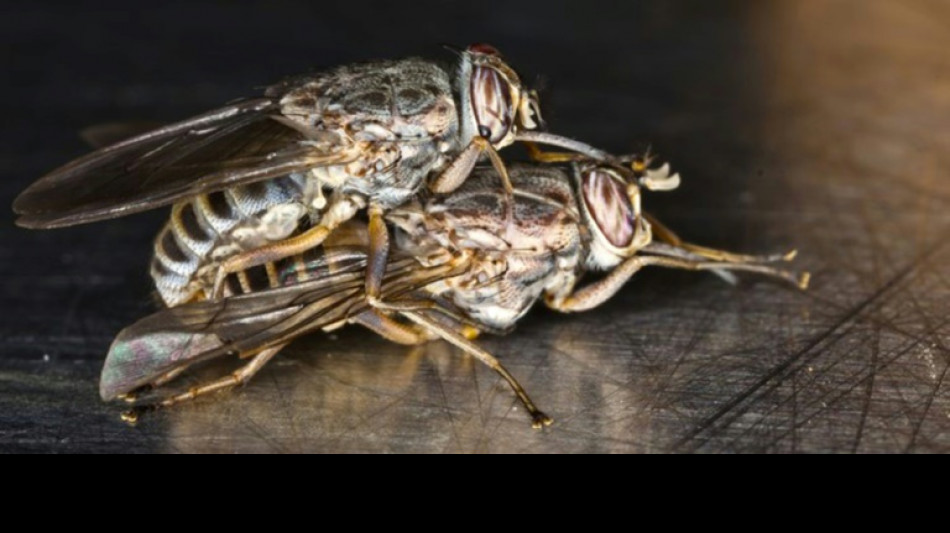
Discovery of tsetse fly mating behavior may help curb sleeping sickness
Discovery of tsetse fly mating behavior may help curb sleeping sickness / Photo: Geoffrey Attardo - EUREKALERT!/AFP

Discovery of tsetse fly mating behavior may help curb sleeping sickness

Researchers have identified chemicals in tsetse flies that control their mating behavior, a discovery that may well aid the fight against the disease-causing insects in sub-Saharan Africa.

Text size:

"It could be used in traps to make them more effective in trapping tsetse flies," said John Carlson, a biology professor at Yale University and one of the authors of a study published Thursday in the journal Science.

Trypanosomiasis, also known as sleeping sickness, is caused by parasites transmitted by the tsetse fly. It affects humans and domestic animals.

The disease threatens millions of people in dozens of countries in sub-Saharan Africa.

Animal trypanosomiasis, known as Nagana, kills some three million cattle each year, an annual cost of $1.2 billion, according to a companion article in Science.

It is considered a major cause of rural poverty and the authors warned that the geographic range of the tsetse fly is expected to grow as a result of climate change.

For the study, the researchers focused on pheromones, chemical compounds an animal releases that affect the behavior of others of the same species.

Pheromones allow insects to identify each other in an environment where there are potentially thousands of other species.

The Yale researchers identified volatile sex pheromones that had not previously been isolated in tsetse flies despite more than a century of study.

Pheromones are currently used to control a wide variety of other insect pests such as moths.

Pantry moths, for example, can be caught using sticky traps baited with a plastic disc soaked with an attractive pheromone.

- 'The flies stop moving' -

For the study, the researchers soaked tsetse flies in liquid and then used a gas chromatograph-mass spectrometer to identify specific chemicals.

One of them, methyl palmitoleate (MPO), acted as an aphrodisiac, attracting male tsetse flies.

In tests, male tsetse flies were attracted to decoys -- knots in yarn doused with MPO -- and, unusually, to females of another tsetse fly species.

Olfactory neurons on the antennae of the flies were found to increase their firing rates in response to MPO.

"Not only is MPO an attractant, but it causes tsetse flies to freeze -- the flies stop moving," Carlson said.

Current traps for tsetse flies use animal odors but MPO tends to last longer and could "enhance the effectiveness of traps," he said.

Carlson said field tests using MPO were getting underway in Kenya.

The type of pheromone identified in the study may not be effective against all types of tsetse flies, however.

The study focused on the species Glossina morsitans, a major vector of the disease in cattle, not on Glossina fuscipes, which causes the most human cases of the disease.

But Carlson said he was optimistic that the research methods used could lead to identifying pheromones from other tsetse species.

G.Gopinath--DT