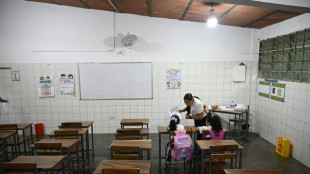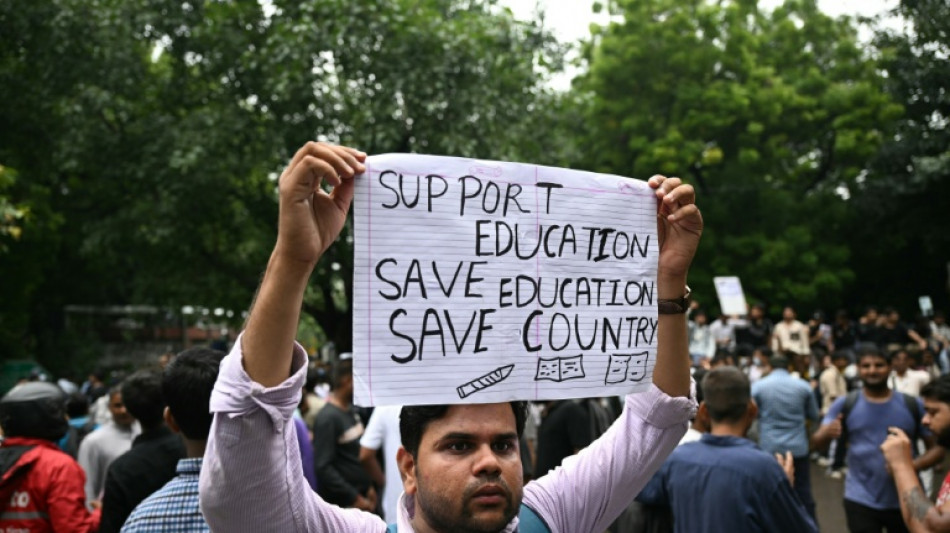
The student movement in India challenging Modi's government / Photo: Sajjad HUSSAIN - AFP
What began as online outrage over exam scandals has snowballed into protests against India's education system, posing one of the biggest challenges to Prime Minister Narendra Modi in his third term in office.
The protests are led by the online Cockroach Janta Party (CJP) movement, which has won millions of followers on social media since it was launched in May by 30-year-old public relations graduate Abhijeet Dipke.
- What are the protesters demanding? -
The unrest began after the leak of a medical entrance examination paper that forced more than two million candidates to retake the test.
Protesters are demanding the resignation of Education Minister Dharmendra Pradhan, whom they hold responsible for a series of exam irregularities that have shaken confidence in India's education system.
They are also seeking compensation of 10 million rupees ($104,000) for the families of around 20 students who reportedly took their own lives after the medical exam leak.
The movement has broadened its agenda to include concerns over unemployment, opportunities for young people and what protesters describe as Modi's increasingly authoritarian style of governance.
Despite rapid economic growth, millions of people in the world's most populous nation still struggle to find stable and well-paying jobs.
Opposition parties, who have thrown their weight behind the protesters, are calling for the resignation of Modi and Home Minister Amit Shah, accusing them of allowing police to use excessive force against students.
- How has the government responded? -
After initially ignoring the protesters, the government has made a delayed attempt to soften its stand.
Pradhan, facing growing pressure over the handling of exam controversies, said Tuesday the government remained committed to reform.
"We owe them (students) answers, reforms and accountability," he said.
Modi has not spoken publicly about the protests, but a cabinet minister said he had promised to take the "strongest possible steps" to protect the interest of the students.
The government is currently on the backfoot, said author and political analyst Nilanjan Mukhopadhyay.
"If he (Modi) drops Pradhan now, then it is going to be seen that public pressure has won. And that is going to be very dangerous for Modi," he told AFP.
- Why is this protest significant? -
The protest has stretched beyond memes and social media posts, tapping into widespread anger among the youth over lack of jobs and anxieties about their future.
Students from across the country have joined the protests in Delhi, transcending caste, religion and regional identities.
Smaller protests have also been held in Mumbai, Bengaluru and Goa.
The government appears to be struggling to put them in a bracket, unlike when farmers protested agricultural reforms five years ago.
Some ruling party members labelled them as Sikh separatists wanting to break the country into pieces.
Muslims protesting against the Citizenship Amendment Act in 2020 were framed as "anti-nationals".
The latest protest was "more serious because this does not give the government an opportunity to paint this as a protest of one community," Mukhopadhyay said.
- What happened on Monday? -
Tens of thousands of protesters, most of them young students, gathered at Jantar Mantar in the heart of the Indian capital after a call to march to the parliament by the CJP.
Police tried to stop the march by firing tear-gas shells and baton charging protesters who responded by pelting stones, marking the capital's biggest street demonstration in around five years.
At least 178 people were injured, Delhi Police said, included 118 security personnel.
Protesters claimed hundreds of demonstrators were injured after being "brutally beaten" by the police.
- Where is the protest headed? -
Undeterred by the police action and intimidation, the CJP has vowed to press ahead until their demands are met.
The government appears wary after youth-led protests in neighbouring Nepal and Bangladesh in recent years toppled incumbent regimes.
Political scientist Suhas Palshikar said it was difficult to say how the protests would shape up in the coming days.
"Cockroach movement has made a beginning. We don't know if it will sustain," he said on social media.
Mukhopadhyay believes that if the protest drags on for another few days, "it is going to be a big problem for the government".
D.Naveed--DT