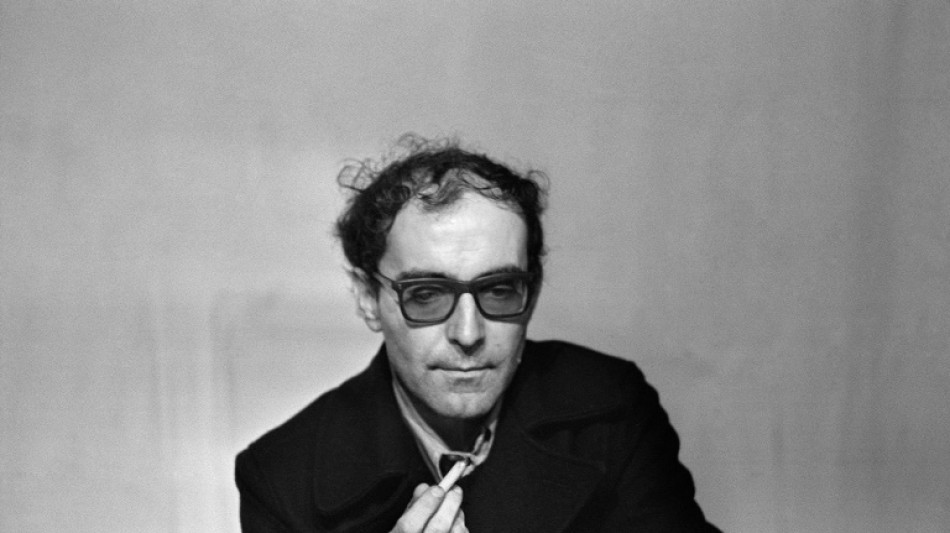
French cinema giant Jean-Luc Godard dies aged 91 / Photo: STRINGER - AFP/File
Jean-Luc Godard, one of the most influential filmmakers of the 20th century and the father of the French New Wave, died "peacefully at home" on Tuesday aged 91, his family said.
The legendary maverick blew up the conventions of cinema in the 1960s, shooting his gangster romance "Breathless" on the streets of Paris with a hand-held camera, using a shopping trolley for panning shots.
He continued to thumb his nose at Hollywood and an older generation of French filmmakers by breaking all the rules again in "Contempt" (1963) with Brigitte Bardot and "Pierrot le Fou" in 1965.
"No official (funeral) ceremony will take place," his family said. "He will be cremated... And it really must happen in private."
The secrecy -- and choosing to disappear in a puff of smoke -- is typical of Godard, who loved to surprise the world from his lair in the Swiss village of Rolle where he lived as a virtual recluse for decades.
It was there that he died "peacefully at home", his wife Anne-Marie Mieville at his side, his producers said.
Godard's influence is hard to underestimate, with directors from Martin Scorsese, Quentin Tarantino and Paul Thomas Anderson to Robert Altman, the maker of "M*A*S*H" and "The Player", often speaking of their debt to him.
- Film's 'John Lennon and Che Guevara' -
French President Emmanuel Macron hailed the director's talent and mourned the loss of a "national treasure".
"Jean-Luc Godard, the most iconoclastic filmmaker of the New Wave, invented a resolutely modern, intensely free art. We have lost a national treasure, a genius," Macron tweeted.
Godard's house, with green shutters and a green bench out front, looked empty on Tuesday, its shades drawn, with an abandoned ashtray and teapot on the windowsill, an AFP reporter said.
Despite the filmmaker's often difficult relationship with critics, The Guardian's Peter Bradshaw heaped praise on Godard, saying, "The last great 20th-century modernist is dead."
He compared him to other 1960s rebels like John Lennon and Che Guevara.
"Or maybe Godard was the medium's Socrates, believing that an unexamined cinema was not worth having," he added.
Guy Lodge, of the screen bible Variety, tweeted that it was "glib to say 'he changed everything', but he sure changed a hell of a lot of things."
Indeed, Godard became a "god" to many 1960s political and artistic radicals who would hang on every word of his often contradictory -- and tongue-in-cheek -- declarations on the state of cinema and the world.
- 'Every edit is a lie' -
"All you need for a movie is a gun and a girl," he once proclaimed, in a nod to US actress Jean Seberg, the star of "Breathless".
The movie was a fashion as well as a film landmark, her pixie haircut copied by millions bowled over by her effortless Parisian cool.
"A story should have a beginning, a middle and an end -- but not necessarily in that order," Godard later famously declared, and "every edit is a lie".
As he grew older, Godard would occasionally emerge from his Swiss bolthole to make low-budget films well into his 80s.
He never, however, regained the capacity to shock or move more mainstream audiences as he had in the 1960s, though a small band of disciples remained doggedly loyal to the master.
Cannes also saw the premiere in 2017 of "Redoubtable", a tragi-comic film about Godard's doomed romance with the French actress Anne Wiazemsky, directed by the Oscar-winning director of "The Artist", Michel Hazanavicius.
I.Uddin--DT