Dubai Telegraph - Japan to relax overtime regulation under workaholic PM

EUR -
AED 4.238811
AFN 75.022966
ALL 91.672628
AMD 419.537692
ANG 2.066447
AOA 1059.55903
ARS 1739.351817
AUD 1.619413
AWG 2.07901
AZN 1.957383
BAM 1.956934
BBD 2.324627
BDT 142.102356
BGN 1.943034
BHD 0.435048
BIF 3450.970122
BMD 1.154204
BND 1.468738
BOB 13.33061
BRL 5.938261
BSD 1.154159
BTN 110.753228
BWP 15.620918
BYN 3.504601
BYR 22622.396885
BZD 2.321225
CAD 1.607968
CDF 2669.093803
CHF 0.945126
CLF 0.027889
CLP 1101.203245
CNY 7.746382
CNH 7.746544
COP 3605.53684
CRC 516.494861
CUC 1.154204
CUP 30.586404
CVE 110.327507
CZK 24.306268
DJF 205.527333
DKK 7.475508
DOP 67.868746
DZD 154.356205
EGP 59.774608
ERN 17.313059
ETB 185.827115
FJD 2.567526
FKP 0.855416
GBP 0.856252
GEL 2.989216
GGP 0.855416
GHS 13.25551
GIP 0.855416
GMD 84.83445
GNF 10148.793838
GTQ 8.81103
GYD 241.467851
HKD 9.05417
HNL 31.071061
HRK 7.534598
HTG 150.846116
HUF 365.292269
IDR 20419.021596
ILS 3.512185
IMP 0.855416
INR 110.699119
IQD 1512.584241
IRR 1586568.712443
ISK 139.820478
JEP 0.855416
JMD 181.782203
JOD 0.818363
JPY 179.229979
KES 149.422829
KGS 100.934904
KHR 4675.66929
KMF 492.845335
KPW 1038.783897
KRW 1577.940296
KWD 0.356256
KYD 0.961849
KZT 516.204696
LAK 25829.745926
LBP 103354.904211
LKR 380.75737
LRD 201.515043
LSL 18.778905
LTL 3.408064
LVL 0.698166
LYD 7.317715
MAD 10.91233
MDL 20.065455
MGA 5049.641947
MKD 61.561745
MMK 2423.199621
MNT 4154.59545
MOP 9.325424
MRU 46.225673
MUR 54.039998
MVR 17.77448
MWK 2004.271858
MXN 19.783361
MYR 4.668291
MZN 73.765567
NAD 18.769115
NGN 1529.554162
NIO 42.25512
NOK 10.78124
NPR 177.205165
NZD 2.008309
OMR 0.443795
PAB 1.154159
PEN 3.872336
PGK 5.127547
PHP 72.433244
PKR 319.961663
PLN 4.342075
PYG 6869.921965
QAR 4.203553
RON 5.260055
RSD 117.373314
RUB 97.18192
RWF 1695.453227
SAR 4.331814
SBD 9.256137
SCR 16.02754
SDG 694.306762
SEK 11.28161
SGD 1.469515
SHP 0.856679
SLE 28.439506
SLL 24203.069786
SOS 659.570827
SRD 43.570862
STD 23889.690871
STN 24.873095
SVC 10.098765
SYP 15006.959696
SZL 18.744258
THB 38.370374
TJS 10.647078
TMT 4.051256
TND 3.363062
TOP 2.779046
TRY 56.159985
TTD 7.832471
TWD 36.768321
TZS 3053.59421
UAH 51.524515
UGX 4535.56966
USD 1.154204
UYU 46.416499
UZS 13578.869679
VES 970.897898
VND 29987.372116
VUV 136.297398
WST 3.152705
XAF 655.957
XAG 0.017855
XAU 0.000267
XCD 3.119294
XCG 2.080124
XDR 0.816082
XOF 655.957
XPF 119.331742
YER 273.035606
ZAR 18.741265
ZMK 10389.219903
ZMW 22.534865
ZWL 371.653192
SSP 6516.900596
MXV 2.243306
  • RYCEF

    0.2600

    19.3

    +1.35%

  • BCC

    0.6800

    75.93

    +0.9%

  • CMSD

    -0.1700

    20.07

    -0.85%

  • RIO

    -0.3800

    97.26

    -0.39%

  • CMSC

    -0.1000

    20.32

    -0.49%

  • RBGPF

    0.0000

    69.99

    0%

  • BCE

    -0.2534

    22.9

    -1.11%

  • NGG

    -0.0300

    74.93

    -0.04%

  • VOD

    0.1500

    17.68

    +0.85%

  • JRI

    -0.2065

    11.62

    -1.78%

  • RELX

    -1.5000

    34.22

    -4.38%

  • AZN

    -1.9300

    161.85

    -1.19%

  • GSK

    -0.0400

    50.01

    -0.08%

  • BTI

    -0.7700

    56.52

    -1.36%

  • BP

    1.0300

    46.96

    +2.19%

Japan to relax overtime regulation under workaholic PM
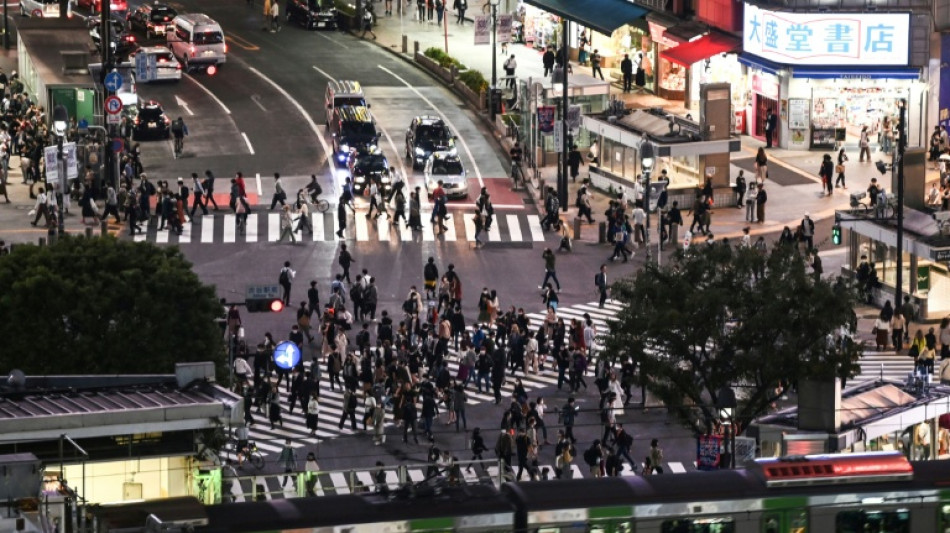
Japan to relax overtime regulation under workaholic PM / Photo: CHARLY TRIBALLEAU - AFP/File

Japan to relax overtime regulation under workaholic PM

Japan will ease overtime regulation starting Tuesday in a move meant to help spur economic growth but criticised as a relapse into the country's ingrained workaholic culture.

Text size:

The move comes after the government led by Prime Minister Sanae Takaichi -- a self-proclaimed workaholic -- adopted a growth strategy in July calling for revisions to the current oversight of work hours.

The change in part reflects calls from certain business sectors for more flexible work styles as they grapple with a deepening labour shortage.

Roughly 40 percent of businesses in Japan are operating under specific labour-management agreements that legally allow monthly overtime of up to 100 hours, according to the labour ministry.

But those companies were still advised by authorities to cap overtime at 45 hours each month, with that guidance considered on par with regulation.

That was because exceeding that threshold can increase risks for so-called "karoshi", or deaths from overwork, a labour ministry official told AFP.

Under the new rule that took effect Tuesday, labour standards inspection offices will no longer pressure businesses over the 45-hour limit.

A Japan Chamber of Commerce and Industry survey showed in May that this pressure was "restricting" activity of around 20 percent of Japan's small and mid-sized businesses, especially in short-staffed industries such as construction, transport and hospitality.

Critics, however, said the move reversed steps taken by Japan to modernise its corporate culture long centred around marathon work hours.

- 'Corporate warriors' -

Once a bastion for "corporate warriors" fiercely devoted to their jobs, the country has in recent years ratcheted up efforts toward a better work-life balance, especially after the 2015 suicide of an exhausted 24-year-old employee at advertising giant Dentsu.

"This is an unacceptable shift away from, and abolition of, the policy that urged companies to shorten work hours," the National Confederation of Trade Unions in Tokyo, commonly known as Zenroren, said in a statement.

The possible shift toward more work is on brand for Takaichi, who herself declared she "shall work, work, work, work and work" when elected as head of her conservative ruling party in October.

And in an X post widely derided for "showing off" her dedication to work, she wrote in July she has been chronically sleeping just "zero to three hours" as prime minister.

The labour ministry stresses that it will keep tabs on companies to ensure they take measures to protect the wellbeing of employees.

It will "continue to provide the necessary guidance if there is a high risk that health problems caused by excessive work may arise," the ministry said in a statement.

And the policy shift, it says, doesn't affect all businesses in Japan.

Those without special labour-management agreements in the first place will remain legally obliged to keep monthly overtime to 45 hours or less.

There are also some companies where going even a minute beyond the statutory working hours -- typically eight hours a day, 40 hours a week -- is illegal.

A.El-Ahbaby--DT