From forced labour to living heritage: Sao Tome's colonial plantations / Photo: Daniel BELOUMOU OLOMO - AFP
Conceicao Moreno is a descendant of agricultural workers, of whom many were brought by force from other African nations to Sao Tome and Principe to labour on colonial-era plantations.
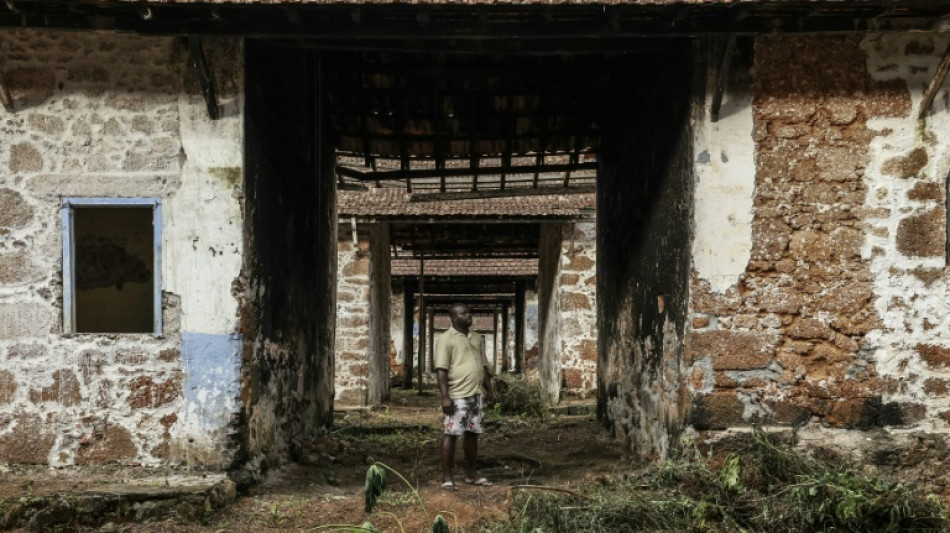
"My grandmother lived here, my father was born here and I was born here too. It's our heritage, in a way," Moreno said, pointing to the crumbling walls of the former Sundy plantation on the island of Principe.
It is one of six "rocas" (pronounced ro-ssas), or plantation estates, that were built on slavery and forced labour and added to UNESCO's World Heritage List last month.
Most of the "rocas" have been abandoned, presenting a major preservation challenge for the small archipelago in the Gulf of Guinea.
However, they have drawn interest from private investors keen to develop the tourism potential of the buildings steeped in history.
Established by Portuguese colonists in the second half of the 19th century, the plantations intensively cultivated sugar cane and later cocoa and coffee.
They initially used slaves who were later replaced by contracted labourers forced to live and work in harsh conditions.
Sao Tome, off Africa's west coast, had a steady supply of slaves passing through as the last staging post on the trade route before ships left for the Americas.
After Portugal abolished slavery in 1869, workers became "contract" employees, brought, often by force, from other Portuguese colonies -- Angola, Mozambique and Cape Verde -- as well as Gabon and the Congo.
The "rocas" had agricultural land, industrial infrastructure, residential areas and social facilities, UNESCO said.
They illustrate "the operation of a large-scale colonial agro-industrial system, based on forced migration and labour" from the late 19th century to the mid-20th century, the UN culture agency added.
- 'Collective memory' -
Sundy plantation still has its old stables with their fortress-like appearance, a Portuguese colonial-style manor house, small white-stone chapel and a row of "sanzalas" where plantation workers lived.
They bear witness to a darker past when the estate was a nearly self-sufficient system of booming agricultural production.
The buildings "preserve the collective memory of Sao Tome and Principe from the colonial era to the present day", the two-island nation's culture chief Emir Boa Morte said.
"Some have already disappeared since colonial times, others have been merged, there has been a decrease. But despite all that, there are still around a hundred of them," he added.
Nationalised by the country's Marxist-Leninist rulers in the late 1970s, the "rocas" were privatised in the 1990s but failed to survive the economic decline of the world's former leading cocoa producer.
The vast majority of the "rocas" -- some still inhabited by former workers and their descendants -- are little more than run-down buildings, often unsanitary and overgrown with weeds.
The forebears of Moreno, a 46-year-old member of the National Assembly, were "servicais", or contracted workers, shipped from Cape Verde to Sundy plantation in the highlands of Principe island.
He is one of a few who stayed at the sprawling site after it was bought a few years ago by HBD (Here Be Dragons), an investment fund founded by South African entrepreneur Mark Shuttleworth.
"I've never lived anywhere else, so I like being here. There's a very strong cultural connection," said Moreno, whose home is now separated from the plantation by a guardhouse and barrier.
- New impetus -
The old plantation owner's mansion has already been turned into a five-star hotel and the workers' houses will become extra bedrooms once the renovation is complete.
"We are creating beautiful hotels where hundreds of people can work. Nobody was using the old 'rocas' in the way they were supposed to be used in the old days; the new use of these 'rocas' is so important," said Egbert Bloemsma, CEO of HBD Hotels.
"It's important we do our part, renovate the 'rocas', preserve the old building, preserve the culture that was here."
The hotel group owns two former "rocas" on Principe.
UNESCO recognition is expected to breathe new life into efforts to preserve the historical heritage.
"We are in the process of mobilising almost the entire population of Sao Tome," said Boa Morte, from the culture ministry.
"Whoever visits the 'rocas' will see that there has been a change since they were elevated to the status of World Heritage of Humanity," he added.
"In five to 10 years, 10 more 'rocas' could join the UNESCO list."
Sao Tome and Principe has launched a 10-year plan to restore the buildings from their state of disrepair and find new uses for them.
But new investment will not "erase the history", insisted Boa Morte.
"The story of these 'rocas' must be told. There will be a combination, a union between the past and the present."
S.Mohideen--DT