AI keeps consumer prices high in 'RAMaggedon' chip crunch / Photo: Peter PARKS - AFP
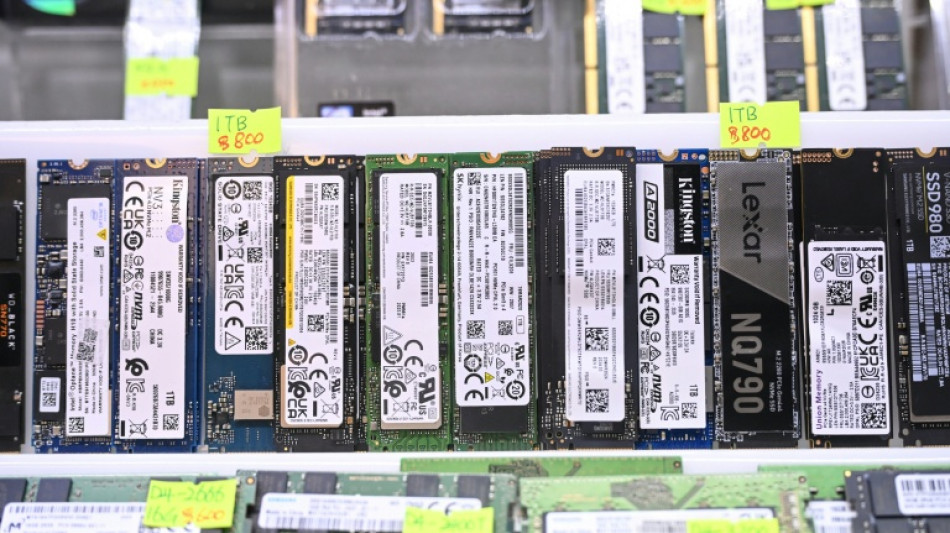
Print-outs of articles about the global memory chip shortage are pinned beside a price list at a Hong Kong computer shop, offering an explanation to confused customers feeling the pinch.
Price rises for goods such as laptops and smartphones, with cars potentially next, have been an unwelcome side-effect of the artificial intelligence gold rush -- and the squeeze is far from over.
Samsung Electronics' chief financial officer said this week shortages of microchips that store digital data will likely deepen in 2027 and stay tight through 2028.
The crunch has been nicknamed "RAMaggedon" after the components called RAM, or "random-access memory".
It is caused as profit-hungry chipmakers pivot to producing high-bandwidth memory (HBM) -- a more advanced type of computer memory in huge demand to help train and run AI tools.
The articles on display at In-Technology Services -- one of many compact vendors crammed into Hong Kong's Wan Chai Computer Centre -- are to inform customers who "don't know what happened," manager Wade Lam told AFP.
The centre's shops sell tech equipment of all sorts, from computer parts to gadgets and games consoles.
Ken Tam, manager of Videocom Computer, which specialises in custom-built PCs, said business has halved since price rises began in September.
Sixteen gigabytes of RAM used to cost HK$300-400 ($40-50) but the price has now hit HK$1,500, he said.
"When it suddenly gets so expensive, customers have a psychological barrier," Tam told AFP.
"If they need it, they will buy it," but otherwise they will wait, or "lower their standards" and buy a less high-performing memory chip, he said.
- Chinese competition -
Analyst Ellie Wang at the Taiwan-based market research firm TrendForce said memory prices for PCs and smartphones were up around five to six times compared to a year ago.
The AI boom has brought humungous profits and share price jumps to the world's top three memory chip makers: South Korea's Samsung Electronics and SK hynix, along with US giant Micron.
In fourth place is ChangXin Memory Technologies (CXMT), which became mainland China's most valuable company on Monday when it made its market debut in Shanghai -- another sign of how red-hot the sector has become.
CXMT, as a relative newcomer, "remains in a follower position regarding leading-edge technologies", James Zhao, senior principal analyst at Omdia, told AFP.
HBM is used in data centre servers to support other powerful chips -- such as those made by US titan Nvidia -- that execute the dizzyingly complex calculations of AI systems.
But when it comes to conventional RAM, and a type for computers called DRAM, "the current supply-constrained market environment" could bring CXMT "late-mover advantages", he said.
At a shopping centre in a different part of Hong Kong, customer Henry Wong, an investment banker, said he had chosen to upgrade the RAM in an older laptop instead of buying a new one with even better specs.
"After upgrading the memory, I found it ran really smoothly, and I stopped wanting to buy a new computer," he told AFP.
- 'Bubble' -
Automakers say they are facing rising costs for in-vehicle computer systems, which could also soon push up the price of new vehicles.
In Tokyo's tech hub of Akihabara, Charles Brousse, a 30-year-old graphic designer and custom PC builder from Belgium, said prices for RAM, graphics cards and motherboards have hit "ridiculous levels".
For his "PC & Chill" service, Brousse does not buy parts to pre-build machines -- as it is too expensive -- but he requires clients to purchase their own that he assembles.
The chip shortage is pushing people to buy cheaper laptops than desktops, which can last up to a decade, said Brousse, in Tokyo on his honeymoon.
"I'm not sure that's a good thing; people end up buying products with shorter lifespans, which fuels a cycle of consumption."
Brousse added that the fact it is driven by the "speculative bubble" of AI is also frustrating, "because I'm a graphic designer by trade, so AI has a real impact on my profession."
V.Munir--DT