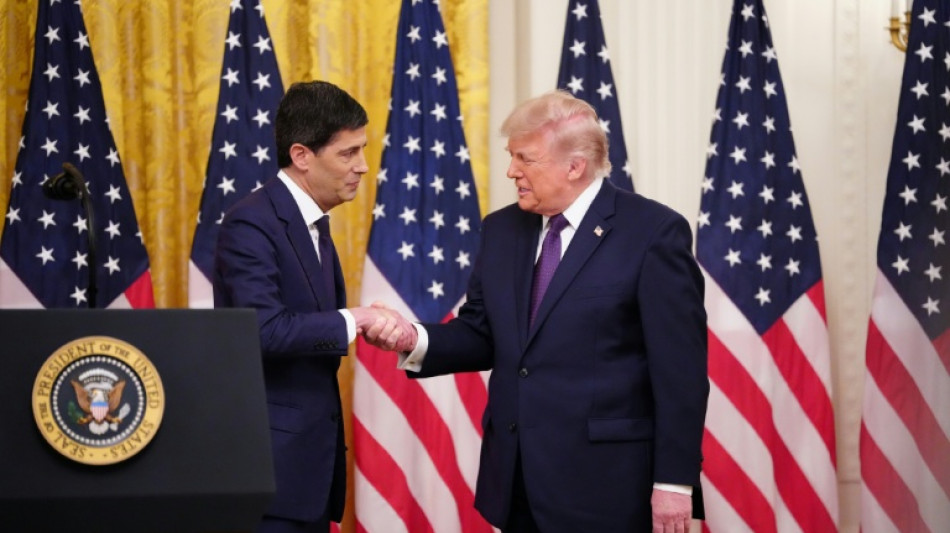
US Federal Reserve kicks off first meeting with Warsh as chair / Photo: Aaron Schwartz - AFP
US Federal Reserve Chairman Kevin Warsh kicked off his first meeting in charge of the central bank's rate-setting committee on Tuesday, with policymakers largely expected to keep rates steady as the fallout of the Iran war ripples through the world's largest economy.
Fed officials are set to keep rates at a range between 3.50 percent and 3.75 percent, extending their pause on cuts since the start of the year.
Their decision will be announced on Wednesday after the two-day meeting. They will also release their quarterly Summary of Economic Projections, which includes guidance on growth, inflation and interest-rate expectations.
All eyes will be on the language the Fed uses to communicate the decision, with at least four of 12 voting members now in favor of indicating a rate hike could be as likely as a cut for the central bank's next move.
With inflation at a three-year high and a firming labor market, pressure has been increasing for the Fed to address rising prices by potentially raising interest rates.
Such a move, however, would be sure to anger US President Donald Trump, who has exerted unprecedented pressure on the Fed since taking office for his second term.
Trump's Justice Department has pursued criminal charges against Warsh's predecessor Jerome Powell -- who he routinely insulted and criticized. That probe was later dropped.
In an unusual move, Powell chose not to resign from the board when his tenure as chairman ended, citing threats to the Fed's independence.
He is expected to remain on as a governor until January 2028.
Separately, Trump has tried to unseat Fed Governor Lisa Cook on mortgage fraud allegations, with the Supreme Court due to rule on the legality of that move.
- Reform agenda -
Warsh, who was picked by Trump, was sworn in last month and has an ambitious and wide-ranging reform agenda.
He has previously expressed support for lowering rates -- in line with Trump's demands -- but will likely face resistance from a divided committee.
At his swearing in he promised to usher in a "reform-oriented" era, with plans to change how much the Fed communicates and to reduce the size of its balance sheet.
"First of all, investors want to hear Warsh's tone," said Steve Sosnick of Interactive Brokers.
In a note on Monday, UniCredit said the Fed would "probably drop its easing bias from the post-meeting statement," while other analysts have indicated it could drop forward guidance altogether.
Markets largely expect the Fed to take an extended pause on rates, with the first move -- a rate hike -- currently priced in for around December, according to the CME FedWatch tool.
"Rate cuts are not on the table in the near term," said UniCredit in its note.
"Equally, there appears to be a high bar to raise rates, given uncertainty regarding the outcome of the new round of negotiations that are set to start after the US and Iran reached an interim agreement."
J.Alaqanone--DT