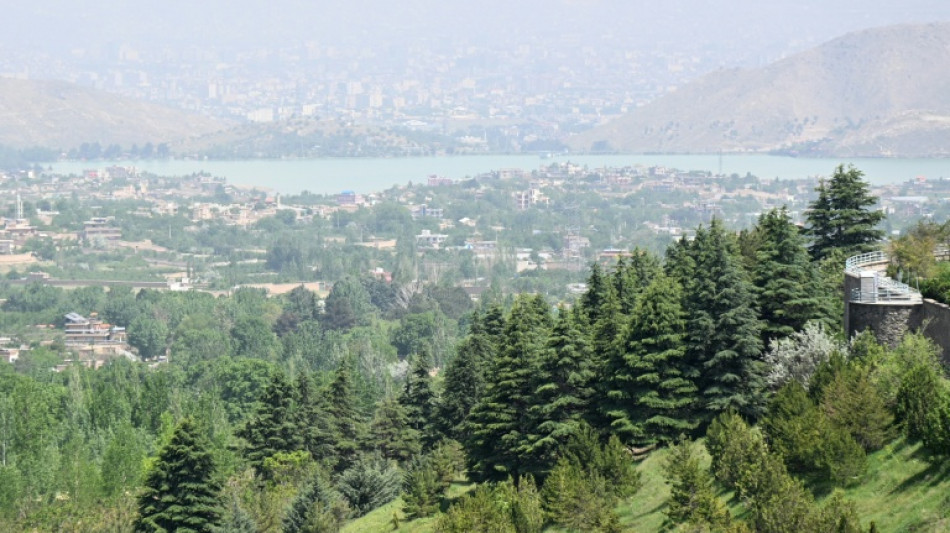
From poplars to pistachios, Afghans rediscover the value of trees / Photo: Wakil KOHSAR - AFP
Under the shade of recently planted poplars in northeastern Afghanistan, village leader Ghulam Ali Poya is proud to see residents rediscover the value of trees after years of wartime deforestation.
"There were forests of pistachio trees," he told AFP, gesturing to the bare mountains that surround Char Bagh's mud homes.
"During the conflicts and the civil war, they were destroyed; no one could stop the logging."
From the 1979 Soviet invasion until the fall of the first Taliban government in the early 2000s, "around 50 percent of Afghanistan's forest cover was lost", said Mohammad Nasir Shalizi, a researcher at North Carolina State University.
In eastern Afghanistan, timber smuggling to Pakistan drove massive logging, while in the more arid central and northern "pistachio belt", residents used wood for heating and cooking.
But in the last two decades, deforestation has slowed "substantially", Shalizi said.
Forest cover has increased 35 percent nationwide since 2011, according to the National Statistics and Information Authority, though just 2.5 percent of Afghanistan was forested in 2025 and cover is still shrinking in some areas.
But experts say communities are working to improve forest cover. Both the US-backed government, in place until 2021, and the current Taliban administration have supported tree-planting campaigns.
In Char Bagh, the Aga Khan Development Network funded a kilometre-square grove which includes poplars, paulownias, pomegranates and persimmons.
- 'A model' -
The land belongs to farmer Bas Begum Ahmadi, who hopes to sell fruit and homemade jam, but it is also open to the community of 350 families.
"Having these trees makes me feel good; my environment is green, and we breathe fresh air," said the 45-year-old, who tends the trees with her husband to support their four children.
This "micro-forest" follows Japanese botanist Akira Miyawaki's principles: dense planting of mostly local species of varying heights.
It is noticeably cooler than the surrounding bare fields and offers twigs for stove fuel and leaves that feed livestock.
Micro-forests "restore ecosystems, improve soil fertility, help climate resilience, and support community livelihood," said Parisa Malikzada, Afghanistan agriculture coordinator for the organisation, which has planted 500 micro-forests in seven provinces.
Poya said the forest, next to a river, prevents soil erosion during flooding and offers "a model for people".
"Everyone comes to have a look, and they'd like to have one too," he told AFP.
In Afghanistan, where many places are hard to reach and the state has limited funds, community-based forest management is the most effective approach to reforestation, experts told AFP.
- Penalties for tree cutting -
Afghan authorities have set a goal of planting 200 million trees between 2023 and 2030, relying partly on NGOs, the United Nations and the private sector.
"Last year, the target was eight million, but in the end, 17 million were planted," said Rohullah Amin, head of climate change at the General Environmental Protection Agency, where he has worked for more than a decade.
This year's goal is nine million.
Challenges include selecting native, climate-adapted species, water scarcity, and livestock damaging saplings.
Some forests have struggled with "lack of care or water", Amin acknowledged, including one site where drought killed 70 percent of the planted pines.
In some places, tribal councils protect forests and penalise residents who damage them. Elsewhere, "forest management associations" run by elected villagers and farmers have been set up.
The UN Food and Agriculture Organization has helped them plant five million trees since 2019, according to its climate change chief, Muhammad Safi.
- Birds coming back -
The government created nurseries to grow local species in places such as Paghman on state land on Kabul's outskirts.
Head gardener Mahmood Khwajazada carefully tends almond, pine nut and walnut trees, as well as deodar cedars, for distribution nationwide.
"Our Prophet said, 'Even if you have only one day left, plant a tree," he told AFP.
In Charikar, northeastern Afghanistan, where thousands of saplings were planted this year along streets, in parks and on hillsides, the municipality sees "a change" in people's attitude towards trees.
Ahmad Khalid Sabiri, a resident, said he volunteered to help plant "because it's beneficial for the environment".
Experts said more work is needed to protect the remaining old growth, as well as planting in forests rather than just in urban areas.
"There's good work happening, but far more needs to be done" to address the impact of global warming, according to Apoorva Oza, head of climate change at the Aga Khan Foundation.
In Char Bagh, Poya sees a beneficial effect of trees in biodiversity, with the return of long-absent birds.
"Don't build a cage for a bird; plant a tree near your house," he said.
A.El-Nayady--DT