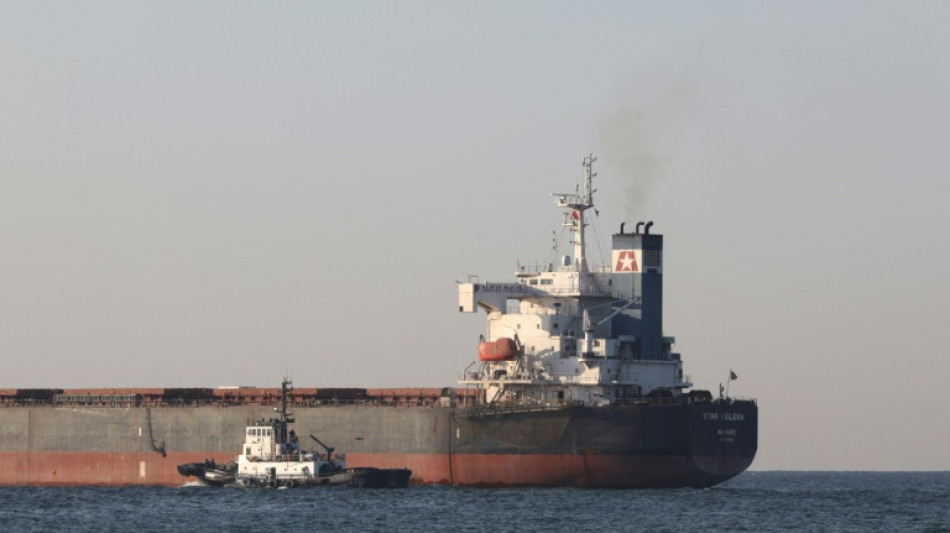
More Ukraine grain sets sail as new shelling hits nuclear plant / Photo: Oleksandr GIMANOV - AFP/File
Four more ships carrying around 170,000 tonnes of grain set off from the Black Sea ports of Odessa and Chornomorsk on Sunday, Ukrainian authorities said, as Moscow accused Kyiv of carrying out a new strike against a Russian-occupied nuclear plant.
"The second convoy of Ukrainian supplies has just left... three from Chornomorsk and one from Odessa," Kyiv's infrastructure ministry wrote on Telegram.
It said that the ships -- which it named as the Mustafa Necati, the Star Helena, the Glory and the Riva Wind -- were carrying "around 170,000 tonnes of agriculture-related merchandise," without specifying further.
Meanwhile, in Russia, Moscow accused Kyiv's forces of again shelling the Zaporizhzhia nuclear plant in the south of Ukraine, which it took control of shortly after invading its pro-Western neighbour.
The Ukrainian army "carried out a strike with a cluster bomb fired from a Ouragan multiple rocket launcher," the occupying authorities in Energodar, the town where the plant is situated, were quoted by the Russian state news agency TASS as saying.
"The shrapnel and the rocket engine fell 400 metres (1,300 feet) from a working reactor", "damaged" administrative buildings and hit "a used nuclear fuel storage area," the authorities said, without providing any evidence to back up the claims.
AFP was not able to confirm the allegations from an independent source.
On Saturday, the plant's operator, Energoatom, had already said that parts of the facility had been "seriously damaged" by military strikes and one of its reactors was forced to shut down.
Both Ukraine and Russia accuse each other of attacking the plant.
Because Zaporizhzhia is Europe's biggest nuclear plant, the prospect of it being seriously damaged in the fighting is setting alarm bells ringing, not least at the UN's nuclear watchdog, the International Atomic Energy Agency.
The strikes underline "the very real risk of a nuclear disaster", the IAEA's director general, Rafael Grossi, said on Saturday.
"Any military firepower directed at or from the facility would amount to playing with fire, with potentially catastrophic consequences," Grossi said.
And the European Union's top diplomat Josep Borrell condemned the attack as "a serious and irresponsible breach of nuclear safety rules and another example of Russia's disregard for international norms".
- 'Sign of hope' -
The renewed shipments of Ukrainian grain to help ease global food shortages and bring down prices nevertheless offer a small glimmer of hope as the war enters its sixth month.
Ukraine, one of the world's largest grain exporters, had been forced to halt almost all deliveries in the wake of Russia's invasion on February 24, sending global food prices soaring and making imports prohibitively expensive for some of the world's poorest nations.
In Rome on Sunday, Pope Francis welcomed the resumption of grain exports as "a sign of hope" that showed dialogue was possible to end the war.
"This step shows that it is possible to dialogue and achieve concrete results, which benefit everyone," the pontiff said in his weekly Angelus prayer.
"Therefore, this event can be seen as a sign of hope, and I sincerely hope that, following this path, we can put an end to the fighting and arrive at a just and lasting peace."
The joint coordination centre in Istanbul that monitors the shipments under a UN-backed deal had said on Saturday that five grain ships would be leaving Ukraine on Sunday. But Kyiv has only announced four.
A bulk carrier had arrived in Chornomorsk on Saturday to be loaded with grain for the first time since Moscow's invasion.
Then on Friday, Kyiv said another three ships loaded with grain had also set sail, heading for Turkey and markets in Ireland and Britain with a further 13 waiting to depart.
K.Javed--DT