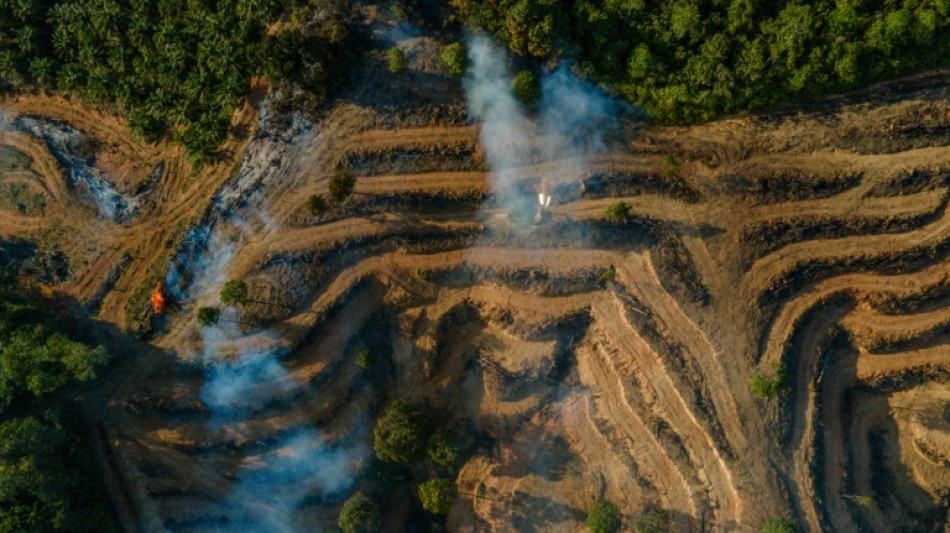
Indonesia firms in palm oil fraud probe supplied fuel majors / Photo: CHAIDEER MAHYUDDIN - AFP/File
Indonesian companies targeted in a palm oil fraud probe supplied European firms including Italian energy giant Eni and Finnish sustainable aviation fuel leader Neste, an investigation by AFP and SourceMaterial has found.
The links raise fresh questions about supply chains in the biofuel sector, experts said, and follow persistent allegations of fraud involving palm oil products used as fuel feedstocks.
There is no suggestion that Eni, Neste or other companies supplied by Indonesian firms implicated in the probe had knowledge of or involvement in fraud.
The Indonesian probe alleges local companies and government officials conspired to pass off palm oil as a waste byproduct called palm oil mill effluent (POME), including by offering bribes.
For the Indonesian government, this is a financial issue -- the higher tax on palm oil means labelling the product as POME allegedly defrauded authorities of millions of dollars in revenue.
For customers, the allegations threaten sustainability pledges. Palm oil has long been associated with deforestation, and both Eni and Neste have officially removed it from their supply chains.
The European Union will ban its use in biofuel from 2030.
Both Eni and Neste received multiple shipments described as POME from Indonesian companies accused of mislabelling palm oil as the waste byproduct.
Experts and campaigners said the alleged fraud illustrated the sector's oversight problems.
"The EU rightly decided to phase out palm oil biofuels in 2019 because of its links to deforestation," said Cian Delaney, biofuels campaigner at environmental NGO Transport and Environment (T&E).
"But disguising palm oil as waste products like POME... has been far too easy for suppliers and traders. Verification and certification of these imports is clearly failing," Delaney said.
- Persistent fraud claims -
Eni said it had no direct contracts with accused companies and received shipments through an accredited supplier who "immediately suspended all operations with the companies involved in the investigation".
The supplier, Enviq, did not respond to requests for comment.
Neste also said it had instructed its supplier to exclude implicated companies from its supply chain after the Indonesian investigation was announced.
It said analysis of periodic samples from shipments between 2023 and 2025 were "consistent with palm-derived waste", not palm oil.
Indonesia has long suspected POME fraud and last year temporarily limited exports after trade data recorded volumes far exceeding estimated available supply.
Then last month, Indonesian authorities arrested 11 people, including customs officials, accused of defrauding the government between 2022 and 2024 by labelling palm oil as POME.
The attorney general's office (AGO) gave only the initials of those arrested and their firms.
AFP and SourceMaterial used trade data, including some supplied by T&E, shareholder agreements, and customs documents obtained through freedom of information requests to ascertain the identities of three of those arrested.
A source in the AGO confirmed the findings.
Among them is "TNY", a shareholder in Green Product International, and director of a company identified only as TEO.
This refers to Tony, who like many Indonesians uses a single name. Tony is director of Tanimas Edible Oils and a shareholder in Green Product International.
Green Product International was the source of multiple shipments of a product labelled as POME to Eni and Neste between 2023 and 2024.
There is no conclusive evidence as to what those shipments contained.
Green Product International did not respond to a request for comment.
AFP and SourceMaterial identified two other companies implicated in the probe, Surya Inti Primakarya, whose director, Van Ricardo, was arrested, and Bumi Mulia Makmur, whose director, Erwin, was arrested.
Both signed off on shipments to Eni between 2022 and 2024.
Calls and messages to both companies seeking comment were not answered.
All three men remain in custody, the AGO said.
- 'Independent scrutiny' -
Eni said the company that handled its shipments was certified by International Sustainability and Carbon Certification (ISCC), an EU-certified verifier of the bloc's palm oil product imports.
An ISCC spokesperson said Surya Inti Primakarya is "currently excluded from recertification" and Bumi Mulia Makmur was "previously excluded".
But Green Product International still holds a valid certificate, the ISCC's online registry shows. The spokesperson did not respond when asked whether that accreditation would be reexamined.
Other companies Green Product International supplied indirectly include Swiss trader Kolmar, which declined to provide an on-record statement, as well as Spanish oil major Repsol and American multinational Cargill, neither of which replied to requests for comment.
Allegations of fraud in the POME sector have circulated for years, given high demand for use as a sustainable fuel feedstock, and the higher taxes sometimes levied on palm oil.
Some analyses have suggested the amount of POME being used in the EU and Britain exceeds available global supply, suggesting widespread mislabelling, though some industry groups have disputed those calcuations.
Ireland has ended incentives for POME's use in biofuels, and Germany will follow suit next year.
James Cogan, head of public policy at ClonBio, an Irish biofuel maker that only sources from the EU, said verification is so problematic that buyers and regulators should be suspicious of any shipment marked as POME.
"I would challenge any POME or POME-based biofuels processor to publish their volumes, sources and paperwork, to allow public and independent scrutiny," he said.
H.Nadeem--DT