Thousands of Chinese boats mass at sea, raising questions / Photo: - - CN-STR/AFP
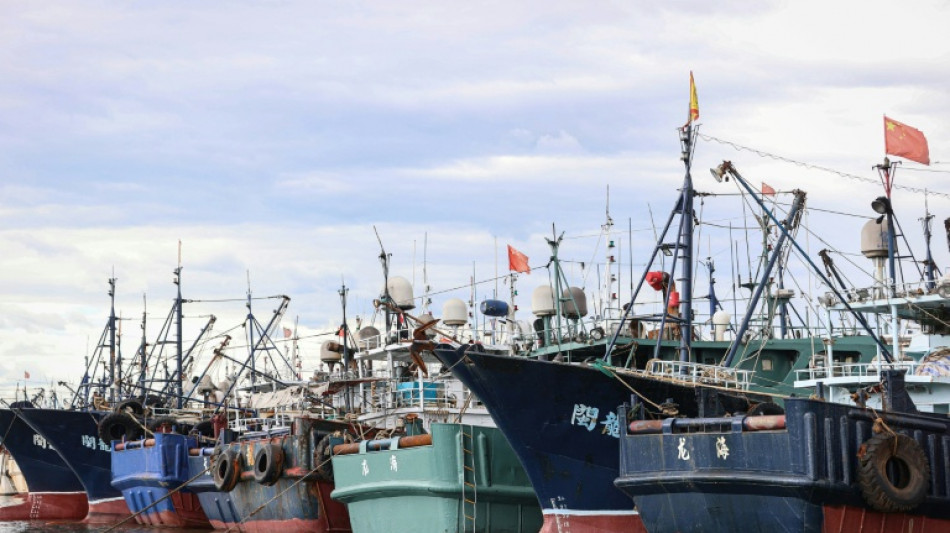
Thousands of Chinese fishing boats have been massing in geometric formations in the East China Sea, in coordinated actions that experts believe are part of Beijing's preparations for a potential regional crisis or conflict.
Monitoring ship-tracking data on Christmas Day, Jason Wang could tell something "unusual" was underway as fishing boats swarmed into two parallel inverted Ls each about 400 kilometres (about 250 miles) long.
Wang could see the roughly 2,000 fishing boats among the many thousands of vessels that ply the busy waterway through their automatic identification systems (AIS) -- a GPS-type signal that commercial ships use to avoid collisions.
The vessels, which were as close as 500 metres (1,640 feet) to each other, held their positions for about 30 hours in near gale-force winds and then suddenly scattered.
"Something didn't look right to me because in nature very rarely do you see straight lines," said Wang, chief operating officer of ingeniSPACE, which analyses satellite imagery and ship signals data.
"We've seen like two, 300, up to a thousand (Chinese fishing boats congregate), but anything exceeding a thousand I thought was unusual."
Maritime and military experts told AFP the massing of Chinese fishing boats on December 25, about 300 kilometres northeast of Taiwan, was on a scale they had never seen before.
Another incident detected in early January involved around 1,000 Chinese fishing vessels clustered in an uneven rectangle, about 400 kilometres long, for more than a day in the same area of the East China Sea.
Hundreds of those vessels were also detected in the December 25 event, Wang told AFP in an interview in Taipei.
Last week, around 1,200 boats massed in two parallel lines further east of the January and December events and held their positions for about 30 hours, Wang said.
China's massive fishing fleet operates in the Yellow Sea, East China Sea and the South China Sea, competing with fishers from Japan, South Korea, Taiwan, Vietnam and the Philippines.
While there is debate about why so many Chinese fishing vessels would gather in geometric formations in the open sea, experts widely agree that they were not there to fish.
Some experts said the only plausible explanation was that China was testing its ability to marshal a large number of fishing vessels that could potentially be deployed in a military operation, such as a blockade or invasion of Taiwan, or a crisis with Japan.
"I've never seen a massing of Chinese fishing boats in these numbers anywhere outside of port ever," Gregory Poling, director of the Asia Maritime Transparency Initiative at the Washington-based Center for Strategic and International Studies (CSIS), said of the December 25 event.
The manoeuvres were a "demonstration with a military lens" to show those watching that the boats had the ability to coordinate their movements, said Jennifer Parker, a former Australian naval warfare officer.
"I've sailed around the entire world and I've not seen fishermen operating in that proximity to each other, in that degree of concentration," said Parker, now an Expert Associate at the National Security College of the Australian National University.
"They're definitely not fishing."
Global Fishing Watch chief scientist David Kroodsma said the Chinese fishing fleet was "highly coordinated" and it was possible that the vessels were ordered not to fish in a certain area.
"Most of the time when you see lines of boats, it's because they're right up against some boundary where they're not allowed to be. In this region that's what you see most of the time," Kroodsma said.
"If you look across the year, you see many, many examples of when there's clearly a line that they're not supposed to fish across at different time periods. We don't know why."
- 'State operation' -
AFP's reporting for this story involved the analysis of AIS data and nighttime satellite imagery, and interviews with experts from ingeniSPACE, Starboard Maritime Intelligence, CSIS and Global Fishing Watch, who also observed the December and January formations.
Unseenlabs, a French company specialising in maritime surveillance, verified the December 25 data for AFP, describing the concentration of vessels as "surprising and unusual".
The experts were confident that the majority of the vessels were real and not spoofed, which is when AIS data is manipulated to give misleading information about a vessel's location or identity.
"We've had enough other corroborating data... to confirm that those vessels were clearly out there," Poling said.
As part of his efforts to verify the data, Mark Douglas, a former New Zealand naval officer and now a maritime domain analyst at Starboard, said he examined fishing patterns in the same area over the previous two years.
"At no time has the behaviour been the same as this," Douglas said. "During other periods of adverse weather the vessels returned to port, rather than massing offshore in these kinds of formations."
"I can't speak to thewhy... butthe how certainly seems to be that there was direction provided to these vessels that this is what they needed to do," Douglas said.
The number of vessels involved indicated a "state operation", said Thomas Shugart, a former US Navy submarine warfare officer and now an Adjunct Senior Fellow with the Defense Program at the Center for a New American Security.
"There's no commercial entity that controls that many fishing boats that I know of," Shugart said.
- 'Maritime militia' -
China's navy ranks number one in the world in terms of the number of warships and submarines on the Global Firepower list.
Beijing is also tapping its huge civilian fleet, including fishing boats, ferries and cargo ships, as part of its preparations for a regional crisis or conflict, including over Taiwan, experts say.
China has threatened to use force, if necessary, to seize Taiwan, which it claims is part of its territory, and US officials have flagged 2027 as a possible timeline for an attack.
In its 2025 report to Congress on China's military power, the US Department of Defense said: The PLA continues to make steady progress toward its 2027 goals" and "China expects to be able to fight and win a war on Taiwan" by the end of that year.
Beijing has stepped up military pressure on Taiwan in recent years, deploying fighter jets and warships around the island on an almost daily basis.
China has also held multiple large-scale exercises around Taiwan that are often described as rehearsals for a blockade and seizure of the territory.
Civilian vessels were "absolutely central" to Chinese military planning for an operation against Taiwan, said Shugart.
China's navy does not have enough landing vessels to deliver the troops and equipment it would need to make an invasion of Taiwan feasible.
"In the absence of that dual-purpose, civil-military maritime mass, I don't think they can invade Taiwan," Shugart said. "With that, (it) turns into a 'maybe they can'."
Many of the fishing boats involved in the December and January massing events were likely part of China's maritime militia, some experts said.
The maritime militia is made up of fishing boats trained to support the military and the fleet has been used to assert China's territorial claims, including in the South China Sea where they have swarmed contested reefs.
AIS data showed the "vast majority" of vessels congregating in the East China Sea appeared to be from the eastern province of Zhejiang, where several maritime militia ports are located, said Poling.
"Like militia on land in China, they get called up from time to time for reserve service," Poling said.
"My guess is that this was an effort to just see if the militia could muster. These are civilians, these are not the professional militia in the South China Sea, they're fishermen," he said.
Maritime militia would have a "range of roles" in a military operation, said Parker, such as harassing warships or acting as decoys for missiles fired by opposing forces, though she noted their presence could also interfere with China's own ability to hit targets.
"It's clear that China's operations planning in the South China Sea and around Taiwan include the maritime militia as a force multiplier," she said.
"It's reasonable to assume that this would also be the case in the event of a military crisis with Japan."
- Threats of retaliation -
The maritime militia's role in the South China Sea has expanded beyond swarming reefs to helping the Chinese coastguard in "blocking and harassing" Philippine fishing boats and even using water cannon against Filipino fishermen, Philippine Coast Guard spokesman Jay Tarriela said.
"They don't have covert roles anymore," Tarriela said.
"They're actually part of the (Chinese) government, a flotilla, advancing their illegal interests in the South China Sea."
Beijing has not publicly commented on the fishing boat formations in the East China Sea.
Japan's coast guard declined to comment when contacted by AFP. Tokyo is involved in a deepening spat with Beijing after Prime Minister Sanae Takaichi suggested that Japan would intervene militarily if China sought to take Taiwan by force.
Responding to China's grey zone activities -- coercive actions that fall short of an act of war -- or military operations in the region is "really hard", a diplomat told AFP on the condition of anonymity.
"China often threatens or implies retaliation -- what is often unclear," the diplomat said.
Experts said the fishing boat manoeuvres were consistent with Chinese President Xi Jinping's overall aim of preparing the military so it could potentially seize Taiwan.
"I can't tell you if Xi Jinping's going to decide to pull the trigger or not," said Shugart.
"But as an analyst, it sure looks like the PLA is, as directed, developing the capabilities required to credibly threaten an invasion in 2027."
burs-amj/hmn/jm
K.Javed--DT