Pilgrimage over, but long journey ahead: Pope ends penitent Canada trip / Photo: Vincenzo PINTO - AFP
Pope Francis ended his trip to Canada Friday as he began -- by apologizing to Indigenous survivors of Catholic-run schools where for decades children were abused, after meeting with Inuit people in the Canadian Arctic.
The six-day "penitential pilgrimage" that took the pontiff from Alberta in western Canada to Quebec and then the far north allowed him to meet many of Canada's First Nations, Metis and Inuit people, who for years had been awaiting his plea for forgiveness.
While many of them welcomed the gesture by the 85-year-old, who spent much of the trip in a wheelchair due to knee pain, they also made clear that this was only a first step on a journey of reconciliation.
The pope wrapped up his journey in the capital of the vast northern territory of Nunavut, Iqaluit, which means "the place of many fish."
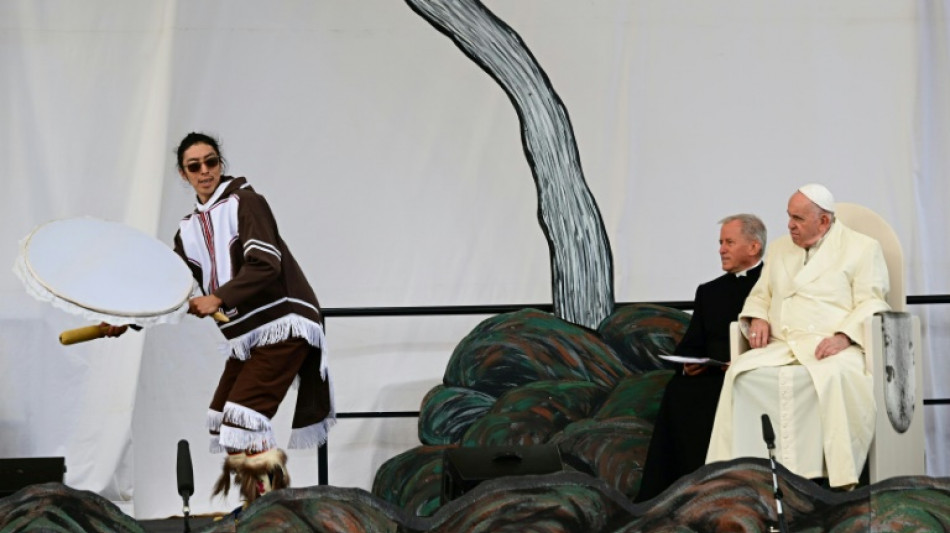
Residents greeted him there with traditional performances including drumming and throat singing, on a stage set up to resemble an Inuit summer home -- evoking whale ribs, sod and stone -- beneath a cool, overcast sky.
Francis met with survivors of the schools, then told a crowd of around 2,000 mainly Indigenous people that their stories "renewed in me the indignation and shame that I have felt for months."
"I want to tell you how very sorry I am and to ask for forgiveness for the evil perpetrated by not a few Catholics who contributed to the policies of cultural assimilation and enfranchisement in those schools," he said.
As he spoke, Inuit people in the crowd could be seen hugging and holding hands. Some wiped away tears. Later, a handful of people shouted "Thank you!" and "We love you!" as the pope was wheeled off the stage.
From the late 1800s to the 1990s, Canada's government sent about 150,000 children into 139 residential schools run by the Catholic Church.
Many were physically and sexually abused at the schools, and thousands are believed to have died of disease, malnutrition or neglect, in what a truth and reconciliation commission later called a "cultural genocide."
Residents in Iqaluit, a community of just over 7,000 people and where small houses line the rocky ocean shore, have listened closely to the pope's words throughout his trip.
"He did apologize, and a lot of people don't seem to be happy with it, but he took that step to come to Nunavut ... and I think that's big," lifelong Iqaluit resident Evie Kunuk, 47, told AFP.
The pope's reception in Canada has been "a little bit lukewarm," admitted Quebec resident Steve Philippe, 52, who had travelled to Iqaluit to see the pope.
"Maybe expectations were too high... but I think it's a step in the right direction," Philippe said.
After the event was over, the leader of the world's 1.3 billion Catholics was taken to the airport where Inuit people performed one last ceremony.
Francis then boarded his flight back to Rome, during which he is expected to hold a press conference.
- 'Brilliant light' -
Throughout the trip, Indigenous people have spoken of a "release of emotion" at hearing the pope's words.
But many have warned it was only the beginning.
Some have called for Francis to rescind the Doctrine of Discovery, the 15th century papal bulls that allowed European powers to colonize any non-Christian lands and people.
Demands were also made for him to allow Indigenous people access to records documenting what happened in the schools, and to return Indigenous artefacts currently held in Vatican museums.
Others have pointed out that while the pope repeatedly apologized for what he said individuals in the Church did, he did not seek forgiveness for the role of the institution itself.
And many have observed that the pope did not specifically mention or apologize for the sexual abuse of First Nations, Metis and Inuit children in the schools.
Inuit leaders had been expected to ask the pope once again to intervene in the case of 93-year-old Joannes Rivoire, a fugitive French priest accused of sexually abusing Inuit children in Nunavut decades ago before fleeing to France.
Earlier this year, Canadian police issued a new arrest warrant for Rivoire, and an Inuit delegation asked Francis at the Vatican to personally intervene to see him extradited.
He did not publicly mention Rivoire or sexual abuse in Iqaluit.
During his Canadian tour, Francis vowed to promote Indigenous rights and made clear the Church was on a "journey" of healing and reconciliation.
"I am returning home greatly enriched," he said in Quebec City earlier Friday.
He said that "it too is strong and resilient, and responds with brilliant light to the darkness that enshrouds it for most of the year."
A.Al-Mehrazi--DT