Young Chinese parents tighten belts as childcare costs rise / Photo: Adek BERRY - AFP
New mother Zhang Xiaofei wanted to be financially secure before having a baby, wary of high childcare costs that have been softened only a little by Chinese government cash incentives to boost record-low births.
The world's second-most populous country is threatened with a demographic crisis after its birth rate halved over the past decade -- all while people rapidly age out of the workforce.
Beijing has made "building a childbirth-friendly society" a priority over the next five years, China's Premier Li Qiang said on Thursday as lawmakers gathered in the Great Hall of the People for their annual political conclave.
The government introduced a raft of financial incentives last year,including free pre-school education and annual subsidies of 3,600 yuan ($500) for each child born.
However, young Chinese say the measures do little to alleviate financial stress.
Zhang, 32, and her husband Zhu Yunfei, both manicurists, decided to save before having a child.
"We discussed it before. The two of us were aligned in wanting to (focus on) work first because our families' (financial) conditions aren't that good," she told AFP while on maternity leave in Hebei province.
"If we were to have a child, we would want to give them the very best life," she said, cradling her three-week-old daughter.
- 'Doesn't mean anything' -
The new childcare subsidies have cost the government more than 100 billion yuan ($14.5 billion), China's national health director told reporters on Saturday.
They were announced shortly after Zhang and Zhu learned they would be parents.
"We thought our kid was too lucky," Zhu, 36, said.
However, the handout -- roughly 1.5 percent of their pooled annual income -- doesn't come close to covering a year's worth of baby formula.
"People joke that it's like giving you a five-yuan voucher towards a Rolls-Royce," he told AFP.
Zhu scours second-hand platforms for deals on diapers, while Zhang plans to return to work after her daughter turns one month old.
In Henan, soon-to-be father Li plans to take up a second job once his daughter is born.
To save money, he and his wife made a five-hour round trip to neighbouring Hubei province, where he said hospitals offer free prenatal genetic screening.
Li, using a pseudonym for fear of repercussions, was reluctant to have children and said he was indifferent to the incentives.
"This bit of cash doesn't mean anything," the 35-year-old told AFP.
- Incompatible with careers -
Social demographer Yun Zhou warned that subsidies "often do not lead to any meaningful rebound in fertility".
The government has also promoted the image of "the ideal Chinese family that is centred around heterosexual marriages" as it tries to boost birth rates, said Zhou, an assistant professor at the University of Michigan.
"For young Chinese women, especially young highly educated Chinese women, there is also this inherent concern about the pervasive gender-based discriminations in the labour market that is front and centre on their mind."
In 2023, the government banned employers from withholding advancement based on marriage, pregnancy, or parental status, as well as the practice of including pregnancy tests as part of pre-employment physical exams.
However, some women still "feel like childbearing and having successful careers and having a life as a whole is fundamentally incompatible", Zhou said.
Lawmakers this week proposed measures such as extra cash for families with three children and lowering the legal marriage age from 22 for men and 20 for women to encourage earlier childbearing.
Chinese social media users slammed such proposals as "nonsense".
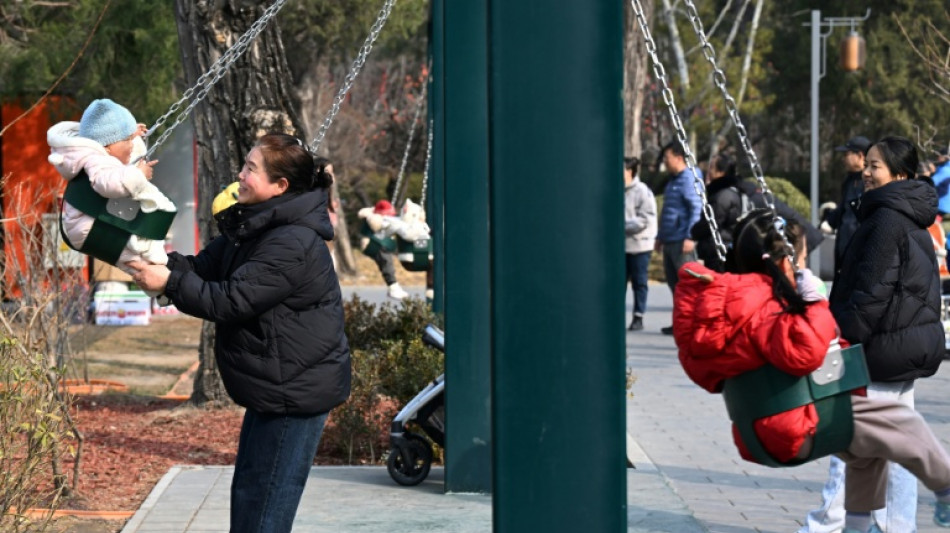
Being a parent in China is "very difficult", Yuan Limei, a 30-year-old mother of two, told AFP.
"There are all kinds of expenses. Everything requires money," she said, pushing her six-year-old on a swing in Beijing.
"And with kids, there's no way for you to work."
Yuan's oldest child is 10 but she does not plan on having a third.
"A kid is much harder to raise than a dog or cat," she laughed.
New father Zhu noted that, while subsidies have little impact in big cities like Beijing, they can make a dent in smaller villages.
"In the city, 3,600 yuan is hardly anything and can't even buy a baby pram, but in some rural areas it's not a small sum," he said.
T.Prasad--DT