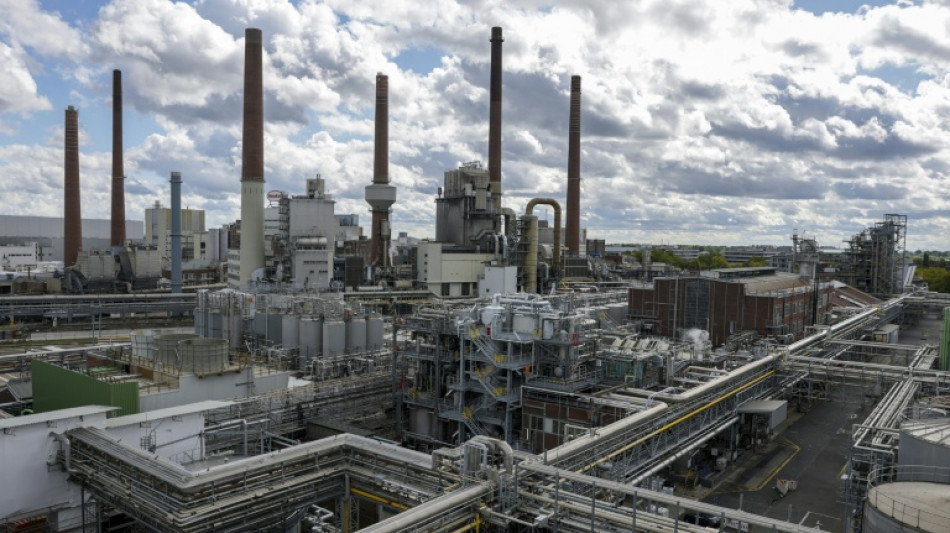
German economy returns to growth, but headwinds fierce / Photo: Christopher Neundorf - POOL/AFP
Germany's economy eked out meagre growth in 2025 and dodged a third straight year of recession, data showed Thursday, but Europe's languishing industrial powerhouse still faces huge challenges to return to long-term health.
Battered by an energy shock triggered by the Ukraine war, a manufacturing slump and weakening demand in the key Chinese market, the world's third-biggest economy shrank in both 2023 and 2024.
Despite the shock of last year's US tariffs blitz, the German economy returned to growth with a modest expansion of 0.2 percent, helped by higher government and household spending, according to statistics agency Destastis.
But another year of falling exports weighed on Europe's top economy, the agency's chief Ruth Brand said.
"Germany's export business faced strong headwinds owing to higher US tariffs, the appreciation of the euro and increased competition from China," she said.
The preliminary GDP reading was in line with a government forecast. For the final quarter of 2025, the agency estimated that the economy grew 0.2 percent from the third quarter.
- Merz under pressure -
A return to growth could offer some relief to Chancellor Friedrich Merz, who took power last May vowing to revive the economy but has faced mounting criticism that efforts are moving too slowly.
In a speech Wednesday, Merz conceded that "the situation of the German economy at the beginning of 2026 is very critical in many areas".
"Our economy is not competitive enough... Productivity in Germany has been at a consistently low level for ten years. We need to change that," he said.
Merz is betting on a public spending spree on defence and infrastructure to get the economy moving again, with the government's latest projection in October forecasting growth this year will reach 1.3 percent.
But after an initial burst of optimism last year, doubts have set in about whether his governing coalition can get to grips with the problems.
The German central bank and several institutes have recently lowered growth forecasts and cautioned the government risks wasting much of the extra money that it borrows and is neglecting much-needed reforms.
"A number of measures are still needed to help the economy out of its structural crisis in the long term and make Germany an attractive business location again," Timo Wollmershaeuser, the Ifo institute's head of forecasts, told AFP.
- 'Deepest crisis' since WWII -
Last month the Federation of German Industries issued a stark warning that the export-driven economy was suffering its "deepest crisis" since the aftermath of World War II, and that the government was failing to respond "decisively".
Appeals for help have increasingly come from the country's traditional big industries, from automakers to factory equipment manufacturers and chemical giants, and 2025 was marked by a steady drumbeat of industrial job losses.
Output in the manufacturing sector declined for the third straight year in 2025, dropping 1.3 percent from 2024, though the fall was less pronounced than in the previous two years, Destatis said.
The key auto and mechanical engineering industries were hit especially hard as they "faced stronger competition on global sales markets", it said.
Adding to the headwinds were US President Donald Trump's tariffs, an especially heavy blow for Germany as the United States is the country's top export market.
China, long a major market for German exporters, also proved a challenging environment as demand has been weakening due to a prolonged slowdown, while many Chinese firms have emerged as rivals to German heavyweights.
Destastis noted it was a "turbulent year" for Germany's foreign trade, with exports falling 0.3 percent, the third straight year of contraction.
Merz has sought to defend his government's record, pointing to relief measures such as a reduction in industrial energy costs, and said Wednesday that new firms were creating jobs lost in traditional industries.
"We are seeing a large number of young companies being founded," he said.
Y.El-Kaaby--DT