Dubai Telegraph - Bank of Japan expected to hike rates to 30-year high

EUR -
AED 4.339975
AFN 76.814055
ALL 96.797455
AMD 444.535927
ANG 2.115423
AOA 1083.663344
ARS 1692.015434
AUD 1.685082
AWG 2.130101
AZN 2.013663
BAM 1.954639
BBD 2.37329
BDT 144.104396
BGN 1.984592
BHD 0.444336
BIF 3491.925652
BMD 1.181748
BND 1.500509
BOB 8.142163
BRL 6.165657
BSD 1.1783
BTN 106.731597
BWP 15.599733
BYN 3.385189
BYR 23162.260663
BZD 2.369792
CAD 1.617282
CDF 2599.846012
CHF 0.916635
CLF 0.025765
CLP 1017.355497
CNY 8.200091
CNH 8.189295
COP 4354.327742
CRC 584.152989
CUC 1.181748
CUP 31.316322
CVE 110.877553
CZK 24.230684
DJF 209.825355
DKK 7.471252
DOP 74.365824
DZD 153.099053
EGP 55.224195
ERN 17.72622
ETB 183.179684
FJD 2.611077
FKP 0.872136
GBP 0.867943
GEL 3.184858
GGP 0.872136
GHS 12.949308
GIP 0.872136
GMD 86.268024
GNF 10342.855918
GTQ 9.037631
GYD 246.523555
HKD 9.234002
HNL 31.26319
HRK 7.534948
HTG 154.358305
HUF 377.809361
IDR 19918.953296
ILS 3.676034
IMP 0.872136
INR 107.038538
IQD 1548.680745
IRR 49781.134392
ISK 145.012752
JEP 0.872136
JMD 184.420447
JOD 0.837906
JPY 185.77138
KES 151.999706
KGS 103.344316
KHR 4765.99007
KMF 495.152823
KPW 1063.575845
KRW 1729.84719
KWD 0.363045
KYD 0.981917
KZT 582.993678
LAK 25320.958308
LBP 105522.815101
LKR 364.543446
LRD 221.518409
LSL 19.009707
LTL 3.489395
LVL 0.714828
LYD 7.461568
MAD 10.854401
MDL 20.090066
MGA 5230.892634
MKD 61.603405
MMK 2481.679614
MNT 4231.489931
MOP 9.482267
MRU 47.093105
MUR 54.43176
MVR 18.258453
MWK 2052.696671
MXN 20.401229
MYR 4.664955
MZN 75.33688
NAD 19.009707
NGN 1615.426317
NIO 43.36424
NOK 11.451852
NPR 170.770555
NZD 1.964016
OMR 0.453131
PAB 1.1783
PEN 3.979541
PGK 5.052998
PHP 69.145302
PKR 329.485672
PLN 4.218238
PYG 7785.375166
QAR 4.303159
RON 5.093811
RSD 117.646603
RUB 90.749791
RWF 1719.778381
SAR 4.431245
SBD 9.522701
SCR 16.161135
SDG 710.825762
SEK 10.663153
SGD 1.504252
SHP 0.886617
SLE 28.894177
SLL 24780.663673
SOS 672.200685
SRD 44.691391
STD 24459.797516
STN 24.485455
SVC 10.309876
SYP 13069.630436
SZL 19.00571
THB 37.266468
TJS 11.040741
TMT 4.142027
TND 3.365032
TOP 2.845365
TRY 51.538989
TTD 7.97926
TWD 37.331853
TZS 3045.890616
UAH 50.612034
UGX 4192.509477
USD 1.181748
UYU 45.542946
UZS 14469.404578
VES 446.683163
VND 30666.360419
VUV 141.795603
WST 3.221816
XAF 655.567566
XAG 0.015204
XAU 0.000238
XCD 3.193733
XCG 2.123638
XDR 0.815316
XOF 655.567566
XPF 119.331742
YER 281.732962
ZAR 18.960639
ZMK 10637.154271
ZMW 21.945963
ZWL 380.522372
  • SCS

    0.0200

    16.14

    +0.12%

  • RBGPF

    0.1000

    82.5

    +0.12%

  • CMSD

    0.0600

    23.95

    +0.25%

  • NGG

    1.1700

    88.06

    +1.33%

  • JRI

    0.0900

    12.97

    +0.69%

  • BCC

    1.8700

    91.03

    +2.05%

  • GSK

    1.0600

    60.23

    +1.76%

  • BCE

    -0.4900

    25.08

    -1.95%

  • CMSC

    -0.0400

    23.51

    -0.17%

  • RIO

    2.2900

    93.41

    +2.45%

  • RELX

    -0.7100

    29.38

    -2.42%

  • BTI

    0.8400

    62.8

    +1.34%

  • VOD

    0.4900

    15.11

    +3.24%

  • RYCEF

    0.2600

    16.88

    +1.54%

  • AZN

    5.8700

    193.03

    +3.04%

  • BP

    0.8400

    39.01

    +2.15%

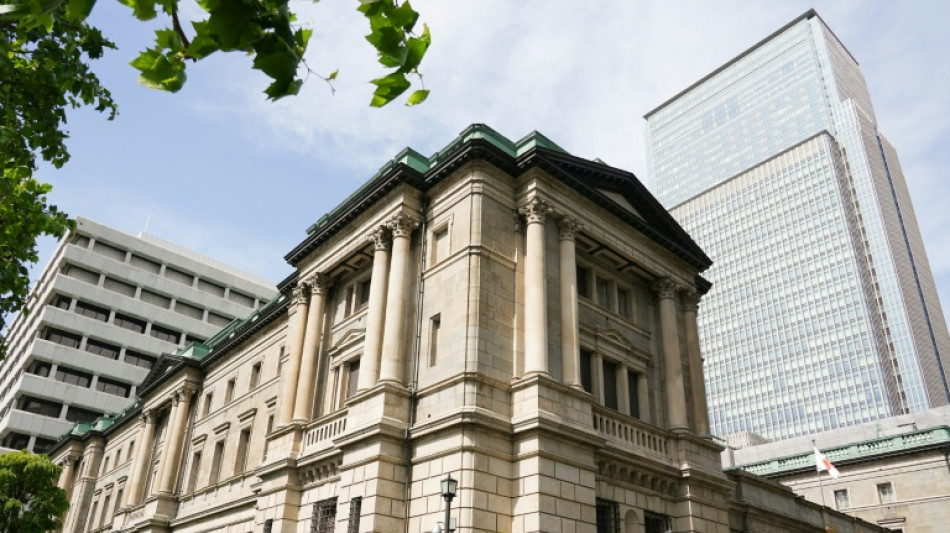
Bank of Japan expected to hike rates to 30-year high
Bank of Japan expected to hike rates to 30-year high / Photo: Kazuhiro NOGI - AFP/File

Bank of Japan expected to hike rates to 30-year high

The Bank of Japan is expected to hike interest rates Friday for the first time since January, pushing them to their highest level in 30 years and potentially exacerbating turmoil in debt markets.

Text size:

Yields on Japanese government bonds have risen in recent weeks on worries about Prime Minister Sanae Takaichi's budget discipline, while the yen has weakened.

Higher BoJ interest rates make Japanese bonds more attractive than other assets, pushing down their prices but sending yields -- which move inversely -- higher.

Japan's economy contracted 0.6 percent in the third quarter, but BoJ governor Kazuo Ueda said last weekthat the impact of US tariffs was less than feared.

"So far, US corporates have swallowed the burden of tariffs without fully passing (them) through to consumer prices," Ueda told the Financial Times.

At the same time, inflation has been above the BoJ's target of two percent for some time, with core consumer prices rising 3.0 percent in October.

"The urgency stems from policymakers' recognition that the window for hiking will close once external headwinds intensify," said BMI (Fitch Solutions) in a note.

- Record-high yields -

The majority of economists polled by Bloombergexpect the BoJ to raise its main rate from 0.5 percent to 0.75 percent, which would be the highest since 1995.

The BoJ only began raising rates from below zero in March 2024. The US Federal Reserve is now going in the other direction and cutting rates.

The BoJ's move should help keep inflation in check, which would be welcome news to Takaichi, Japan's first woman prime minister.

She hopes to avoid the fate of her predecessor Shigeru Ishiba, who suffered a string of election debacles in part because of anger over rising prices.

The lower house last week approved an extra budget worth 18.3 trillion yen ($118 billion) to finance a major stimulus package to help households.

But more than 60 percent of the planned spending will come from government borrowing, rekindling market anxiety about Japan's fiscal health.

The country already has the biggest ratio of debt to gross domestic product (GDP) among major economies, with the International Monetary Fund projecting it to hit 232.7 percent this year.

Yields on 30-year bond yields reached a record high in early December, and 10-year yields last week hittheir highest level in 19 years.

As well as pushing up bond yields, worries about Takaichi's "responsible proactive fiscal policy" have added to pressure on the yen, which in turn fuels inflation since Japan is so reliant on imports.

"These factors will offset the effects of the economic stimulus measures and undermine the medium- to long-term stability of the economy and financial markets," said Takahide Kiuchi at the Nomura Research Institute.

"This is the contradiction and weakness of the Takaichi administration's proactive fiscal policy," he said.

G.Koya--DT