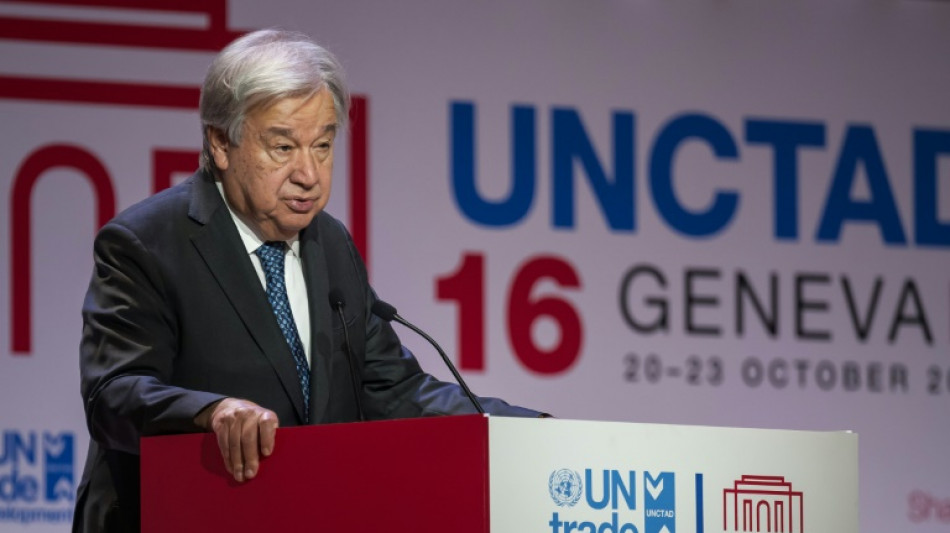
Global trade system risks coming off the rails: UN chief / Photo: Fabrice COFFRINI - AFP
The rules-based international trade system is in danger, UN chief Antonio Guterres warned Wednesday, amid spiralling debt, heavy tariffs and financial insecurity for emerging nations.
Guterres said too many countries were trapped in a debt crisis, spending more money on servicing creditors than funding health and education.
"Global debt has soared. Poverty and hunger are still with us. The international financial architecture is not providing an adequate safety net for developing countries. And the rules-based trading system is at risk of derailment," Guterres said at the 16th UN Conference on Trade and Development (UNCTAD) in Geneva.
Guterres said trade and development were facing a "whirlwind of change", with three-quarters of global growth now coming from the developing world, services trade surging and new technologies boosting the global economy.
However, he said geopolitical divisions, inequalities, conflicts and the climate crisis were limiting progress.
- 'In turmoil' -
Furthermore, US President Donald Trump's administration has imposed wide-ranging tariffs on other nations, triggering trade tensions around the globe.
Guterres acknowledged that "protectionism might be, in some situations, inevitable" but "at least it should be rational".
He warned that developing countries "continue to be short-changed", with uncertainty rising, investment retreating and supply chains "in turmoil".
"Trade barriers are rising, with some least-developed countries facing extortionate tariffs of 40 percent, despite representing barely one percent of global trade flows," he said.
"We see a rising risk of trade wars for goods" while "military expenditure trends show that we are increasingly investing more in death than in people's prosperity and well-being".
Guterres outlined four priorities for international action: a "fair global trade and investment system", financing for developing countries, technology and innovation to stimulate the economy, and aligning trade policies with climate objectives.
- Crushed by debt -
Guterres announced the creation of a Sevilla Forum on Debt, aimed at tackling an entrenched crisis in developing countries.
Calling for lower borrowing costs and risks, and quicker support for countries facing debt distress, he said some states were being "crushed" by debt.
Global public debt reached $102 trillion last year, with developing countries owing $31 trillion and paying $921 billion in interest, UNCTAD said.
The Sevilla Forum is aimed at unlocking financing for developing countries, strengthening the ability to mobilise domestic funding, leveraging more private finance and tripling the lending power of multilateral development banks.
Its first meeting should be held next year.
UNCTAD says 3.4 billion people are living in countries that spend more on debt servicing than on health or education.
"It's a slow erosion of development, one budget cut at a time," said the agency's chief Rebeca Grynspan.
"True stability means countries can plan beyond the next payment, invest in their future and build, not just survive. What we have now is perpetual crisis management dressed up as normality," she said.
The Sevilla Forum, she said, would build a framework where "debt serves development instead of consuming it".
Y.I.Hashem--DT