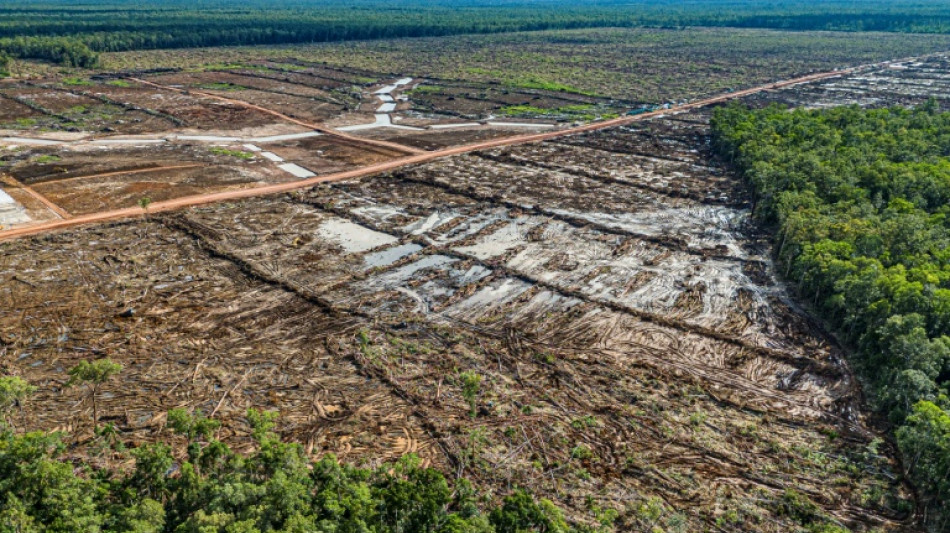
Indonesia growth push sparks fight on deforestation, rights / Photo: Yusuf WAHIL - MIGHTY EARTH/AFP/File
An "eco-city", a mining complex, and a massive project to grow food and fuel are all part of an Indonesian growth drive that activists allege is causing deforestation and dispossession.
The projects have been sped by a deregulation campaign that began in 2020 with an "omnibus law" that reformed dozens of regulations at once to boost investment and create jobs in Southeast Asia's largest economy.
But the law had to be revised just three years later after parts were ruled unconstitutional.
Now it faces fresh legal jeopardy, with two challeges before the constitutional court brought by environmentalists and rights activists who say the drive does little to help ordinary people.
It is "being used as a pretext to legitimate big industrial projects", said Salsabila Khairunisa, a researcher at NGO Pantau Gambut, which is among the plaintiffs.
"They do not consider the well-being of the people."
At issue are the 2023 "job creation law" that replaced the omnibus law, and its enshrinement of the controversial "national strategic project" (PSN) designation.
Previously only conferred by presidential decree, PSNs are seen as a way to fast-track major infrastructure and speed investment.
But they also replace a previously required environmental assessment with a simple "commitment letter", and limit input to those "directly impacted", excluding NGOs or outside experts.
"In practice, affected communities do not always have the knowledge, courage, or access to raise objections," noted researchers at Indonesia's State University of Semarang in an analysis.
Critics say PSNs are being used for projects with minimal domestic benefit, including industrial zones managed by foreign companies, and allow developers to ride roughshod over environmental and rights protections.
- 'Making them miserable' -
Among their most prominent examples is a campaign in South Papua province's Merauke that some environmentalists dub the world's "largest deforestation project".
The programme's true scale is unknown, but at a minimum it aims to plant several million hectares of rice and sugar cane for food and biofuel.
"The Merauke PSN project has destroyed natural forests, hamlets, and areas managed by Indigenous communities," said Roni Saputra, director of law enforcement at NGO Auriga Nusantara, another plaintiff.
It has "clearly displaced the territory of Indigenous communities, without any meaningful consent", he told AFP.
The military has been heavily involved, a measure made possible by the PSN designation, causing tension in the restive region.
Indonesia officially seized Papua, a former Dutch colony, in a widely criticised but UN-backed vote in 1969.
It has since been accused of abuses in a decades-long separatist conflict in the region.
In one village, "more than 2,000 soliders were deployed, more than the number of locals", said Frederikus Stanislaus Awi of the Papua Merauke Legal Aid Institute.
"We don't hate development... but let us make efforts for development that appreciates Indigenous communities."
Elsewhere, several thousand residents of Rempang in Riau Islands province face eviction for an "eco-village" where Chinese investors will manufacture glass and solar panels.
Miswadi, an Indonesian fisherman and farmer who uses one name, faces displacement from his village Sembulang and is a plaintiff in one case.
He said compensation plots were far smaller than the land villagers are losing, and residents have been intimidated by authorities.
"The government said investment is to make people prosperous," he told AFP.
"It's not bringing prosperity to people, but making them miserable."
- 'A blunt tool' -
Indonesia's Coordinating Ministry for Economic Affairs, which oversees PSNs, did not respond to a request for comment on the court cases.
But the government's own National Commission on Human Rights has cited reports of intimidation, violence, unfair compensation and environmental damage linked to PSNs.
Indonesia's need for economic growth is clear, said Siwage Dharma Negara, an economist and senior fellow at the ISEAS-Yusof Ishak Institute, but there is more than one path to get there.
"PSNs have been used as a blunt tool to support whatever infrastructure project," focused on speed and scale rather than impact, he told AFP.
"We need to start changing that mindset... we have to think about long-term implications," he added.
"Not just the positive economic impact, but also the negative impact to the environment, to the community, ecosystem. That often is neglected."
F.Damodaran--DT