Indian garment exporters reel under US tariffs
/ Photo: R. Satish BABU - AFP
When Donald Trump was elected, Indian garment exporter R.K. Sivasubramaniam thought the new US president would boost business and invested heavily in anticipation of a boom.
But less than a year later, everything is "upside down", he admits with a pained smile.
Trump's 50 percent tariffs on Indian goods, imposed in August, have upset the country's $11 billion textile export industry and shaken confidence in the US market.
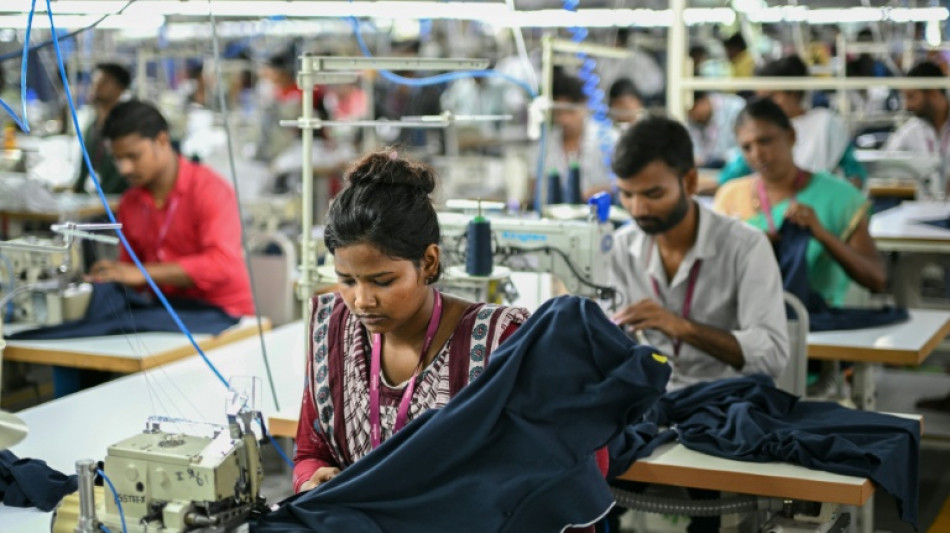
Sivasubramaniam's Raft Garments factory in southern India, normally frenetic with humming sewing machines, is quieter and work hours have been cut, hitting employees' paypackets.
If his US buyers turn to other suppliers, half his business could vanish.
Meanwhile, half a million garments sit in towering stacks, ready for shipment but stalled over who will pay the new duties.
Buyers are asking for a 16-20 percent discount.
"We cannot give that much," said Sivasubramaniam, whose desk carries crossed US and Indian flags. "It's a very huge loss for us."
If Raft doesn't shoulder part of the duties, it won't be paid for garments already produced -- leaving it unable to cover costs.
"If it continues for another month... we cannot give work to our employees," he warned.
Trump's anger at India's purchases of Russian oil -- which Washington says help finance Moscow's war in Ukraine -- has left New Delhi facing some of the world's steepest tariffs.
A trade deal that could ease that hinges partly on progress in peace talks.
But the fallout is being felt in Tiruppur, in the southern state of Tamil Nadu.
- 'Worst possible situation' -
Dubbed India's "knitwear capital", and "Dollar City" for its export earnings, the small industrial town produced $5 billion in garments last fiscal year, two-fifths going to the United States.
Its lanes are dotted with thousands of units including dyeing, embroidery and sewing workshops.
Manufacturers paint a grim picture.
"US orders have largely stopped, around 80 percent of the US business has reduced," said Ramesh Jebaraj of Trinity Tex.
In the same season last year, he produced 100,000 garments.
Now he has barely a fifth of that -- forcing him to seek buyers in Israel and the United Arab Emirates.
"This is the situation across Tiruppur," he told AFP. "Some of the bigger factories are on the verge of closing some of their units."
Alexander John of NC John Garments, which supplies Walt Disney, called the tariff standoff "the worst possible situation any business can be in".
With his US orders "completely at a standstill", he has cut shifts and laid off workers.
To stay afloat, he is looking to Europe and Britain but said "none of these markets can replace the US".
Tamil Nadu Chief Minister M.K. Stalin has warned that up to three million jobs could be at risk across the state's textile belt, a grim prospect for a country struggling to provide well-paid work for its youth.
Local industry associations say they have so far avoided widespread layoffs by agreeing to steep discounts on US shipments.
"In the short term, we're giving discounts to the customer ranging from 20 to 25 percent," said N. Thirukkumaran, general secretary of the Tiruppur Exporters Association.
But he admits it is not a long-term solution, and has pleaded for government support.
- 'We are helpless' -
Exporters describe the move as a calculated gamble, by selling at a loss to maintain US buyer relationships while awaiting a trade deal.
At RRK Cotton's facility in Palladam, 17 kilometres (10 miles) from Tiruppur, dimly lit production halls are quieter than normal.
Owner R. Rajkumar, a former tailor who built his business over three decades, has closed two factories and furloughed some staff.
"This is a situation nobody could have anticipated," he said, adding that he was running three factories fulfilling European orders, and shipping some US orders after giving a discount.
He fears the next ordering cycle could be disrupted if US buyers shift to rivals such as Vietnam or Bangladesh.
All that depends on a trade deal.
Meanwhile, anger and confusion run deep among workers and business owners.
"My tailor... He doesn't know what is a trade war, or why India is buying oil from Russia, and why it is affecting our lives, our bread," said Kumar Duraiswamy, CEO of Eastern Global Clothing.
"The problem is we are helpless," he added.
N. Karthick Raja, 38, employed at a small embroidery unit now running reduced shifts, fears for his livelihood.
"If this job goes away, I don't know what I will do next," he said. "America has abandoned us, more or less."
F.Damodaran--DT