No bread, no fuel, no dollars: how Bolivia went from boom to bust / Photo: AIZAR RALDES - AFP
A bread roll has become a symbol of a severe economic crisis in Boliva that looks set to decide the outcome of the most significant elections in nearly two decades.
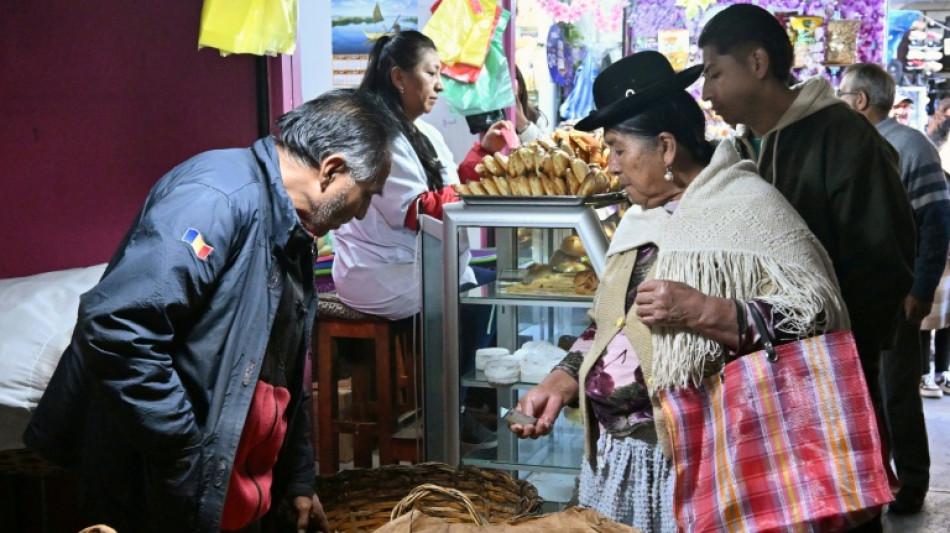
The marraqueta, which is subsidized by the state, is the baguette of Bolivia.
But even the humble "battle bread," as it is nicknamed, is hard to come by these days in La Paz as the government runs out of the dollars it needs to import essentials such as fuel and wheat.
Ligia Maldonado, 70, tried over a dozen street stalls for what she calls the "bread of the poor" but went home empty-handed.
"This government offers no hope," she said disconsolately.
On Sunday, Bolivians go the polls in the first round of presidential and parliamentary elections which could see a country that steadfastly voted left for a generation swing to the right.
- 'Anyone else is better' -
Opinion polls show voters poised to punish the ruling MAS party, which has been in power for 19 years, for socialist policies that, like in Venezuela, lifted millions out of poverty in the 2000s but are now blamed for leading the country to ruin.
Carlos Tavera, a 70-year-old socialist activist, says the best-placed opposition candidate would get his vote, even if it meant backing a right-wing candidate.
"Anyone else would be better than this," he said.
As in parts of Venezuela, life for many in Bolivia has become a daily slog to find affordable subsidized goods.
The lines at gas stations in La Paz at times extend for nearly up to a kilometer (0.6 miles).
"This morning I came at 6:00 am, and at 11:00 am. I'm just getting in to fill up," Manuel Osinaga, a taxi driver, told AFP at a gas station in La Paz.
Wheat, used to make flour for bread, is also becoming scarce, as is cooking oil and rice and medication.
Wilson Paz, a 39-year-old self-employed man, said he was forced to buy expensive unsubsidized bread to feed his family of seven.
"We can't wait for these elections to arrive in order to change this (economic) model, which has impoverished us so much," he added, without revealing how he would vote.
In the heyday of former leftist president Evo Morales, in the 2010s, things were very different.
Bolivia, which has Latin America's second-biggest natural gas deposits, was being talked up as one of the region's hottest economies, powered by a commodities boom.
But years of falling gas output, caused by underinvestment in energy exploration, have caused the country to go from boom to bust.
Gas exports only brought in $1.6 billion last year, down from a peak of $6.1 billion in 2013.
- Street protests -
The dollar has doubled in value against the local boliviano in less than a year, which is in turn fuelling annual inflation of 24.8 percent, the highest level since at least 2008.
The shortages of basics have sent Bolivians repeatedly into the streets over the past year, in protest over outgoing President Luis Arce's handling of the crisis.
Napoleon Pacheco, an economics professor at the state-run Universidad Mayor de San Andres, said the economic meltdown had erased gains in living standards made under MAS.
"The little that had been gained in previous years has been lost because the economy has contracted," he told AFP.
The official poverty rate is listed at 36-37 percent, but if rising inflation were accounted for, 44 percent of Bolivians would be considered poor, according to the Jubileo Foundation, a Bolivian think-tank.
- 'Blood, toil and tears' -
The government has sought to stabilize the economy by printing money -- a policy that the two election frontrunners, center-right multimillionaire Samuel Doria Medina and hard-right former president Jorge Quiroga have vowed to end.
Doria Medina and Quiroga have also pledged to close loss-making public companies, and both they and leading left-wing candidate Andronico Rodriguez have vowed to cut fuel subsidies, among other austerity measures.
On a walkabout in La Paz last week Quiroga told AFP that Bolivians could expect "radical change (to) regain 20 lost years" if he were elected.
"I believe a period is coming, to quote Churchill, of blood, toil, and tears. We must buckle up," said Pacheco.
H.Pradhan--DT