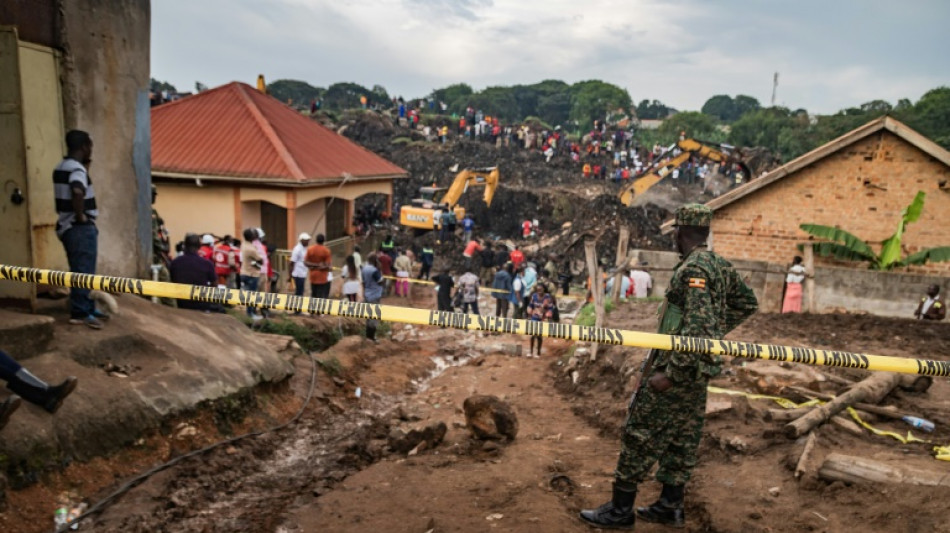
A year on, Ugandans still suffering from deadly garbage collapse / Photo: BADRU KATUMBA - AFP/File
When the giant landfill collapsed in Uganda's capital Kampala a year ago, Zamhall Nansamba thought she was hearing an aeroplane taking off.
Then came screams and a giant wave of garbage rushing towards her, ripping up trees as it went.
Nansamba, 31, grabbed her children and ran. She was luckier than most -- the avalanche of waste killed some 35 people before stopping at her doorstep.
Many survivors of the collapse at the Kiteezi dump on August 9, 2024, have yet to be compensated for their losses, leaving them trapped at the dangerous garbage site.
"We are living a miserable life," Nansamba told AFP.
Kiteezi is the largest landfill in Kampala, serving the city's residents since 1996, receiving 2,500 tonnes of waste daily.
City authorities recommended closing it when it reached capacity in 2015, but garbage kept coming.
The disaster highlighted the challenge of managing waste in many rapidly urbanising African cities.
A 2017 landfill collapse in Ethiopia killed 116 people. A year later, 17 died after heavy rain caused a landslide at a dump in Mozambique.
It doesn't help that wealthier countries send vast amounts of waste to Africa, particularly second-hand clothes, computers and cars.
In 2019, the United States exported some 900 million items of second-hand clothing to Kenya alone, more than half designated as waste, according to Changing Markets Foundation, an advocacy group.
The Kiteezi collapse "could have been avoided", said Ivan Bamweyana, a scholar of geomatics at Kampala's Makerere University.
For a decade, he said, the landfill grew vertically until it reached a height of some 30 metres (98 feet).
Early on the fateful morning, rain seeped into the landfill's cracks, causing a fatal cascade.
"What is coming can still be avoided," Bamweyana said, of the continued risks at the site.
- Another crash? -
The landfill continues to emit methane gas, which caused fires in February and June.
While no longer in official use, locals sneak up its slopes to eke out a living collecting plastic bottles to sell.
"I would not be shocked if there was a secondary crash," Bamweyana said.
Official figures of the number of homes destroyed vary, but it is certain that dozens disappeared in the initial incident, with more totalled during the hunt for bodies.
A Red Cross spokesperson said many of the 233 people displaced have still not received compensation.
Shadia Nanyongo's home was buried and she now shares a single room with six other family members.
The 29-year-old told AFP she had still not been compensated. The family eats one meal a day and at night squeezes together on two mattresses on the floor.
"I pray to God to come with money, because this situation is not easy," Nanyongo said.
Her friend, fellow survivor Nansamba, still lives on the edge of the landfill.
The stench of garbage fills her house and the area is infested with vermin. She said her children get bacterial infections at least three times a month.
Nansamba would like to move but cannot afford to unless the government, which promised compensation, pays out for other houses she owned and rented out and lost in the disaster. Her own house was not destroyed.
Memories of the collapse keep her up at night. "You hear dogs barking... you think ghosts have come," she said.
- 'Hurriedly and illegally' -
Kampala Capital City Authority (KCCA) told AFP that compensation would be paid out in September and a new landfill site had been chosen in Mpigi district, around 30 kilometres (19 miles) from the city centre.
KCCA says everything has been done legally, but the National Forestry Authority (NFA) told AFP that the new garbage site infringes on a protected forest and wetlands reserve and that city authorities began dumping at the site in late 2024 without their knowledge.
"They did it hurriedly (and) illegally," said NFA spokesperson Aldon Walukamba.
The city is home to some 1.7 million, according to last year's census, and continues to grow -- meaning such trade-offs between trash and the environment will likely continue.
For Bamweyana, the scholar, what is needed is education about waste and recycling.
"We cannot keep solving the problem using the same mechanism that created it," he said.
K.Al-Zaabi--DT