Sharaa's pullout from Syria Druze heartland exposes shaky leadership / Photo: Stephanie Lecocq - POOL/AFP
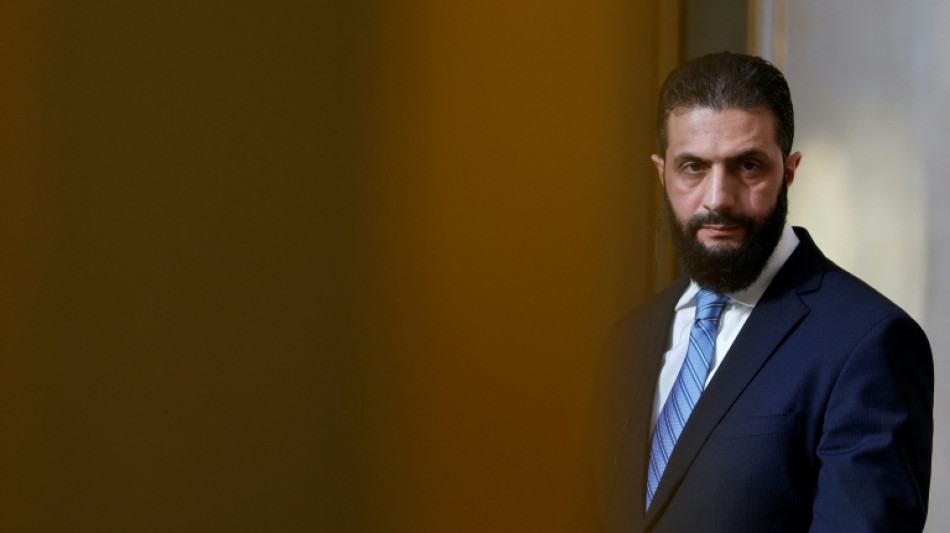
Under Israeli bombardment and diplomatic pressure, Ahmed al-Sharaa pulled troops from Syria's Druze heartland -- a move that exposes the interim leader's weakness just as he sought to assert control.
Since seizing office in December after ousting longtime autocrat Bashar al-Assad, Sharaa has worked to recast himself from jihadist to statesman, even earning praise from US President Donald Trump as a "tough guy".
But in the early hours of Thursday, he was forced to announce the withdrawal of troops from the Druze-majority city of Sweida, framing it as an effort to avoid confrontation with Israel and prevent further destabilisation in a country still reeling from 14 years of war.
AFP looks at what drove Syria's interim president to this withdrawal -- and whether his leadership is now fatally undermined.
- 'Imbalance of power' -
In his Thursday speech, Sharaa praised the "effective intervention of American, Arab and Turkish mediation, which saved the region from an unknown fate".
That followed Israeli air strikes targeting the Syrian military headquarters and the vicinity of the presidential palace in Damascus.
It also came amid diplomatic pressure from the United States.
Gamal Mansur, a comparative politics researcher specialising in Syrian and Israeli studies at the University of Toronto, said he believed "the withdrawal was imposed on the authorities due to the imbalance of power caused by Israel's presence".
Syria "was forced to retreat because its position in Sweida was not that strong and it was unable to retain the land in Sweida without a high price that would force a second Israeli intervention", he said.
Sharaa admitted on Thursday that his options to avoid "open war" with Israel were limited.
Israeli Prime Minister Benjamin Netanyahu said the ceasefire in Syria was "obtained by force" and "not by demands, not by pleas".
A senior Western diplomat, who requested anonymity due to the sensitivity of the topic, told AFP that Sharaa "is very aware of the situation that he is in and he is realistic".
"He knows Syria is at a weak point and that the best option is to reach a deal with the Israelis."
Heiko Wimmen, project director for Iraq, Syria and Lebanon at International Crisis Group, said Sharaa's pullback showed he was "making a further step towards accepting that Israel basically projects power onto the doorstep of Damascus".
Since leading the overthrow of Assad, Sharaa has repeatedly said his country does not seek conflicts with its neighbours.
Damascus has acknowledged holding indirect talks to reduce tensions with Israel, which has occupied Syria's Golan Heights since 1967.
The Israeli army deployed troops into the UN-patrolled zone on the Golan after the fall of Assad and launched hundreds of bombing raids.
Mansur believes the Sweida events "will place Israel in a better position and with stronger negotiating terms".
The Western diplomat said that while full normalisation was unlikely, Israel could still reach a favourable security agreement with Syria.
- Internal pressure -
Sharaa and his government have been pushing for unified control of the country from Damascus, with the various armed factions, often tied to ethnic or religious identities, merged into the state's armed forces.
That goal was undermined by the events in Sweida, which remains outside Damascus's direct control, and major sectarian clashes like the coastal massacres in March, during which more than 1,700 mostly Alawite civilians were killed.
Sharaa's ability to control armed factions loyal to him, which include extremist groups and foreign jihadists, was heavily questioned following those incidents.
Washington had previously demanded that "foreign terrorists" leave Syria.
These developments reveal "the weakness of Sharaa's authority", Mansur said, adding the Syrian leader needed to consolidate his authority and secure control over the state's security apparatus.
Additionally, the Kurds in northeastern Syria are still demanding a decentralised system despite repeated rejections by Damascus.
Bedran Ciya Kurd, a senior official in the autonomous administration, said on Thursday that Damascus should "review" its attitude towards minorities.
Syria's Kurds may be in a stronger position after the Sweida clashes, according to Wimmen, who said there was now a "big question mark" over the idea of full integration with Damascus.
The Kurds now have "many reasons to be very careful about any form of integration", he said.
V.Munir--DT