Dubai Telegraph - UK startup looks to cut shipping's carbon emissions

EUR -
AED 4.333813
AFN 76.694218
ALL 96.458833
AMD 446.314032
ANG 2.112139
AOA 1081.980314
ARS 1707.917161
AUD 1.690045
AWG 2.126794
AZN 2.003739
BAM 1.952934
BBD 2.375244
BDT 144.108487
BGN 1.981511
BHD 0.44482
BIF 3480.691272
BMD 1.179913
BND 1.500298
BOB 8.149074
BRL 6.203154
BSD 1.179284
BTN 106.725812
BWP 15.530272
BYN 3.367657
BYR 23126.298749
BZD 2.371789
CAD 1.613112
CDF 2595.809277
CHF 0.916244
CLF 0.025684
CLP 1014.158893
CNY 8.186472
CNH 8.190893
COP 4281.598231
CRC 584.622111
CUC 1.179913
CUP 31.2677
CVE 110.098739
CZK 24.379723
DJF 209.694622
DKK 7.466733
DOP 73.981728
DZD 153.072875
EGP 55.339571
ERN 17.698698
ETB 182.70601
FJD 2.604184
FKP 0.861238
GBP 0.864664
GEL 3.179902
GGP 0.861238
GHS 12.949049
GIP 0.861238
GMD 86.133714
GNF 10349.371313
GTQ 9.045417
GYD 246.728913
HKD 9.217913
HNL 31.157401
HRK 7.535282
HTG 154.573782
HUF 379.74445
IDR 19816.465232
ILS 3.651601
IMP 0.861238
INR 106.723562
IQD 1544.938988
IRR 49703.843799
ISK 144.787077
JEP 0.861238
JMD 184.928574
JOD 0.836519
JPY 184.848147
KES 152.149521
KGS 103.183534
KHR 4760.033709
KMF 493.203477
KPW 1061.857147
KRW 1722.826151
KWD 0.362599
KYD 0.982762
KZT 585.848344
LAK 25366.875674
LBP 105607.344052
LKR 364.991916
LRD 219.348055
LSL 18.846999
LTL 3.483977
LVL 0.713718
LYD 7.452746
MAD 10.811166
MDL 19.953798
MGA 5224.354177
MKD 61.638824
MMK 2477.742356
MNT 4212.109227
MOP 9.490211
MRU 46.827682
MUR 54.134825
MVR 18.229397
MWK 2044.543931
MXN 20.445413
MYR 4.63944
MZN 75.219714
NAD 18.847716
NGN 1614.781643
NIO 43.396673
NOK 11.422923
NPR 170.792046
NZD 1.968927
OMR 0.453673
PAB 1.179274
PEN 3.964381
PGK 5.052413
PHP 69.585426
PKR 329.840899
PLN 4.218177
PYG 7805.279322
QAR 4.301341
RON 5.094507
RSD 117.37538
RUB 89.968813
RWF 1721.181058
SAR 4.424956
SBD 9.50786
SCR 16.181867
SDG 709.719337
SEK 10.611821
SGD 1.502053
SHP 0.88524
SLE 28.878401
SLL 24742.189014
SOS 672.815337
SRD 44.711638
STD 24421.821036
STN 24.464404
SVC 10.318418
SYP 13049.338421
SZL 18.846418
THB 37.452217
TJS 11.020671
TMT 4.141495
TND 3.410778
TOP 2.840948
TRY 51.355719
TTD 7.988478
TWD 37.335402
TZS 3044.518392
UAH 50.873625
UGX 4198.837225
USD 1.179913
UYU 45.451363
UZS 14456.291932
VES 438.503609
VND 30656.504801
VUV 141.066633
WST 3.216644
XAF 654.998412
XAG 0.013812
XAU 0.00024
XCD 3.188774
XCG 2.12539
XDR 0.813527
XOF 655.01227
XPF 119.331742
YER 281.26177
ZAR 18.991527
ZMK 10620.635681
ZMW 23.085215
ZWL 379.931569
  • SCS

    0.0200

    16.14

    +0.12%

  • RBGPF

    0.1000

    82.5

    +0.12%

  • CMSC

    -0.1400

    23.52

    -0.6%

  • JRI

    0.0300

    13.15

    +0.23%

  • BCC

    5.3000

    90.23

    +5.87%

  • BCE

    0.2400

    26.34

    +0.91%

  • RYCEF

    -0.3200

    16.68

    -1.92%

  • NGG

    1.5600

    87.79

    +1.78%

  • CMSD

    -0.0700

    23.87

    -0.29%

  • RIO

    0.1100

    96.48

    +0.11%

  • VOD

    0.4600

    15.71

    +2.93%

  • RELX

    -0.7300

    29.78

    -2.45%

  • GSK

    3.8900

    57.23

    +6.8%

  • BP

    0.3800

    39.2

    +0.97%

  • BTI

    -0.2400

    61.63

    -0.39%

  • AZN

    3.1300

    187.45

    +1.67%

UK startup looks to cut shipping's carbon emissions
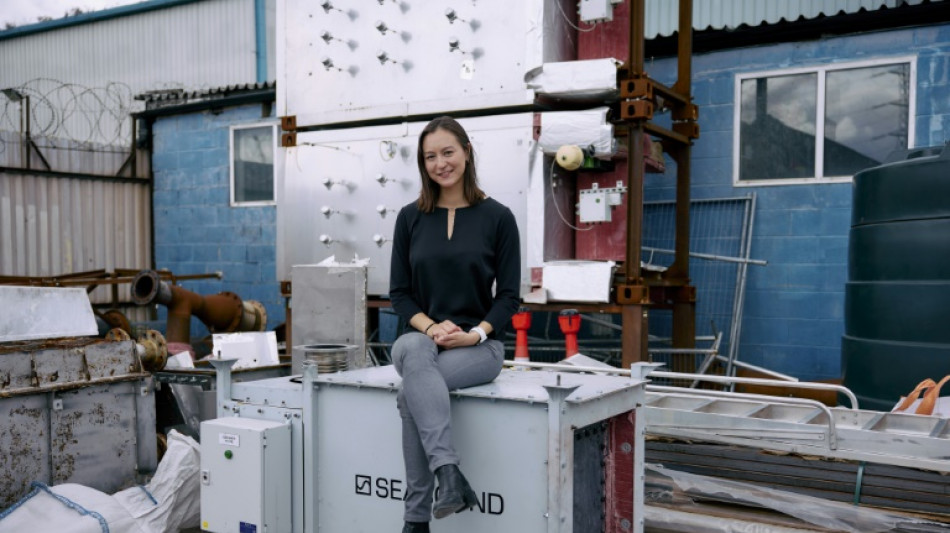
UK startup looks to cut shipping's carbon emissions / Photo: BENJAMIN CREMEL - AFP

UK startup looks to cut shipping's carbon emissions

In a small London workshop, a prototype mimics the process of capturing carbon emissions from a cargo ship's engine.

Text size:

For two celebrated young designers, it is the beginning of a journey aimed at helping the maritime sector decarbonise.

"We're simulating what happens on a ship," Alisha Fredriksson told AFP of the technology she developed alongside her friend Roujia Wen.

The women, both aged in their early thirties, met at university and have since founded the company Seabound.

Its work on "ocean-ready carbon capture" has seen the friends shortlisted for this year's Young Inventor Prize, which rewards technology contributing to sustainable development goals put forward by the United Nations.

Winning the award on Wednesday "would be an extra boost to the team... a validation that the world cares about the shipping industry and its decarbonisation journey", said Fredriksson.

Shipping accounts for three percent of global emissions, while the International Maritime Organization (IMO) recently voted in favour of a pricing system to help tackle excess carbon.

At Seabound's miniature courtyard factory, Fredriksson showed off the prototype, which is fitted with a generator.

"We're burning fuel, and that creates CO2," she explained, as exhaust gas was routed through a complex system of pipes into various containers.

The carbon pollution was captured by lime pebbles, while the other elements were released into the atmosphere.

The white-coloured lime acts "like a sponge", said chemical engineer Glexer Corrales, wearing a navy laboratory coat as he tested the quality of the granular-like substance that "is readily available" and "cheap".

Once absorbed, the carbon was transformed into limestone through a chemical process.

Seabound claims that minimal customisation is necessary for its system to work across many types of vessel.

- Shipping transformation -

Technology for carbon capture, utilisation and storage (CCUS) has so far been used primarily on land by heavy industry, for example in the production of cement, glass and steel.

Potential safety risks of using CCUS at sea have yet to be set out by the IMO.

And for the process to be truly beneficial, the amount of carbon captured "must be greater than the carbon produced" through the energy use incurred in installing the system, including on land, IMO official Camille Bourgeon told AFP.

This objective was largely achieved during an initial test in 2023, when Seabound's system captured 78 percent of CO2 emitted aboard a ship run by Lomar Labs.

From 2028, all ships will be required to use a less carbon-intensive fuel, the IMO recently ruled, while a penalty of $380 will be imposed for each tonne of CO2 emitted beyond allowances permitted by the UN shipping body.

The IMO move has created "a big tailwind for our system", said Fredriksson, whose company aims to charge $150 for each tonne of captured CO2, before selling it on to companies requiring it for the production of certain types of fuel.

Seabound plans also to recycle the limestone.

W.Darwish--DT