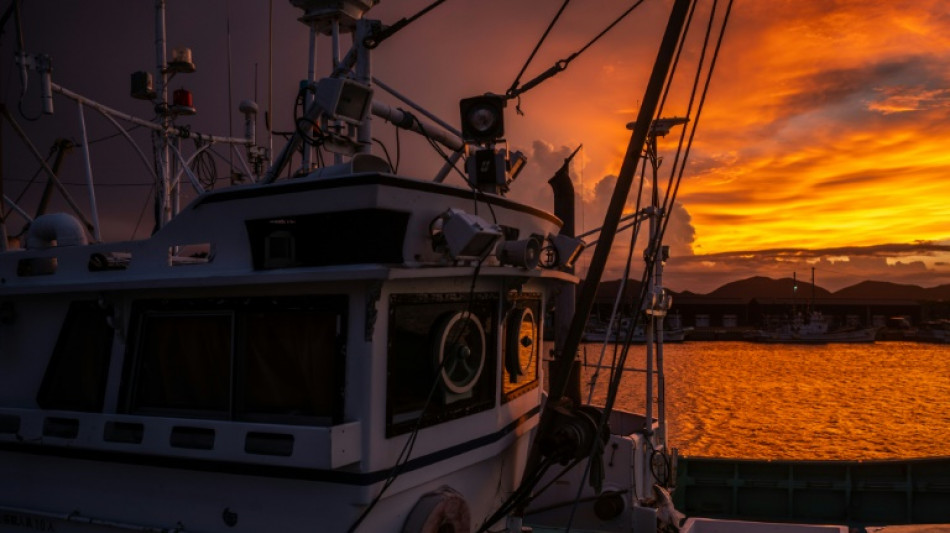
Startups show off ocean-preserving tech at Paris trade fair / Photo: Philip FONG - AFP/File
Harnessing ocean currents to boost fuel efficiency of vessels, or tracking whales using sensor data and AI -- startups at Paris trade fair Vivatech have been showing off the latest innovations aimed at protecting the environment.
Recently developed AI programs capable of learning from vast datasets have boosted projects trying to understand and predict real-world phenomena, several company founders told AFP.
"We have to use AI because in the natural world there are too many variables" to deal with manually, said Emily Charry Tissier, a biologist and founder of Canadian startup Whale Seeker, which is developing technology to track sea mammals.
Powered by "neural network" systems that ape the functioning of the human brain, the learning systems behind today's AI models "can calculate a weather forecast 1,000 times faster than a standard digital model running on a supercomputer", agreed oceanographer Alexandre Stegner.
He flagged an AI model developed by his firm, Amphitrite, that he said could predict ocean currents by crunching "several layers of satellite data corresponding to different physical variables".
It can forecast currents up to 10 days in advance, he said, offering sea captains "a simple way to save fuel" by slightly changing course and using currents to gain a speed boost of up to four knots.
That could save operators money on fuel, reduce the carbon emissions from shipping, and avoid the classic solution of telling sea captains to reduce their speed.
- Global protection push -
Technologies like these were being shown off in the halls of Vivatech as the UN Ocean Conference (UNOC) drew to a close hundreds of kilometres to the south in French Mediterranean city Nice.
The conference has pushed a treaty to protect 60 percent of the world's oceans closer to becoming law, with 55 signatures -- just five shy of the number required for its enactment.
New technologies could be "a very good thing" for the oceans, said Andre Abreu, International Affairs Director at the Paris-based Tara Ocean Foundation.
But he warned that innovation should not be harnessed to allow more fish to be caught.
"That would mean shooting ourselves in the foot" on goals like preserving marine biodiversity, he said.
That ambiguity can be seen in technology from OceanEyes, a Japanese startup using AI analysis of satellite data to predict sea conditions.
The company hopes to cut the time fishing boats spend tracking down a catch.
"A big problem in Japan is the efficiency of the fishery operations. Many fishers spend a lot of time searching for fish in the water," said boss Yusuke Tanaka.
With less fuel burnt, operators will save money and greenhouse emissions can be slashed.
Anticipating concerns about overfishing, OceanEyes said it also aimed to help vessels comply with recently updated Japanese regulations that oblige fishers to "ensure sustainable use of marine resources".
- 'Can' vs 'should' -
Whale Seeker's Tissier said technology could be used in a considered way to find sustainable solutions.
"I'd like the market to recognise its own limits -- not the limits of what we can do, but what we should do," she told AFP.
That attitude pushed her to refuse to work with a company that wanted to use whale detection to identify nearby fish to catch.
But startups cannot grow without funding and, in the context of oceans, investments are likely to come from big firms keen to make a saving -- from fishing and ship management companies to haulage and logistics giants.
This could well limit their ability to stand on principle.
Stegner called for "regulations that would push the maritime sector to reduce carbon emissions".
But Charry Tissier said the initiative could come from business.
"Technology is developing so much faster than regulation... what I'd like is for big companies to decide for themselves to be responsible," she said.
T.Prasad--DT