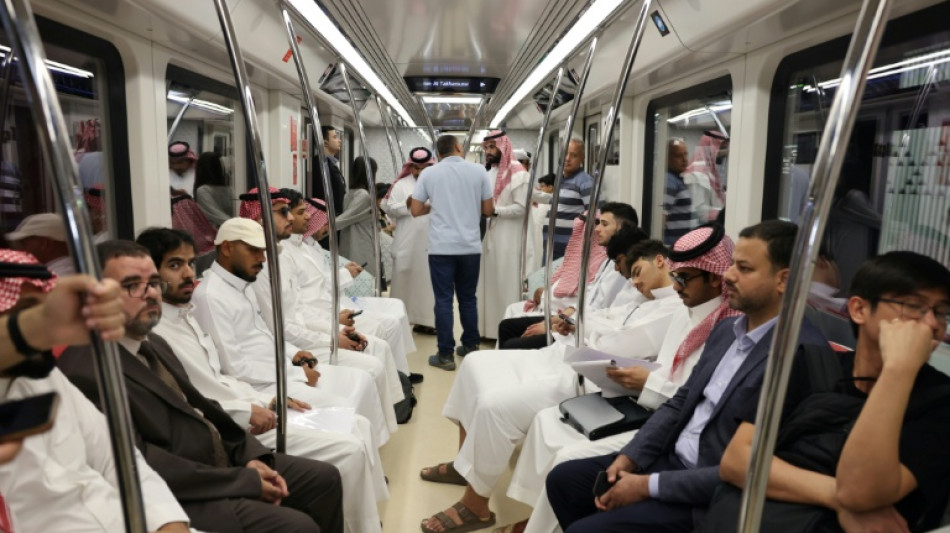
New metro cuts through Saudi social divisions / Photo: Fayez Nureldine - AFP
For decades, civil servant Zayed al-Ghamdi's social circles in Saudi Arabia were more than predictable, bound by routine and kinship in a country where societal divisions have rarely been challenged. Then came the metro.
A decade after breaking ground, Riyadh's gleaming new metro opened in December, offering the capital's eight million residents an alternative to roads chronically clogged by its two million cars.
A quicker commute is not the only difference: for the first time, the wealthy are sharing journeys with the less well off, and Saudi nationals are mixing with the large expat population, from white-collar workers to labourers.
"For 40 years, I was confined to my car or restaurants with my father and brothers, then with my wife and children," Ghamdi, a 42-year-old civil servant working in downtown Riyadh, told AFP.
"I didn't mix or talk to anyone except those I knew or who resembled me.
"Now, things have changed. You feel that society, with all its classes, is in one place," he added while speeding along the blue line, which connects working-class areas in the south with the downtown business district and affluent northern neighbourhoods.
With its eye-watering oil riches, intricate tribal networks and large numbers of foreign workers, Saudi society has long been divided by rigid class structures.
But on the metro, those divisions are more porous.
Metro carriages are frequently crowded with labourers, university students, government employees and business executives wearing expensive suits.
"I can now discuss general topics with strangers and even get to know new things and cultures up close," said 56-year-old engineer Nasser Al-Qahtani, pointing to a young Saudi holding a skateboard.
- 'Family and friends only' -
While the metro has done little to clear Riyadh's perennially gridlocked streets, its opening has been "a major social and psychological event", said sociologist Mohammed Al-Hamza.
"The metro has shifted the mindset of Saudi society. It has made people come closer together," he said.
"The culture in Saudi Arabia is one of family and friends only, and there is reluctance to get to know new people."
Along with chipping away at class divisions, the system is saving commuters time and money, to the delight of many.
"I used to get to work in over an hour and a half, exhausted and stressed due to traffic," said Ghamdi, adding that he had hardly used his prized SUV for months.
"Now, I arrive relaxed and without stress," he added.
Prices range from just four riyals ($1) for a limited one-day pass to 140 riyals for a month.
As in other countries in the Middle East and beyond, the metro offers family carriages reserved for women, children and couples.
They afford women a safe and socially acceptable way to use the network to travel to work or study.
For those willing to pay an extra 10 riyals per day, first-class compartments also offer a reprieve from the busy single-male carriages.
For law student Hadeel Waleed, 20, the metro has been a game-changer, cutting her trip from the southern suburbs to Princess Nourah University from three to four hours to one hour or less.
"Now I arrive home with energy for my family and studying," she told AFP.
- 'No one expected this usage' -
The project is one of many major infrastructure initiatives under "Vision 2030" -- the reform programme overseen by the kingdom's de facto ruler, Crown Prince Mohammed bin Salman.
With six lines spanning about 176 kilometres (109 miles) of track, the network serves 85 stations, including stops at all terminals of Riyadh international airport.
There had been fears among city officials that the huge project could prove a white elephant, with few Saudis deigning to use it.
A bus network developed by the city struggled to gain traction as Saudis remained committed to their cars, especially during the hot summer months when temperatures hit 50 degrees Celsius (122 degrees Fahrenheit).
"Honestly, for 10 years, the question was: 'Who will use the metro?'" a senior official who helps operate the system told AFP on condition of anonymity.
"No one ever expected the current level of usage or even the financial returns," he added.
The Royal Commission for Riyadh did not respond to AFP's enquiries about daily ridership but the official suggested the figure was likely in the tens of thousands if not more.
Authorities are already hoping to expand the network, with a seventh line under development linking Riyadh to several new projects on the capital's outskirts.
For Muneer, a 28-year-old government employee, the metro is a welcome addition to a city undergoing rapid change.
"It makes life easier," he said.
X.Wong--DT