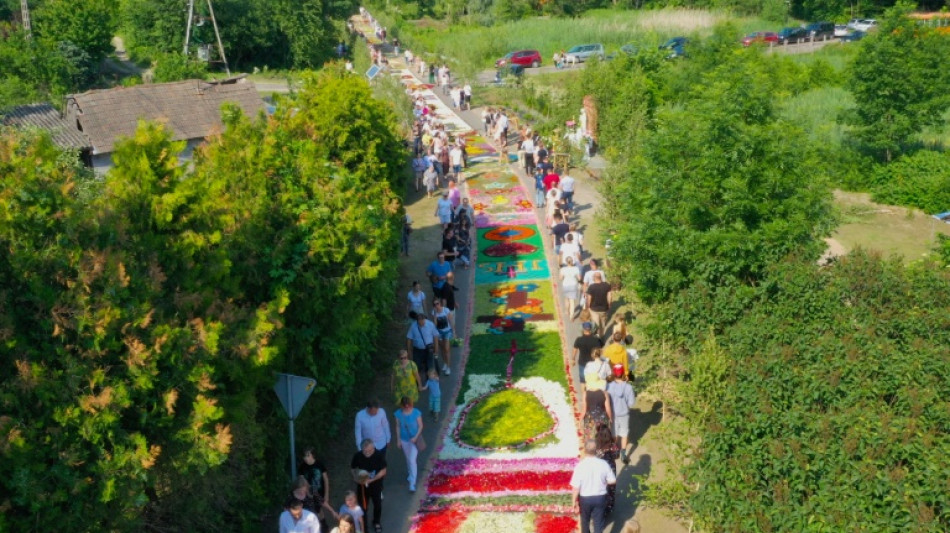
Poles carpet streets with flowers for Corpus Christi / Photo: JANEK SKARZYNSKI - AFP
Katarzyna Kaczmarek carefully arranges petals on the pavement in front of her house -- part of a long colourful flower carpet snaking its way through her village of Spycimierz in central Poland.
Making the carpet, which measures more than two kilometres (over a mile), for the Corpus Christi holiday is "an old tradition going back 200 years," she told AFP.
"It's passed down from generation to generation," added the 38-year-old farmer and mother-of-two.
Every year, thousands of people descend upon the village to admire the floral handiwork. In December, UNESCO added the tradition to its list of the Intangible Cultural Heritage of Humanity.
"The preparation lasts several hours, and the end result is an ephemeral and collective art piece meant to express religiosity, creativity and an appreciation of the beauty of nature," UNESCO said on its website.
Ever since Corpus Christi was introduced to Poland in 1320, the faithful have marked the occasion by walking the streets of their towns and villages to visit altars.
"For years now, the observance of the holiday has been accompanied by flowers -- petals tossed by girls before the priest," the culture ministry said in a statement this week.
In Spycimierz, residents arrange their floral design along the route of the Corpus Christi procession, meaning that everyone then walks right on top of the flower carpet.
The annual event harks back to a medieval tradition that saw royal gardens donate flowers to the Church to make its cathedrals extra snazzy for the holiday.
- Like colouring books -
To form her segment of the carpet, Kaczmarek first uses chalk to sketch out her design on the sidewalk, before covering the outline with dirt.
She then fills the empty space with sand and tosses handfuls of petals onto it -- an exercise not unlike filling in a page of a colouring book.
"Everyone can choose their own design," she said, rattling off the various motifs including "hearts, crosses, geometric shapes, flowers, and some even make churches".
"Back in the day it was different, there were no designs. My grandmother says the flowers were all in a jumble and they just scattered them across the sidewalk," she added.
Residents gather the carpet supplies -- flowers, leaves, tree bark, grass -- from fields and gardens in the days leading up to the holiday.
"According to tradition, each resident lays down their piece of carpet along the length of their property," said Grzegorz Gorka, 49, who lives just outside the village.
"But you can have a property that's 10 metres (33 feet) or another that's 150 metres. So we make do, we help each other out," the security officer told AFP.
It takes Gorka's whole family of around 20 people a couple of hours to lay down his distant cousin's section of the flower carpet.
- Polish, Ukrainian flags -
This year, one resident used petals to spell out the words "in solidarity" along with the Polish and Ukrainian flags in a show of support for the war-torn country.
While the imagery may change, the tradition itself is a given.
"According to the village elders, there was just one time that there was no flower carpet for the procession," Gorka said.
Now with the UNESCO listing, the town's residents have an extra reason to keep the tradition going.
"We're even more motivated now," said Dariusz Ziemniak, a priest at the local parish.
"There's a greater responsibility but also more engagement" on the part of the residents, he added.
Kaczmarek is happy to take part even if their creations don't last.
"We do it for the glory of God, so no regrets," she said.
Z.W.Varughese--DT