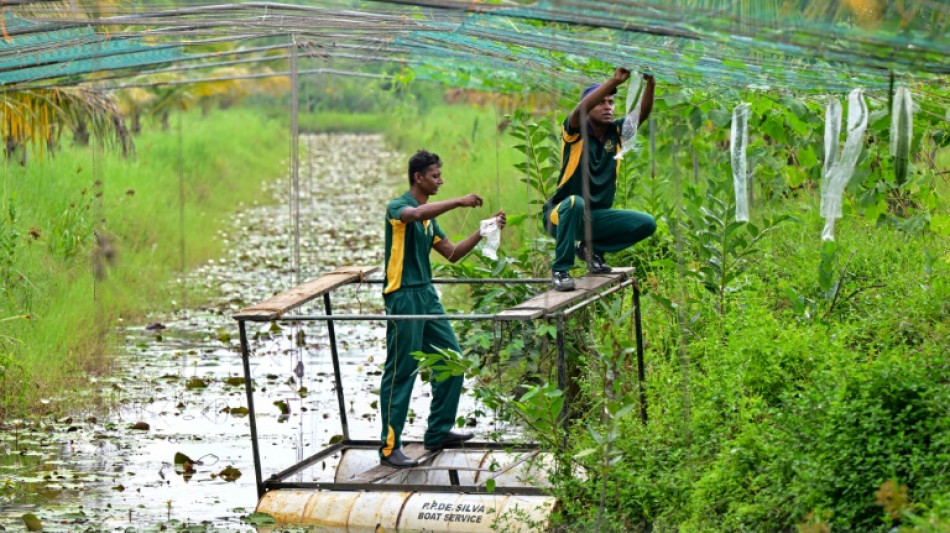
Salt of the earth: Pilot project helping reclaim Sri Lankan farms / Photo: Ishara S. KODIKARA - AFP
A commando in an elite Sri Lankan police unit, Sameera Dilshan has an unusual mission -- to reclaim farms poisoned by salt, a long-standing problem now accelerating due to climate change.
Increasing salinity is slowly and steadily swallowing traditional rice paddies along the island's coastline, taking away the livelihood of generations of farmers.
Two hours' drive south of the capital Colombo lies Katukurunda –- one of the camps of the formidable Special Task Force (STF), an elite force created four decades ago to fight Tamil rebels.
While his colleagues train for riot control under the humid heat of the nearby Indian Ocean, the 35-year-old non-commissioned officer and his "commando-farmer" team are hoeing, weeding, and watering.
Their goal? To grow coconut palms and a wide variety of fruits and vegetables in a paddy declared dead 40 years ago due to salt water contamination.
"This plantation was launched in 2022 as part of a government initiative to improve food security," Dilshan said, with local authorities allocating out land parcels.
The method -- known as "sorjan", is similar to techniques used in Thailand and Indonesia.
It reshapes flood-prone land by digging ponds where rice can be grown or fish raised, with more saline-tolerant coconut trees planted.
Embankments around these ponds are used for more delicate crops.
"We're tending to 360 coconut trees planted here... along with pumpkins, gourds, and cucumbers," said Dilshan. "In two and a half years, we'll know if it's a success or not."
- Yields under threat -
"It's an efficient and climate-resilient production system that optimises land use and productivity, and increases farmers' profits," said Buddhi Marambe, from the University of Peradeniya.
The UN Food and Agriculture Organization (FAO) said in a 2024 report that saltwater from seas and oceans affects 10.7 percent of the earth's land, making it uncultivable in some cases.
It travels up rivers with the tides, seeps into soil through evaporation, and contaminates groundwater used for irrigation.
Climate change -– which dries out the soil, reduces water resources, or raises sea levels –- is expected to increase the proportion of such "salty" land from 24 percent to 32 percent of the world's surface area by the end of the century, the FAO warns.
These trends "threaten agricultural productivity and reduce crop yields in affected zones", it warns.
Sri Lanka is no exception.
Marambe estimates that 223,000 hectares (551,000 acres), half of which are rice paddies, are impacted by salinity -- nearly eight percent of the country's total arable land.
- Seeping salt -
South of the pilot plantation lies the village of Parappuwa, surrounded by abandoned land.
Here, just a few kilometres from the sea, only a tiny portion of the paddy fields is still in use.
"Everything is polluted by salt that comes up during high tide," said Gamini Piyal Wijesinghe, 46, a farmer's son who, after he left the army, went into the restaurant business instead.
He pointed to a small stream, where 18 small dams were built to stop the seawater.
"They weren't constructed properly," he said. "The water seeps through."
Other former rice farmers have turned to cinnamon or rubber cultivation.
"Cinnamon is doing fairly well, but our income has significantly dropped since we stopped growing rice," said W.D. Jayaratne, 50, head of the local farmers' association.
The future is gloomy.
"Salinity in the water is increasing and threatening our farmland," he added. "There are also insects. Everywhere you look, there are problems."
In this district of Kalutara, local authorities are offering abandoned land to farmers to bring it back under cultivation, mostly with coconut trees.
"We've already allocated 400 hectares and plan to increase that to 1,000 in the next two years," said the district chief Janaka Gunawardana.
"There's high demand for coconut. It will create income for our people."
- Resistant varieties -
In Katukurunda, Aruna Priyankara Perera, 55, was encouraged by the success of the STF farming experiment.
"I got five acres (two hectares) next to my hotel to replicate the STF's project," he said standing in front of his freshly planted coconut and pumpkin field.
"The land is free for two years, provided you can show it's being cultivated."
The local staple rice is a top concern for the authorities.
"Soil salinity is a major issue in Sri Lanka," said Marambe.
"We've successfully tested several promising rice varieties that are resistant to salinity and flooding."
The stakes are high.
A recent study of the Bentota river estuary, in the island's southwest, found that half of local rice farmers had lost all their income due to saltwater contamination.
Even more seriously, Sri Lanka's food security is now under threat. The last rice harvest, from September to March, was the country's lowest since 2019.
"If we don't all roll up our sleeves to bring salt-polluted land back into cultivation and production," warned Marambe, "the future will only get darker."
R.Mehmood--DT