Austria trials DNA testing to uncover honey fraud / Photo: JOE KLAMAR - AFP
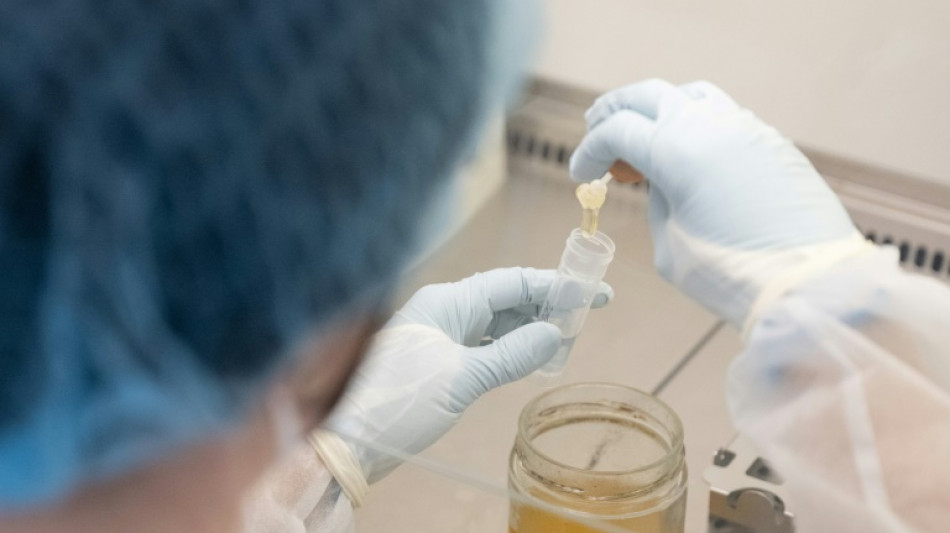
At a laboratory in Austria's mountainous Tyrol province, scientists are DNA testing about 100 honey samples a month to learn about their composition -- and in some cases to determine whether they have been adulterated.
With fake honey flooding markets, and only a few European laboratories running such analysis, the small Austrian company Sinsoma began offering the tests two years ago.
"It is really something new for the honey market," said Corinna Wallinger, head of sales at Sinsoma.
It is essential that technology "always moves forward -- just as the counterfeiters" do, she added.
Honey cannot have ingredients such as water or inexpensive sugar syrups -- which might boost its volume -- added to it, according to EU legislation.
But tests have shown that is common practice.
Between 2021 and 2022, 46 percent of the honey tested under an EU investigation as it entered the bloc was flagged as potentially adulterated, up from 14 percent in the 2015-17 period.
Of the suspicious consignments, 74 percent were of Chinese origin.
- Beekeepers' livelihoods threatened -
Seeking to better detect fraud, Austria's health and food safety agency (AGES) used DNA testing for the first time this year and is still evaluating the results.
European supermarket chain SPAR also ordered DNA tests for its honey.
The chain put its honeys -- taken off the shelves late last year in Austria for testing -- back after they passed DNA tests and another analysis.
Besides cheating consumers, fake honey threatens the livelihood of beekeepers, who struggle to compete with the far lower prices of imported honey -- often blended from various countries -- and are demanding more effective testing.
"We don't have a chance at all," said Matthias Kopetzky, owner of the Wiener Bezirksimkerei, which takes care of up to 350 hives in Vienna, as bees buzzed around him on a meadow overlooking the capital.
While the European Union is the world's top honey producer after China, it is also the second-biggest importer after the United States.
Most of the bloc's honey imports come from Ukraine, China and Argentina, according to EU data.
An EU directive adopted last year stipulates that honey labels from mid-2026 must detail the countries of origin, as opposed to merely referencing a "blend of EU and non-EU honeys".
Beekeepers like Kopetzky hope the new rule will raise consumer awareness.
Brussels also set up a group of experts, with a mandate until 2028, to "harmonise methods to detect adulteration in honey and trace the product back to the harvesting producer or importer".
- Rigorous process -
Austria's Sinsoma has specialised in DNA testing.
"Honey is full of DNA traces, of information from the environment where bees collected the nectar. Every honey has a unique DNA profile," Wallinger said.
When a honey sample lacks a wide range of DNA traces or for example contains a high proportion of DNA traces from rice or corn -- which bees do not frequent -- this indicates a honey is not genuine, she added.
Co-founded by Wallinger in 2018, Sinsoma now employs about a dozen people working in the small laboratory room and adjacent open office space in the quiet town of Voels near Innsbruck.
Sinsoma charges beekeepers 94 euros ($103) for a basic DNA test targeting plants -- about half of what a classic pollen test would normally cost, she said.
For the DNA profile, beekeepers also get a QR code which allows consumers to see exactly which plant species the bees making the honey have frequented, she said.
Experts warn the DNA method can detect certain types of fraud but not all, and that a rigorous process of validation is required to ensure trustworthy results.
Wallinger recognised the need for standardisation of the methods but said this will take time.
"It is always somewhat of an issue -- and this is also the case at the EU level," she said.
"If you always wait until you can use a standardised method to uncover a fake honey, then you will always be lagging behind what counterfeiters are doing."
I.Khan--DT