Indonesia food plan risks 'world's largest' deforestation / Photo: Yusuf WAHIL - MIGHTY EARTH/AFP
An Indonesian soldier gives a thumbs up as he crosses a rice field on a combine harvester in remote Papua, where a government food security mega-project has raised fears of mass deforestation.
Keen to end its reliance on rice imports, Indonesia wants to plant vast tracts of the crop, along with sugar cane for biofuel, in the restive eastern region.
But environmentalists warn it could become the world's largest deforestation project, threatening endangered species and Jakarta's climate commitments.
And activists fear the scheme will fuel rights violations in a region long plagued by alleged military abuses as a separatist insurgency rumbles on.
The project's true scale is hard to ascertain; even government statements vary.
At a minimum, however, it aims to plant several million hectares of rice and sugar cane across South Papua province's Merauke. One million hectares is around the size of Lebanon.
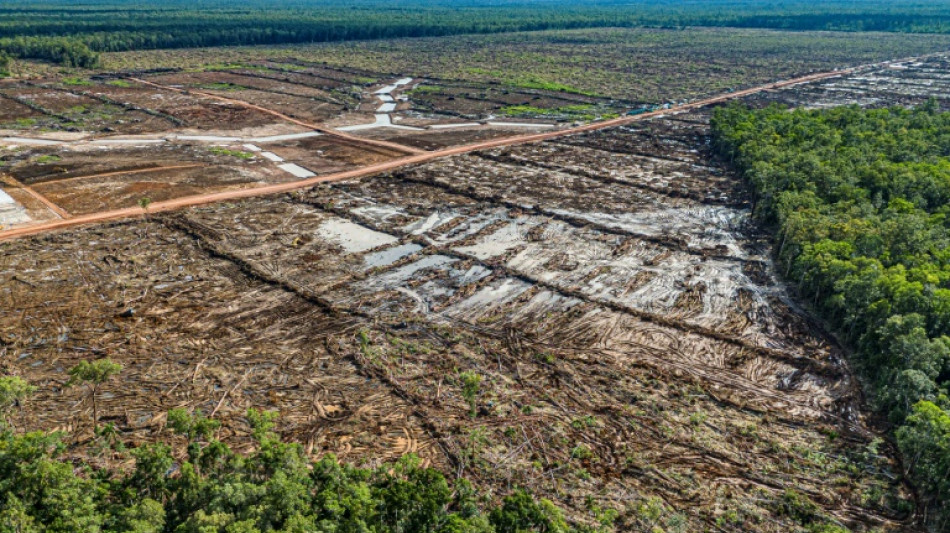
Deforestation linked to the plan is already under way.
By late last year, more than 11,000 hectares had been cleared -- an area larger than Paris -- according to Franky Samperante of environmental and Indigenous rights NGO Yayasan Pusaka Bentala Rakyat.
That figure has only increased, according to analysis by campaign group Mighty Earth and conservation start-up The TreeMap.
Their work shows areas cleared include primary and secondary natural dryland and swamp forest, as well as secondary mangrove forest, savanna and bush.
"Usually, deforestation is a product of government not doing its job," said Mighty Earth chief executive Glenn Hurowitz.
"But in this case, it's actually the state saying we want to clear some of our last remaining forests, carbon-rich peatlands, habitat for rare animals," he told AFP.
Indonesia's government says the land targeted is degraded, already cultivated or in need of "optimisation", dismissing some areas as little more than swamps.
- 'Tragedy' -
Environmentalists argue that misunderstands the local ecosystem.
"In South Papua, the landscape and the ecosystem is lowland forest," said Samperante.
"There are often misconceptions or even belittling" of these ecosystems, he added.
Mapping done by Mighty Earth shows the project threatens a broader ecosystem range -- including peatlands and forests the group says should be protected by a government moratorium on clearing.
"The tragedy in this project," said Hurowitz, "is that Indonesia has made so much progress in breaking the link between agricultural expansion and deforestation."
"Unfortunately, this single project threatens to undermine all progress."
Indonesia has some of the world's highest deforestation rates and Papua retains some of the largest remaining untouched tracts.
Indonesian think-tank CELIOS says cutting down so much forest could derail Jakarta's plan to reach net-zero by 2050.
For President Prabowo Subianto's government, criticism of the project ignores Indonesia's agricultural and economic realities.
He has made the scheme a priority, visiting soon after taking office.
In January, he said the country was on track to end rice imports by late 2025, and reiterated its energy independence needs.
The agriculture ministry did not respond to AFP's request for comment.
In Papua, planting is in full swing. In the region's Kaliki district, AFP saw farmers supported by soldiers tending rice paddies in recently-cleared land.
"This location used to be like the one on the right here. Non-productive and neglected land," said Ahmad Rizal Ramdhani, a soldier serving as the agriculture ministry's food resilience taskforce chief, at an event lauding the project.
That characterisation is disputed by Mighty Earth's satellite analysis, which found that at least two areas in the region cleared for rice overlap with government-designated peatland.
Indonesia's military is heavily involved in the project.
Local farmer Yohanis Yandi Gebze told AFP soldiers gave him "tools, agricultural equipment and machinery" for rice cultivation.
Speaking not far from Ramdhani's event, he praised the military.
"I see them cooperating with the people very well," he said.
- 'Cannot refuse' -
Others say that is only part of the story.
Indonesia officially seized Papua, a former Dutch colony, in a widely criticised but UN-backed vote in 1969.
It has since been accused of abuses in a decades-long separatist conflict in the region.
"The community feels intimidated," said Dewanto Talubun, executive director at Merauke-based environmental and rights group Perkumpulan Harmoni Alam Papuana.
"Not all members of the community agree with this project, and they cannot directly refuse," he told AFP.
Samperante too reported local fears.
"Almost every day a human rights violation occurs," he said.
The defence ministry told AFP the military had the resources and "high discipline" to accelerate the food project while securing "stability and security" in the region.
However, there are significant doubts about the project's viability.
"Soils in Merauke are likely too acidic and the climate too extreme... to grow rice," said David Gaveau, founder of The TreeMap.
He warned that draining Merauke's wetlands for agriculture risks turning the area "into a tinder box" -- a fate seen elsewhere in Indonesia.
Critics do not dispute Jakarta's food security needs, but said crops should be grown elsewhere on abandoned agricultural land.
"It should be done in places that are capable of absorbing it," said Hurowitz.
"Without destroying Indonesia's gorgeous, beautiful natural heritage and community lands."
V.Munir--DT