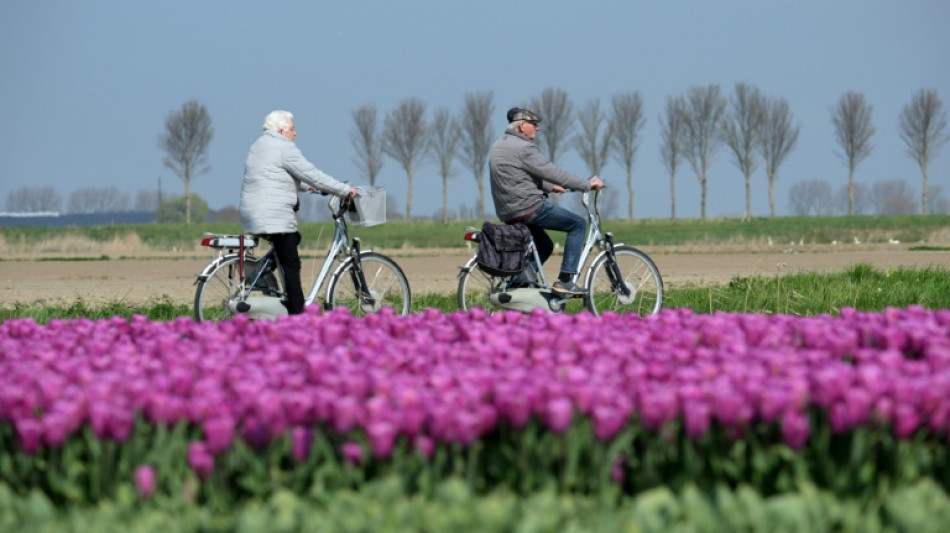
Dutch flower industry grasps thorny pesticide issue / Photo: Nicolas TUCAT - AFP
As Margriet Mantingh gazes at flowers stretching as far as the eye can see at the world's biggest flower market near Amsterdam, all she sees is a huge bouquet of pesticides.
Known globally for tulips, the Dutch are world leaders in the international flower sector, which is coming under increasing scrutiny for pesticides sprayed on the fields.
This global leadership role makes it all the more important for the Dutch to show the way in the face of mounting criticism of the industry, said Mantingh, president of the PAN-NL anti-pesticide group.
Her organisation recently published a study showing most bouquets bought at a florist, supermarket, or online, are stuffed full of pesticides.
She said the flowers were sprayed with a toxic cocktail that can cause cancer, affect hormones, and decrease fertility.
"We examined 13 bouquets and found 71 different pesticides, one third of which were banned substances" in the European Union, the 78-year-old retiree told AFP.
The flowers examined contained traces of insecticides and fungicides, some of which are banned "because they are very toxic for humans," she said.
- 'Different diseases' -
The issue of pesticides on flowers hit the headlines in France after a young girl died of a leukaemia linked to her mother's exposure to the chemicals, as she worked as a florist during her pregnancy.
French consumer group UFC Que Choisir has also raised concerns about pesticide contamination of cut flowers, warning of dangers for those handling the flowers.
At Aalsmeer, near the Dutch capital, dozens of staff on electric scooters weave through the world's biggest flower market.
The Royal FloraHolland group based there sells some nine billion flowers per year for an annual turnover of around 5.2 billion euros ($5.8 billion).
Most of their produce is exported, mainly to Germany, Britain and France.
Dutch companies also import some three billion stems annually from Africa, notably Ethiopia and Kenya, said Michel van Schie, spokesman for Royal FloraHolland.
And the rules on pesticides are determined by the country cultivating the flowers -- often applying different standards, he added.
"In Africa, there are different diseases than in Europe. That means that other products are needed to fight against these diseases," he said.
The problem is that these flowers then make their way into the European market, say groups like UFC Que Choisir and PAN-NL.
There are no EU laws limiting pesticides on cut flowers, 80 percent of which are imported from countries still permitting the use of highly toxic substances, said PAN-NL's Mantingh.
While the EU has laws restricting pesticides on fruits and vegetables, no such legislation exists for flowers, she said.
- 'Perfect flowers' -
The death of the young girl in France had a knock-on effect in the Netherlands.
Together with the agriculture ministry, the Dutch VBW florists' association urged its members to use gloves and always wash their hands after cleaning the flowers delivered to their shops.
And from next year, Royal FloraHolland will require its producers to show a durability certificate, a label that will enable authorities to check the amount of pesticides used.
"This case in France is horrible and even if we don't know exactly what happened, we have to ensure that everything is as safe as possible at all times," said Marco Maasse, head of the VBW.
He said that no bouquet sold in the Netherlands presents a danger to the public "because it would not be permitted to be sold."
The two men and Margriet Mantingh agree on one point: as world leader, the Netherlands has a duty to set the example.
"We need to have a better understanding of the (pesticide) residue that is actually on the product when it comes from the producer or enters the Netherlands," said Maasse.
"The whole chain could be improved further in that respect," he added.
But at the end of the day, said Van Schie, "the consumer wants perfect flowers and plants," even in winter.
A.Hussain--DT