Trump's steep tariffs trigger fresh market panic / Photo: SAUL LOEB - AFP
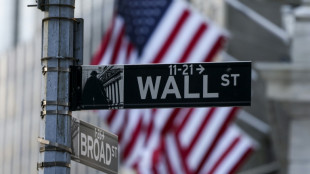
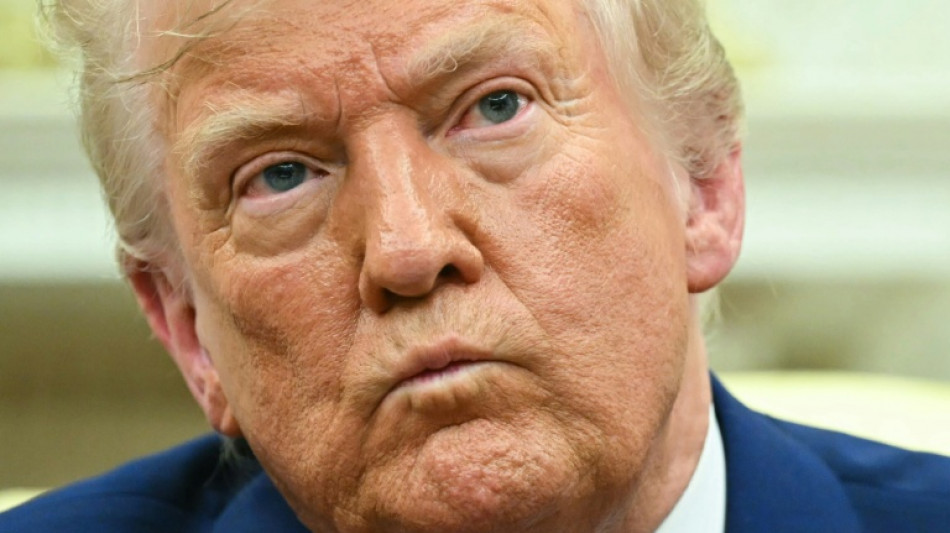
US President Donald Trump reignited market turmoil on Wednesday as punishing tariffs on dozens of countries kicked in, with China set to retaliate after being hit with levies topping 100 percent.
Following the sweeping 10 percent tariffs that took effect over the weekend, the tax US importers pay to buy goods from the likes of the European Union, Japan and Vietnam rose dramatically higher overnight.
After some respite on Tuesday, stock markets were in panic mode again, with Tokyo's Nikkei index closing almost four percent lower on Wednesday while Paris, Frankfurt and London were down around three percent in their midday trading.
China -- Washington's top economic rival but also a major trading partner -- has been the hardest hit, with tariffs imposed on its products since Trump returned to the White House now reaching a staggering 104 percent.
In response, the Chinese foreign ministry promised to take "firm and forceful" steps to protect its interests, while its commerce ministry said the country had "abundant means" to fight a trade war.
Trump has said his government was working on "tailored deals" with trading partners, with the White House saying it would prioritise allies such as Japan and South Korea, which were hit with tariffs of 24 percent and 25 percent, respectively.
His top trade official, Jamieson Greer, told the Senate that Argentina, Vietnam and Israel were among those who had offered to reduce their tariffs. Vietnamese goods were hit with one of the highest tariffs at 46 percent.
Trump told a dinner with fellow Republicans on Tuesday night that countries were "dying" to make a deal.
"I'm telling you, these countries are calling us up kissing my ass," he said.
But Beijing was set to impose retaliatory tariffs of 34 percent on US goods from 12:01 am local time on Thursday (1601 GMT Wednesday).
Trump had originally planned to impose an additional 34 percent tariff on Chinese goods, but he decided to add another 50 percent on top of that after Beijing decided to retaliate. Combined with previous levies, the tax on Chinese goods rose to 104 percent.
Despite rising tensions, a Chinese government white paper released on Wednesday stressed that the two countries could still resolve their differences "through equal-footed dialogue and mutually beneficial cooperation".
- Recession fears -
The escalating trade war has wiped off trillions of dollars in market value since last week as investors fear that the tariffs will rekindle inflation and spark a recession.
The Bank of England warned of risks to "UK financial stability" from increased geopolitical tensions, including the fallout from the US tariffs.
Central banks in India and New Zealand cut interest rates to boost their economies in the face of tariffs.
Italy is preparing to cut its 2025 growth forecast in half from 1.2 to 0.6 percent, a government source said, while Spain is also set to downgrade its outlook.
Oil prices slumped, with the international benchmark contract, Brent, falling under $60 per barrel, its lowest level in four years.
In foreign exchange, the South Korean won this week fell to its lowest level against the dollar since 2009.
China's offshore yuan also fell to an all-time low against the US dollar, as Beijing's central bank moved to weaken the currency on Wednesday for what Bloomberg said was the fifth day in a row.
"Letting the yuan grind lower at this measured pace won't offset the blow from a full-blown tariff barrage," analyst Stephen Innes from SPI Asset Management said. "The levies are simply too big."
Government bond yields -- essentially the interest states pay to borrow money -- rose in the United States, Japan and Britain, among other countries.
Trump believes his policy will revive America's lost manufacturing base by forcing companies to relocate to the United States.
But many business experts and economists question how quickly -- if ever -- this can take place.
Trump on Tuesday said that the United States was "taking in almost $2 billion a day" from tariffs.
He also said the United States would announce a major tariff on pharmaceuticals "very shortly".
- 'Survival mode' -
Residents in Beijing expressed fears over the escalating trade war.
"I hope that everyone can sit down and reconcile and talk, and then put things out step by step, rather than irrationally escalate them," Yu Yan, a lawyer, told AFP.
In the United States, consumers also voiced worries over rising prices.
At a supermarket in New York, Anastasia Nevin told AFP she was in "survival mode".
"I have two kids so I'm just trying to get by. It's tough," she said, adding that she would likely need to cut back on spending if prices rise further.
burs-oho-lth/bc
A.Al-Mehrazi--DT