Burning fields betray Russia's creeping Ukraine advance / Photo: Yasuyoshi CHIBA - AFP
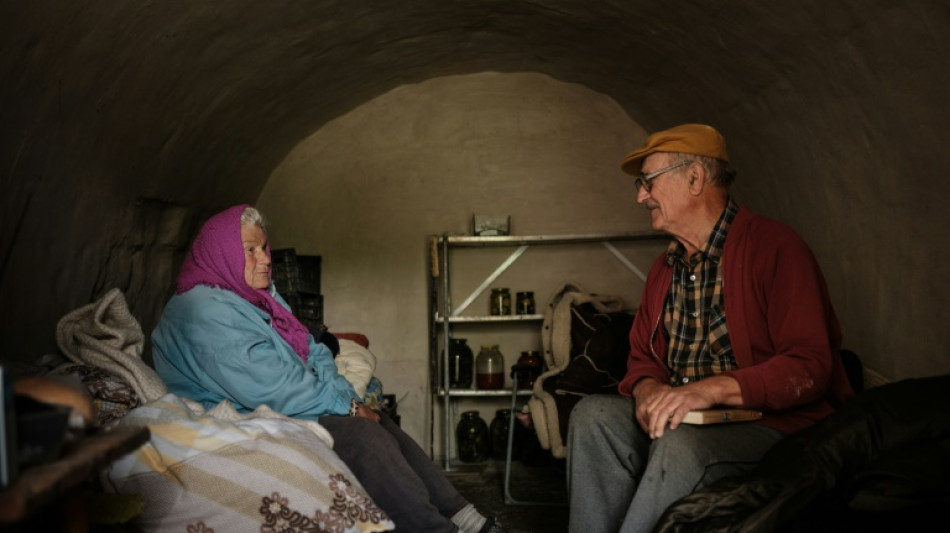
Ukrainian biology professor Oleksiy Polyakov is reading a book on the stoop of his cellar, trying to ignore the Russian mortar shells smashing into the hill overhead.
Braving the road being pelted since the morning by the advancing Russians, a fireman pushes his red truck to the site of a bushfire ignited by the blasts.
The 84-year-old professor puts down his book about overseas travel and cranes his neck to see how close the flames have got to his wooden door.
They still seem to be out a good distance and the fireman has just taken a few confident steps up the burning hill -- and that much closer to the invading Russians on the other side.
But another earsplitting mortar explosion kicks up dust and ultimately forces the professor to scuttle back inside to his 81-year-old wife.
"We are sitting here waiting for our guys to launch their counteroffensive -- for the Ukrainians to push forward," Galina says from the dark depths of a cellar stacked with potatoes and jars of pickles.
"Then the front will move further out from here and we will be free," the bespectacled professor agrees.
- 'Time to run' -
The hard truth is that Ukrainian forces -- heroes worshipped for their defence of Kyiv and rout of the Russians around the northern city of Kharkiv -- are retreating across swathes of the eastern front.
The losses often come after weeks of battles over towns and small cities that get pulverised by the time the Russians surround them in a slow-moving wave.
White smoke from burning fields such as those licking at the doorstep of the professor's cellar in the village of Sydorove often mark the pace of Russia's advance from afar.
"I tell everyone that there is no reason to worry when the banging is from outgoing fire," constructor Volodymyr Netymenko said, while packing up his sister's belongings before evacuating her from the burning village.
"But when it is incoming, it is time to run. And things have been flying at us pretty hard for the past two or three days."
- 'My war' -
Ukrainians' resilience in the third month of Russia's invasion often comes through clearest in moments of their most painful loss.
Army volunteer Yaroslava sat on a slab of concrete jutting out from the remains of a school raised by a Russian precision attack a short walk from the professor's cellar the previous evening.
The 51-year-old knew that her husband's unit had set up camp at the abandoned school only hours before the strike imploded a section of the building occupied by the gym.
The woman kept looking at the spot where rescuers and de-miners had spotted a motionless hand reaching out from the rubble overnight.
"We had settled in London before the war but felt like we had no choice but to come back," Yaroslava said, still staring at the spot of the buried body.
"My two sons have just signed three-year contracts with the army. We will fight. We will still fight," she said without moving her eyes. "My war is not over."
- 'A lot of pro-Russians' -
The professor's cellar sits near the bank of a winding river that the Russians have been trying to push south for more than a month.
One such attempt near the village of Bilogorivka further east last week ended in a fiasco that saw the Russians lose dozens of armoured vehicles and an unknown number of troops.
But the Kremlin's forces have had much better luck in the hilly forests surrounding the professor and his wife.
The Russians' advance past Sydorove would give them a clear run across 20 kilometres (12 miles) of open fields to the militarily important city of Slovyansk and Ukraine's eastern administrative centre in Kramatorsk.
Both are being targeted almost daily by long-range missile fire that has taken out disguised weapons storage sites and barracks.
What worries many across the region is how the Russians know where to attack.
The school where Yaroslava probably lost her husband had stood vacant until the day the Ukrainian unit moved in -- and was immediately hit.
"There are a lot of pro-Russians here," said volunteer soldier Oleksandr Pogasiy while helping clear out the school debris. "The guys had just arrived and it was hit."
A.Krishnakumar--DT