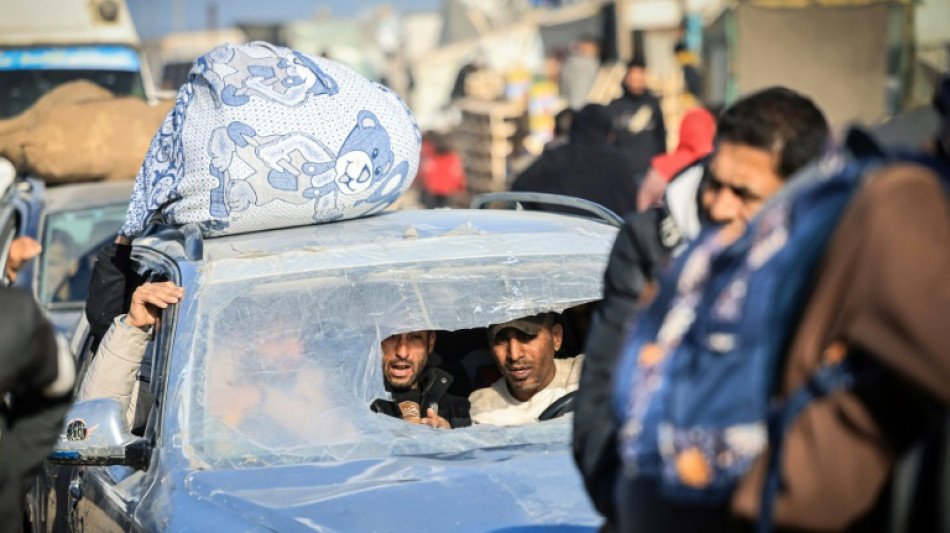
Israel pressed on two-state solution, pounds south Gaza / Photo: - - AFP
Palestinians sheltered from intense fighting in southern Gaza where communications were cut again on Monday, as pressure mounted on Israel for a solution involving long-sought Palestinian statehood.
Mahdi Antar, 21, sought refuge at Al-Nasser hospital in Khan Yunis, Gaza's main southern city which has become the epicentre of the war between Hamas militants and Israeli soldiers now in its fourth month.
"The situation is terrifying. Tonight and today are very difficult, bombing and shooting. I do not know what to do," he said.
The health ministry in the Hamas-run Gaza Strip reported on Monday that more than 120 people had been killed in the previous 24 hours.
Victims of the latest Israeli strikes were brought to Al-Nasser hospital and mourners buried corpses in a mass grave, AFP journalists saw.
The war broke out with Hamas's unprecedented October 7 attacks that resulted in the deaths of about 1,140 people in Israel, mostly civilians, according to an AFP tally based on official Israeli figures.
In response, Israel has carried out a relentless offensive that has killed at least 25,295 people in Gaza, around 70 percent of them women, children and adolescents, according to Gaza's health ministry.
Israel announced the deaths of three soldiers, raising the toll to 198 since ground operations in Gaza started in late October.
The Hamas attack also saw about 250 hostages seized, and Israel says around 132 remain in Gaza.
This includes the bodies of at least 28 dead hostages, according to an AFP tally based on Israeli data.
Relatives of the captives and campaigners for their release, who have held regular rallies demanding action from the Israeli government to free them, on Monday stormed a parliamentary committee meeting.
"You sit here while our children are dying over there," yelled Gilad Korngold, father of hostage Tal Shoham, an AFP correspondent reported.
Telecoms operator Paltel said that services in Gaza were cut off on Monday "due to the ongoing and escalating aggression", the 10th time since the war began.
- 'Other solutions?' -
The fresh strikes on southern Gaza came as European foreign ministers held meetings in Brussels with top diplomats from the warring sides and key Arab states.
EU foreign policy chief Josep Borrell told Israel "peace and stability cannot be built only by military means".
"Which are the other solutions they have in mind? To make all the Palestinians leave? To kill them off?"
Alleviating the humanitarian crisis must be the priority as more hardship for Gazans will not defeat Hamas or increase Israel's security, Borrell added.
Israeli Prime Minister Benjamin Netanyahu has drawn condemnation from the United Nations and defied the United States -- which provides Israel with billions of dollars in military aid -- by rejecting calls for a Palestinian state.
The Palestinian Authority's top diplomat, Riyad al-Maliki, demanded the European Union call for an immediate ceasefire and urged it to consider sanctions against Netanyahu for "destroying the chances for a two-state solution".
Israel's top diplomat Israel Katz ignored questions from journalists over a future two-state solution and said his government was focused on returning the hostages and ensuring its own security.
The war has spurred fears of a wider escalation, with a surge in violence involving Iran-backed Hamas allies across the region.
At least 202 people have been killed in south Lebanon since early October, according to an AFP tally, as Israeli forces and Hezbollah militants traded near-daily fire. On the Israeli side, 15 people have been killed.
Yemen's Huthi rebels announced they had fired missiles at a US military ship in the Gulf of Aden near the Red Sea, but a US defence official said no attack had taken place.
- 'Heading to the unknown' -
UN agencies and aid groups have sounded the alarm about the growing threat of disease and famine claiming more lives in Gaza than fighting.
The territory's health system is sagging under the weight of the hostilities and an Israeli siege that has triggered dire shortages of food, water, fuel and medicine.
The Palestinian Red Crescent Society on Monday called on the international community to protect its staff and facilities, particularly its headquarters and Al-Amal hospital in Khan Yunis.
The Israeli army said 12,000 trucks carrying 1,052 tons of medical aid have entered Gaza since the war began.
French Defence Minister Sebastien Lecornu, on a visit to Israel, told AFP he hoped medicines delivered to Gaza last week under a deal mediated by France and Qatar would reach "every hostage".
The UN agency for Palestinian refugees estimates the war has displaced 1.7 million Gazans.
Abu Iyad, his belongings piled on a donkey-drawn cart, told AFP he was on the move for the seventh time.
He was fleeing Khan Yunis for Rafah near the Egyptian border, where hundreds of thousands of displaced Palestinians have settled, many living in makeshift tents.
"I'm heading to the unknown," he said.
"They told us to go to Rafah, where to go in Rafah? Is there any space left?"
Y.I.Hashem--DT