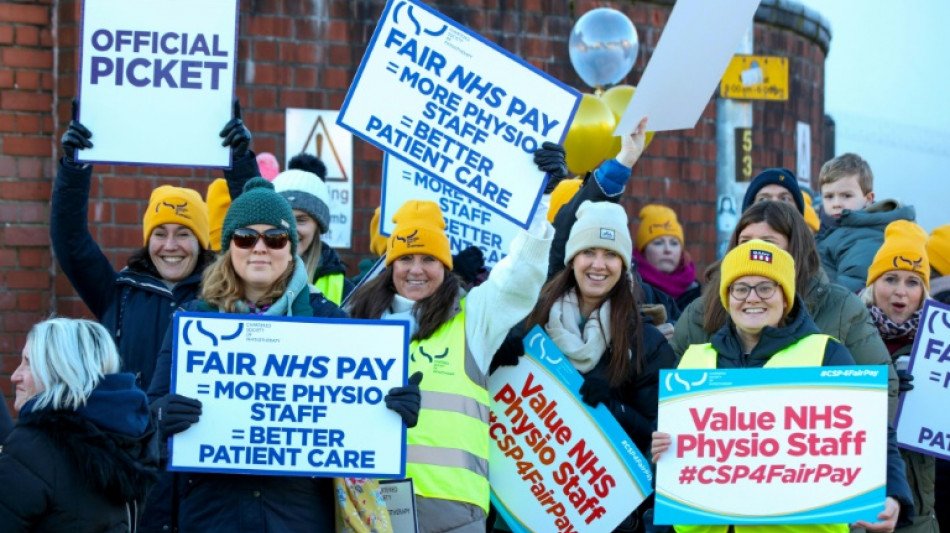
Public-sector strikes add to N. Ireland's political crisis / Photo: Paul Faith - AFP
Tens of thousands of public-sector workers in Northern Ireland walked off the job on Thursday, in what one union boss said could be the biggest strike in the province.
The mass strike, dubbed a "coordinated day of action", was predicted to cause havoc for already crumbling public services.
The walkouts come with no end in sight to a protracted political crisis that has left the UK province without devolved government for almost two years.
Around 16 trade unions representing teachers, civil servants, nurses and transport workers were expected to join picket lines and rallies, according to organisers.
Six rallies were due to take place across Belfast with another two in Londonderry, also known as Derry, and one in Enniskillen.
Trades union chief Owen Reidy said he expected Thursday to be the "largest industrial dispute in the history of Northern Ireland".
"Public-service workers in Northern Ireland are being used as political pawns by this discredited Tory government," said Reidy, who is general secretary of the Irish Congress of Trade Unions (ICTU).
"Many of these workers have not had a pay increase for three years despite... the cost-of-living crisis. The money is available but workers are being held to ransom."
The ICTU estimated that 170,000 of the 220,000 public-sector union workers would stop work to demand the release of held-up funding for pay increases.
The department of health warned that there would be a "significantly reduced health service" and people were advised to take care "to reduce your chances of needing health service treatment".
Authorities said healthcare services would be severely depleted, though essential and emergency care would remain available.
- Boycott -
Schools were shut and transport services halted as several hundred service workers who salt roads during winter joined the strike, which coincided with a cold weather snap.
The strike, which is estimated could cost the economy more than £10 million ($12.6 million), comes as a political stalemate in the region approaches a two-year milestone.
In February 2022, the largest pro-UK party, the Democratic Unionist Party (DUP), withdrew from the Northern Ireland Assembly at Stormont because of post-Brexit trading rules it said undermined Northern Ireland's place in the wider United Kingdom.
The DUP lost its place as Northern Ireland's biggest party in 2022 elections, giving the post of first minister in the power-sharing executive to nationalists Sinn Fein, who want Northern Ireland united with the Irish Republic.
Sinn Fein vice president Michelle O'Neill told the BBC that public-sector workers felt "forced to take" to the picket lines "in defence of what is reasonable and fair" and urged the DUP to restore the assembly.
UK Northern Ireland Secretary Chris Heaton-Harris said Monday that a £3.3 billion package offered to the parties last month would be available on condition that the assembly restarts.
Around £584 million of that is earmarked for public-sector pay increases.
But on Wednesday -- as the legal deadline for a return approached on Thursday -- lawmakers failed to elect a speaker for the seventh time, as no candidate could command the required support.
"I understand the serious concerns that people across Northern Ireland have about the impact this action will have on vital public services," he said.
The main unions say the money for pay rises should be released as soon as possible, regardless of the suspended assembly.
But the DUP accuses London of using industrial unrest as a lever to end the party's boycott of Stormont.
I.Uddin--DT