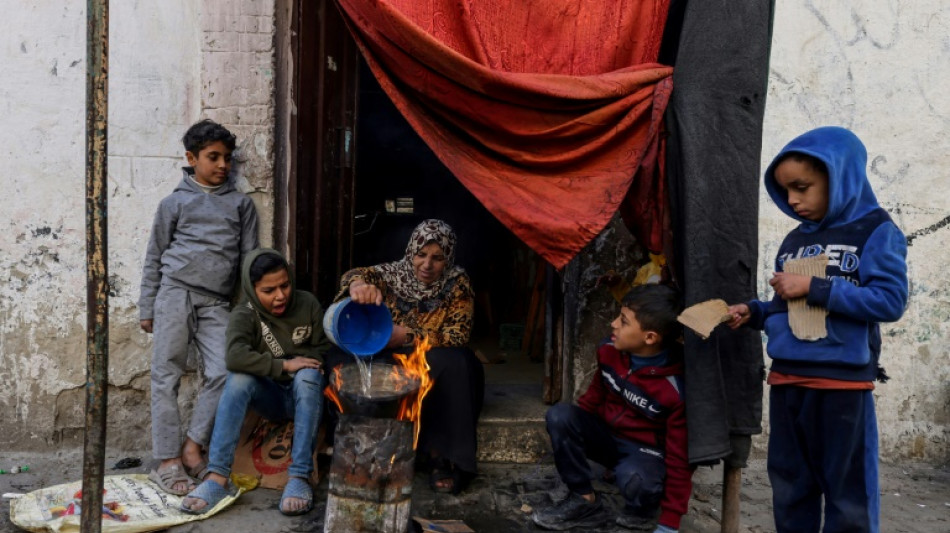
War pushing Gaza to famine, UN warns / Photo: Mohammed ABED - AFP
The Israel-Hamas war is pushing Gaza towards famine, the United Nations warned ahead of an expected Security Council vote Friday on a resolution to boost aid to the Palestinian territory but not call for a ceasefire.
Separate diplomatic efforts were also underway for a fresh pause in the worst-ever Gaza war, which was triggered by an unprecedented attack by Hamas militants on Israel in October.
With aid workers running out of words to describe conditions in Gaza, the UN Security Council has been locked all week in negotiations over how to phrase a resolution about the war.
The latest draft seen by AFP calls for "urgent steps to immediately allow safe and unhindered humanitarian access, and also for creating the conditions for a sustainable cessation of hostilities."
It does not call for an immediate end to fighting.
Backed by its ally the United States, Israel has opposed any reference to a "ceasefire".
Linda Thomas-Greenfield, US ambassador to the UN, told reporters that Washington would support the resolution if it "is put forward as is".
The war began on October 7 when Hamas gunmen broke through Gaza's militarised border and killed around 1,140 people in Israel, mostly civilians, according to an AFP tally based on Israeli figures.
Palestinian militants also abducted about 250 people.
Vowing to destroy the group, Israel began a relentless bombardment of targets in Gaza, alongside a ground invasion, which has killed 20,057 people, according to the latest toll released Friday by Hamas authorities who govern Gaza.
Most of the dead are women and children, Hamas officials say.
The entire population of Gaza faces "an imminent risk of famine", according to a UN-backed global hunger monitoring system on Thursday.
"We have been warning for weeks that, with such deprivation and destruction, each day that goes by will only bring more hunger, disease and despair to the people of Gaza," UN humanitarian chief Martin Griffiths posted on X, formerly Twitter.
- Israel blames UN -
The UN estimates 1.9 million Gazans are now displaced, out of a population of 2.4 million.
With homes destroyed, they are living in crowded shelters and struggling to find food, fuel, water and medical supplies. Diseases are spreading, and communications have been repeatedly cut.
After weeks of pressure, Israel approved the temporary reopening of the Kerem Shalom crossing on December 15 to enable aid deliveries directly to Gaza, rather than through the Rafah crossing from Egypt.
On Thursday, an Israeli strike hit the Palestinian side of Kerem Shalom, the crossings authority and the the health ministry in the Hamas-run territory said.
Israeli officials did not respond to requests from AFP for comment.
The UN secretary-general's spokesman, Stephane Dujarric, said aid movement via the crossing had been temporarily suspended following the "drone strike".
Dujarric's comments came after Israeli President Isaac Herzog said Israel could enable as many as "400 trucks a day" of aid and blamed the UN for failing to bring more.
According to the UN, the number of aid trucks entering Gaza is well below the daily pre-war average.
- 'Even the animals have died' -
On Thursday, military spokesman Daniel Hagari said Israeli troops have killed more than 2,000 Palestinian militants since a one-week ceasefire ended on December 1. He did not elaborate on the basis of his figures.
According to Israel's military, the deaths of two more soldiers in Gaza brought to 139 the number killed since it began its ground assault on October 27.
Hamas authorities said overnight strikes claimed several more lives across the territory.
In north Gaza, parts of Gaza City including Shujaiya have seen street-by-street combat -- even building-by-building -- between Israeli soldiers and Hamas fighters.
Israel regularly announces destruction of underground tunnels and other Hamas infrastructure while the militants say they have destroyed Israeli vehicles including tanks.
The area around the city of Khan Yunis in southern Gaza has been a focus of Israeli military operations which "intensified" over the past week, a military spokesperson said.
Many Gazans have fled as far south as they can, to Rafah, yet even there they have not found safety.
"These are the houses of peaceful people," Shehda al-Kurd, a bespectacled man, said after his family's house "collapsed over us" during a pre-dawn strike.
"This area might have been considered the safest one, but they struck it," he said.
A separate strike hit an area of greenhouses in Rafah.
Wael Azad, a Palestinian farmer, said "even the animals have died. May God have mercy on the people," he said, wrapped in a scarf and woollen cap against the cold.
Israel has been under increasing pressure from allies, including the United States which provides it with billions of dollars in military aid, to protect civilians.
- Far apart -
Qatar, backed by Egypt and the United States, last month helped broker a week-long truce that saw 105 hostages released, including 80 Israelis in exchange for 240 Palestinian prisoners.
Hopes that Israel and Hamas could be inching towards another truce and an exchange for the remaining 129 hostages rose this week as the head of the militant group visited Egypt and talks took place in Europe.
However, the stated positions of Israel and Hamas remain far apart.
The war has sparked fears of wider conflict.
There have been regular exchanges of fire across the Lebanon border, and missiles from Iran-backed Yemeni rebels have disrupted Red Sea shipping.
The Pentagon said on Thursday that more than 20 countries have joined a US-led coalition to protect shipping in the waterway vital for world trade.
burs-it/kir
F.El-Yamahy--DT