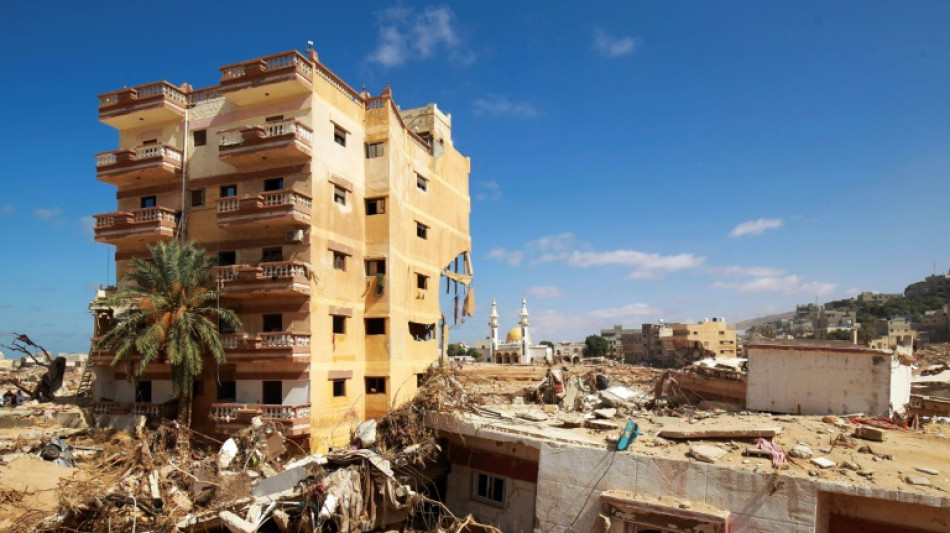
Libya's flood-ravaged Derna in grisly hunt for thousands missing / Photo: Abdullah DOMA - AFP
Rescuers sifted through mud and rubble Friday in their search for people missing from the tsunami-sized flash flood that swept the Libyan port city of Derna, killing more than 3,000.
The surge of water burst two upstream dams on Sunday, turning Derna into an apocalyptic wasteland with entire city blocks and untold numbers of people washed into the Mediterranean.
The United Nations launched an appeal for more than $71 million to assist hundreds of thousands in need and warned the "extent of the problem" remains unclear.
An AFP journalist in Derna said central neighbourhoods on either side of the river, which normally dries up at this time of year, looked as if a steam roller had passed through, uprooting trees and buildings and hurling vehicles onto the port's breakwaters.
"Within seconds the water level suddenly rose," said a survivor, who was swept away with his mother in the late-night ordeal and injured, before they both managed to scramble into an empty building downstream.
"The water was rising with us until we got to the fourth floor, the water was up to the second floor," the unidentified man said from his hospital bed, in testimony published by the Benghazi Medical Center.
"We could hear screams. From the window, I saw cars and bodies being carried away by the water. It lasted an hour or an hour and a half -- but for us, it felt like a year."
Officials in the east of the divided country give different toll estimates, with one speaking of at least 3,840 dead.
"We don't know the extent of the problem," UN aid chief Martin Griffiths said Friday in Geneva, as he called for coordination between Libya's two rival administrations -- the UN-backed, internationally recognised government in Tripoli, and one based in the disaster-hit east.
While most fear the death toll will be much higher, Tamer Ramadan of the International Federation of Red Cross and Red Crescent Societies said there was still hope of finding survivors but declined to give a figure.
- DNA testing -
Hundreds of body bags now line Derna's mud-caked streets, awaiting mass burials, as traumatised and grieving residents search mangled buildings for missing loved ones and bulldozers clear streets of debris and mountains of sand.
"We are trying to take DNA samples and pictures of the victims before their burial to help with identification later on," Lieutenant Tarek al-Kharraz, a spokesman for the east-based government, told a local news channel.
In one shattered home, a rescue team pumped out the water to reveal a woman's lifeless arms still clutching her dead child, the AFP journalist reported.
"This disaster was violent and brutal," said Yann Fridez, head of the Libya delegation of the International Committee of the Red Cross, which had a team in Derna when the floodwaters hit.
"A wave seven metres (23 feet) high wiped out buildings and washed infrastructure into the sea. Now family members are missing, dead bodies are washing back up on shore and homes are destroyed."
Abdelaziz Bousmya, who lives in the Chiha neighbourhood which was spared by the wall of water that devastated lower-lying districts, said he lost loved ones.
"They are all either buried under the mud or got swept out to sea by the floodwaters," the 29-year-old said, accusing the authorities of failing to take preventive measures.
The floods were caused by hurricane-strength Storm Daniel, compounded by the poor infrastructure in Libya, which was plunged into turmoil after a NATO-backed uprising toppled and killed longtime dictator Moamer Kadhafi in 2011.
- 'Sea corridor' -
UN World Meteorological Organization chief Petteri Taalas said many deaths could have been avoided if early warning and emergency management systems had functioned properly in the war-scarred country.
"They could have issued the warnings and the emergency management forces would have been able to carry out the evacuation of the people, and we could have avoided most of the human casualties."
Access to Derna remains severely hampered as roads and bridges have been destroyed and power and phone lines cut to wide areas.
The United Nations said that "with the collapse of most roads, the municipality (of Derna) is urging relevant authorities to establish a sea corridor for emergency relief and evacuations".
The UN's World Food Programme said it began to distribute food aid to more than 5,000 families displaced by the flood, adding however that thousands in Derna were "homeless and without food".
Climate experts have linked the disaster to the impacts of a heating planet, combined with Libya's decaying infrastructure.
D.Farook--DT