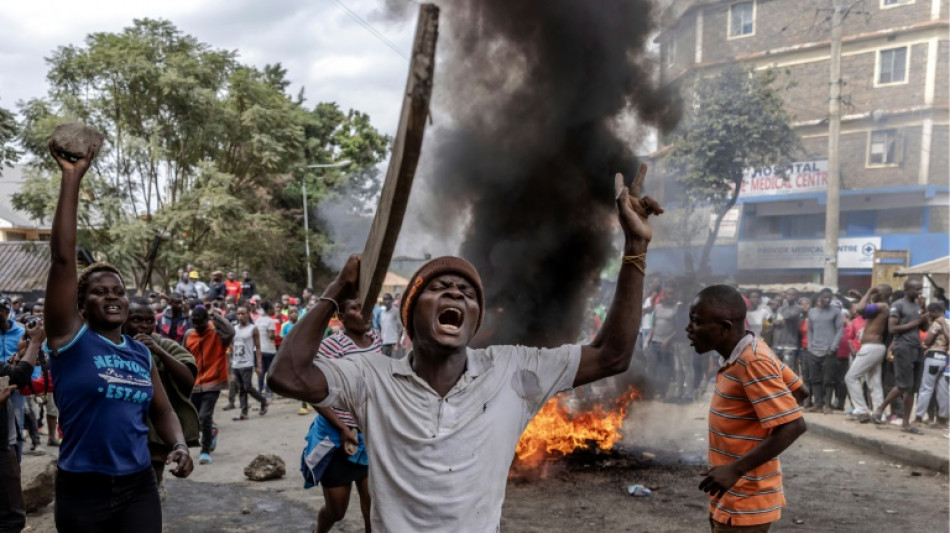
Two killed, hundreds arrested in Kenya protests / Photo: Luis Tato - AFP
Two people were killed on Wednesday following anti-government protests in Kenya, a hospital official said, as the interior ministry announced the arrest of over 300 others in connection with the demonstrations.
Veteran opposition leader Raila Odinga has held several rounds of protests since March against the government, alarming the international community which has joined calls for a political solution after earlier demonstrations left more than a dozen dead.
Clashes between police and protesters led to two deaths in the opposition bastion of Kisumu, said George Rae, CEO of Jaramogi Oginga Odinga hospital.
"There are two bodies recorded at the morgue with gunshot wounds," he told AFP by telephone, adding that 14 others were hospitalised.
Odinga's Azimio alliance has vowed to stage three straight days of protests this week, and on Wednesday evening urged "Kenyans to come out in an even bigger way tomorrow".
Although Wednesday's protests in Nairobi and other towns appeared to be more muted than earlier demonstrations, with fewer reports of casualties resulting from sporadic clashes, Interior Minister Kithure Kindiki said the authorities had recorded many cases of vandalism and looting.
"More than 300 people have been arrested across the country and will be charged with various crimes, including looting, malicious damage of property, arson, robbery with violence, assaulting law enforcers," Kindiki said.
Schools and shops were closed in Nairobi, Kisumu and the port city of Mombasa, with small groups of mostly young men setting fire to tyres and engaging in running battles with police.
Police fired tear gas at scattered groups of demonstrators in Nairobi's Kibera slum and the towns of Homa Bay, Kisii and Migori, all Odinga strongholds, while offices in the capital's business district were largely shuttered.
- 'Wrong direction' -
It is the third time this month that Odinga has staged mass rallies against a government he says is illegitimate and responsible for a cost-of-living crisis.
The government in turn has accused the opposition of derailing efforts to improve the economy and fomenting chaos.
"We do not want a country of violence or fighting or destruction of property," President William Ruto said during a visit to the Rift Valley town of Kericho.
"The police must make sure they are firm on criminals, gangs and anarchists and all the people who want to cause mayhem."
The use by police of live rounds and tear gas to disperse stone-throwing protesters has drawn accusations of heavy-handedness from civil groups.
Last week police arrested 312 people who were accused of directly or indirectly planning, orchestrating or financing the protests, including a member of parliament who was later released.
The demonstrations have divided Kenyans, who are struggling to cope with high inflation and a jobs crisis.
Fred Onzere, a 47-year-old unemployed man, told AFP Kenya was "going in the wrong direction" and said he supported the protests.
Others said the shutdowns would only worsen the economic problems.
"Even if we are (employed)... we can't work," said businessman Peter Kajinji, 62.
"It's better for our leaders to sit together, talk and solve this problem," he told AFP.
- 'Resolve differences' -
Ruto, a former deputy president, rose to the top job after winning a narrow election victory last August over Odinga, who claimed the vote was "stolen".
But he took office as Kenya's economy reeled from debt and soaring inflation, and was criticised for raising taxes despite campaigning to bring prices down.
Kenya is seen as a stable democracy in the often-turbulent East Africa region, and 13 western nations issued a joint statement on Tuesday expressing concern over the recent violence.
"We... urge all parties to table their concerns through a meaningful dialogue and resolve their differences peacefully to build the nation together, ensuring no further loss of life," the foreign missions said.
Opposition protests following Odinga's election loss in 2017 continued until he brokered a surprise pact with his erstwhile foe, former president Uhuru Kenyatta, that became known as "the handshake".
ho-np-str-amu/giv
V.Munir--DT