Azerbaijan, Armenia hold talks, Russia proposes Moscow summit / Photo: Ani BALAYAN - AFP
Azerbaijan and Armenia held a fresh round of EU-mediated peace talks Saturday, while Russia offered a summit in Moscow in a bid to reassert a lead role in the normalisation process.
Azerbaijani President Ilham Aliyev and Armenian Prime Minister Nikol Pashinyan met in Brussels for talks aimed at resolving their decades-long conflict for the control of Armenian-populated Karabakh, the foreign ministry in Baku said.
European Council President Charles Michel, who mediated the discussions, said the exchanges were "frank, honest and substantive".
"I encouraged them to take courageous steps to ensure decisive and irreversible progress on a normalization track," he added.
"As a matter of priority, violence and harsh rhetoric should stop in order to provide a proper environment for peace."
The Armenian foreign ministry said negotiations focused on "the deepening humanitarian crisis in Nagorno-Karabakh" among other issues.
Both sides "agreed to step up work on addressing the existing issues" as the peace process goes forward, the ministry added.
Michel said he intended to organise a fresh meeting between Aliyev and Pashinyan in Brussels and another in Spain in October involving German Chancellor Olaf Scholz and French President Emmanuel Macron.
The talks come amid renewed tensions after Azerbaijan closed the Lachin corridor, the sole land link between Karabakh and Armenia.
- 'Threat to aviation safety' -
Baku and Yerevan have been trying to negotiate a peace deal with the help of the European Union and United States, whose diplomatic engagement in the Caucasus has irked traditional regional power broker Russia.
Moscow on Saturday offered to host the two countries' foreign ministers and suggested the future peace treaty could be signed in Moscow.
Russia is ready "to organise a trilateral meeting of the foreign ministers in Moscow in the near future", the country's foreign ministry said in a statement.
It offered to hold later a "Russian-Azerbaijani-Armenian summit in Moscow to sign the relevant (peace) treaty".
Azerbaijan's defence ministry has also said Armenian separatist forces in Karabakh "use radio interference against GPS navigation systems of local and foreign airlines' passenger aircraft flying through our country's airspace".
Two Azerbaijan Airlines aircraft reported the interference on Thursday, the ministry said.
"Such incidents pose a serious threat to aviation safety," according to the statement.
Karabakh's rebel authorities dismissed the claims as an "absolute lie".
- Uneasy peace talks -
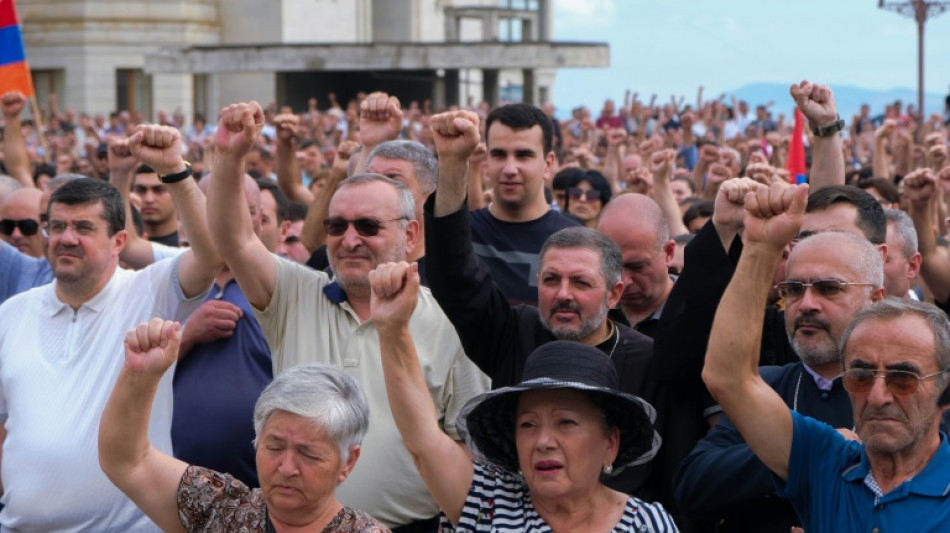
On Friday, around 6,000 people rallied in Karabakh calling for the reopening of the Lachin corridor.
Local separatists, warning of a humanitarian crisis, urged Moscow to ensure free movement through the road.
Azerbaijan later allowed the Red Cross to resume medical evacuations from Karabakh to Armenia.
Karabakh has been at the centre of a decades-long dispute between the two countries, which have fought two wars over the mountainous territory, mainly populated by Armenians.
During previous rounds of Western-mediated talks, Baku and Yerevan made some progress towards preparing the text of a peace agreement, but its signature remains a distant prospect.
Yerevan agreed to recognise Karabakh as part of Azerbaijan but demanded international mechanisms for protecting the rights and security of the region's ethnic-Armenian population.
Baku insists such guarantees must be provided at the national level, rejecting any international format.
In autumn 2020, Russia sponsored a ceasefire agreement that ended six weeks of fighting between Armenian and Azerbaijani forces for control of Karabakh.
Armenia has relied on Russia for military and economic support since the collapse of the Soviet Union. It has accused Moscow -- bogged down in its war against Ukraine -- of failing to fulfil its peacekeeping role in Karabakh.
When the Soviet Union collapsed in 1991, ethnic-Armenian separatists in Karabakh broke away from Azerbaijan, and the ensuing conflict claimed some 30,000 lives.
G.Gopinath--DT