Russian forces attack Ukrainian nuclear plant, blaze extinguished
Russian troops attacked Europe's largest nuclear power plant on Friday, setting part of the Ukrainian facility ablaze in an assault the country's leader branded "nuclear terror" and said could endanger the continent.
After hours of uncertainty throughout the night, local authorities reported the fire was extinguished at dawn. They had earlier reported that no immediate radiation rise was detected and "essential" equipment was unaffected.
But it remained unclear what the invading forces planned next.
President Volodymr Zelensky spoke with world leaders, including US President Joe Biden and British Prime Minister Boris Johnson, who called for a halt to fighting at the Zaporizhzhia nuclear plant.
Johnson accused Russian President Vladimir Putin of "reckless actions" that he said "could now directly threaten the safety of all of Europe".
The British leader will seek an emergency UN Security Council meeting in the coming hours, according to a statement from his office.
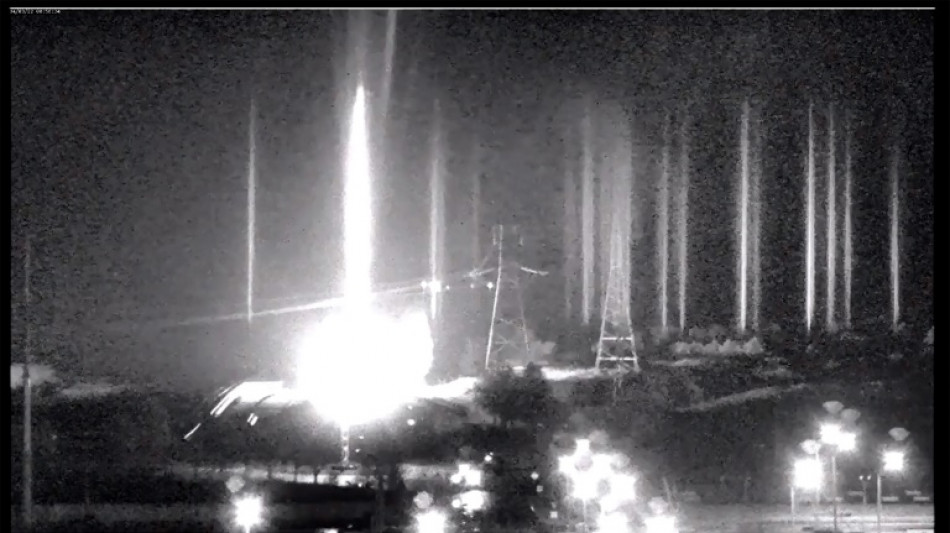
Images on a live feed from the Zaporizhzhia nuclear plant site earlier showed blasts lighting up the night sky and sending up plumes of smoke.
Zelensky angrily denounced the attack, in a video message saying: "No country other than Russia has ever fired on nuclear power units."
"This is the first time in our history. In the history of mankind. The terrorist state now resorted to nuclear terror," he added, calling for global help.
"If there is an explosion, it is the end of everything. The end of Europe. This is the evacuation of Europe. Only immediate European action can stop Russian troops."
Despite the fears, after several hours of uncertainty, Ukrainian authorities said the site had been secured.
"The director of the plant said that the nuclear safety is now guaranteed," Oleksandr Starukh, head of the military administration of the Zaporizhzhia region, said on Facebook.
"According to those responsible for the plant, a training building and a laboratory were affected by the fire," he added.
And the IAEA said it had been told by Ukraine's regulator that "there has been no change reported in radiation levels" at the site.
"Ukraine tells IAEA that fire at site of Zaporizhzhia Nuclear Power Plant has not affected 'essential' equipment, plant personnel taking mitigatory actions," the watchdog added in a tweet.
US Energy Secretary Jennifer Granholm also tweeted that "the plant's reactors are protected by robust containment structures and reactors are being safely shut down".
- 'Give me planes' -
Russia has intensified strikes across the country during the nine days of conflict, with fresh reports of civilian casualties and devastating damage, particularly in southern areas near the first city to fall to Moscow's troops.
In a second round of talks held Thursday, Moscow agreed to a Ukrainian request for humanitarian corridors to allow terrified residents to flee, but there was no immediate clarity on how they would work, and no sign of any move towards a ceasefire.
Zelensky called for direct talks with Putin, saying they were "the only way to stop this war". But he also urged the West to step up military assistance and "give me planes."
Much of the international community has rallied behind Ukraine since Putin invaded, making Russia a global outcast in the worlds of finance, diplomacy, sport and culture.
But the offensive has continued despite punishing international sanctions, and Putin said Thursday that his invasion was going "strictly according to schedule, according to plan."
He said Russia was rooting out "neo-Nazis", adding in televised comments that he "will never give up on (his) conviction that Russians and Ukrainians are one people".
French President Emmanuel Macron, who spoke to Putin Thursday, believes "the worst is to come," an aide said.
While a long military column appears stalled north of Ukraine's capital Kyiv, Russian troops have already seized Kherson, a Black Sea city of 290,000 people, after a three-day siege that left it short of food and medicine.
Russian troops are also pressuring the port city of Mariupol east of Kherson, which is without water or electricity in the depths of winter.
"They are trying to create a blockade here, just like in Leningrad," Mariupol mayor Vadym Boichenko said, referring to the brutal Nazi siege of Russia's second city, now re-named Saint Petersburg.
In the northern city of Chernihiv, 33 people died Thursday when Russian forces hit residential areas, including schools and a high-rise apartment block.
And Ukrainian authorities said residential areas in the eastern city of Kharkiv had been "pounded all night" by indiscriminate shelling, which UN prosecutors are investigating as a possible war crime.
Many Ukrainians were digging in, with volunteers in industrial hub Dnipro making sandbags and collecting bottles for Molotov cocktails.
In Lviv, others organised food and supplies to send to cities under attack and produced home-made anti-tank obstacles after watching YouTube tutorials.
- 'Maybe it's hell' -
But for some, the worst had already arrived.
Oleg Rubak's wife Katia, 29, was crushed in their family home in Zhytomyr, west of Kyiv, by a Russian missile strike.
"One minute I saw her going into the bedroom. A minute later there was nothing," Rubak, 32, told AFP amid the ruins in the bitter winter chill.
"I hope she's in heaven and all is perfect for her," he said, in tears.
Gesturing at the pile of rubble, he said what remained was "not even a room, it's... maybe it's hell."
The conflict has already produced more than one million refugees who have streamed into neighbouring countries to be welcomed by volunteers handing them water, food and giving them medical treatment.
Both the EU and the United States said they would approve temporary protection for all refugees fleeing the war.
The fear of igniting all-out war with nuclear-armed Russia has put some limits on Western support for Ukraine, though a steady supply of weaponry and intelligence continues.
The main lever used to pressure Russia globally has been sanctions, which have sent the ruble into free-fall and forced the central bank to impose a 30-percent tax on sales of hard currency after a run on lenders.
Putin's invasion has pushed some eastern European countries to lean even harder West, with both Georgia and Moldova applying for EU membership on Thursday.
On Friday, Facebook and multiple media websites were partially inaccessible in Russia, as authorities crack down voices criticising the war.
burs-sah/kma/oho
F.A.Dsouza--DT